Auto publish 2
Auto publish 2
Auto publish 2
Auto-publish
In a capitalist society, money performs an essential function. It is the material representation of an immaterial social relation: value, which is established through the labour of millions of people across the world. Money serves as a means of exchange, a unit of account, and a way of storing that value. Yet money is never neutral. When a specific national currency transcends its borders to become a world currency, it becomes a powerful instrument of hegemony, discipline, and imperial power.
The history of the last two hundred years is the history of the rise and contestation of two such key currencies: the British pound sterling in the nineteenth century, and, far more expansively, the US dollar from the twentieth century to the present.
The current global order, underpinned by the dollar, grants the United States what has appropriately been called an ‘exorbitant privilege’: the power to issue the currency that the rest of the world needs as a store of value, means of payment, and unit of account.1 This allows the United States to finance its deficits, consume more than it produces, and project its military power simply because its public debt is treated as the safest asset on the planet. It also enables the United States to host the world’s most important financial market, shaping expectations that extend far beyond the financial sphere and influencing investment and production worldwide. In turn, these financial flows establish key conditions that determine the direction of global finance and limit the autonomy of dependent and subordinated countries.
National currencies exist within a hierarchy defined in relation to the dollar. For countries of the Global South, this architecture imposes a high cost. Their currencies are treated as volatile financial assets, and their economies are held hostage to the discipline imposed by international financial capital. The need to accumulate dollars as a defence against speculative attacks and to guarantee imports results in a perverse net transfer of wealth from the Global South to the Global North, particularly to investors and speculators in Western Europe and the United States. Given these structural features of contemporary capitalism, understanding the rise of the dollar, the mechanisms of its present domination, and the structural limits facing any alternative is therefore a central task for those who seek a more just and cooperative international order.
In any society based on the division of labour and the exchange of commodities, money emerges as a practical necessity. When different producers specialise – one growing wheat, another making cloth, yet another extracting ore – they need to exchange their products with each other in order to meet their needs. But direct exchange, or barter, presents obvious difficulties: the farmer who wants cloth must find a weaver who at that same moment wants wheat, in the exact amount, and accepts the proposed exchange ratio.
Money solves this problem by functioning as a universal equivalent: a special commodity that everyone accepts in exchange for any other. With money, the farmer can sell wheat to any buyer, keep the value received, and later buy cloth from any seller. Money thus fulfils three basic functions: it serves as a means of circulation, facilitating exchange; a unit of account, allowing the value of different commodities to be compared; and a store of value, allowing wealth to be preserved for future use.
In Marxist analysis, money is not an arbitrary invention or a mere technical instrument. It is the material expression of a social relation called value. The value of a commodity corresponds to the socially necessary labour time required to produce it. When millions of independent producers exchange commodities on the market, they are, in practice, comparing quantities of human labour. Money is therefore the form through which that comparison becomes possible and visible. It represents social labour in condensed form.2
Within a single country, the use of money is relatively simple: there is a national currency, issued and guaranteed by the state, which all inhabitants recognise and accept. But what happens when producers in different countries want to trade with one another? Let us consider a concrete example. A Brazilian company exports coffee to Germany. The German importer has euros, while the Brazilian exporter needs reais to pay workers, suppliers, and taxes. How can these two currencies be reconciled? The problem unfolds on several levels. First, an exchange rate must be established: how many reais are equivalent to one euro? Second, there must be a mechanism to convert one currency into the other. Third, both parties must trust that the currency they receive will hold its value and be accepted by others.
When international trade was small-scale and sporadic, such problems could be resolved on a case-by-case basis, often with universally accepted precious metals such as gold and silver. But as the world market expanded, that solution became insufficient. As international trade grew, there emerged a need for an organised system to settle accounts between countries. It is not practical for each individual transaction to involve either the physical transfer of gold or the direct conversion of one currency into another. A clearing mechanism is needed. Imagine that, over a given period, Brazil exports US$100 million in coffee to Germany and imports US$80 million in machinery. Rather than making two separate transfers, the two amounts are offset against each other, and Germany only needs to transfer the net difference of US$20 million to Brazil. This is the principle of clearing.
For such a mechanism to work on a global scale, involving dozens of countries and currencies, a common reference point is required – a currency that everyone accepts as a unit of account and means of payment for settling balances. Historically, that role was first played by gold and later by the national currencies of economically dominant countries. The advantages associated with controlling the reference currency are anything but simple. They include:
This gives rise to fundamental questions: who issues this reference currency? Through what mechanisms does it become dominant? What are the consequences when a country’s national currency is elevated to the status of a world currency?
Since the sixteenth century, the expansion of the world market has been driven by colonial conquest, the trafficking of enslaved people, the seizure of land and natural resources, and the imposition of unequal trading relations on subjugated populations. Originary accumulation, which Marx analysed in the first volume of Capital, was a global and violent process.3 As capitalism consolidated itself as the dominant mode of production, the volume of international trade grew exponentially.
In the eighteenth century, the Industrial Revolution intensified this process: the European powers needed raw materials from across the world, such as cotton, minerals, and agricultural products, and sought markets for their manufactured goods. This growth made the problem of an international currency increasingly urgent. With thousands of daily transactions between dozens of countries, an organised international monetary system became indispensable: a set of rules, institutions, and practices that defined how currencies relate to one another, how payments are settled, and how trade imbalances are adjusted. The solution adopted in the nineteenth and early twentieth centuries reflected the power structure at the time: a world divided among competing colonial empires. Each imperial power organised its own monetary zone, integrating its colonies and spheres of influence into a system of trade, credit, taxation, and payments centred on its national currency.
As the leading industrial, commercial, and financial power of the nineteenth century, Britain made the pound sterling the principal currency of international trade, enforcing its system of ‘imperial preferences’ on the rest of the world. The so-called gold standard, which prevailed from the 1870s until 1914, was in practice a sterling-gold standard: sterling was the currency in which most trade contracts were denominated, major commodities were priced, and international loans were issued.
The sterling system’s dominance as an international currency was made possible by draining wealth from the colonies. India maintained large current-account surpluses (meaning that it earned more from exports and other external payments than it spent abroad) with continental Europe, the United States, Canada, and Japan, but it ran a current-account deficit with Britain (meaning that it paid more to Britain than it received from it). This was partly because of British exports to India and, above all, the obligations imposed by the British on the colony, including ‘gifts’ of huge sums of wealth transferred from British India to the metropole.4 As S. B. Saul writes in Studies in British Overseas Trade 1870–1914, ‘The key to Britain’s whole payments pattern lay in India, financing as she probably did more than two-fifths of Britain’s total deficits’.5
The British colonies – from India to Africa and the Caribbean to Oceania – were integrated into the metropole’s monetary zone through the British system of imperial preferences. Their exports were quoted in sterling; their imports, largely supplied by Britain because of the metropole’s trade monopoly, were paid for in sterling; and their banking systems operated with sterling as their reference currency. Colonial populations were forced to obtain sterling to pay taxes and buy essential goods, which subordinated them entirely to the terms of trade set by the metropole.
The French colonial empire – stretching across North and West Africa, Indochina, and islands in the Pacific and the Caribbean – constituted its own monetary zone based on the franc. To this day, remnants of that structure survive in the CFA franc, used by fourteen African countries and tied first to the French franc, then to the euro.6 Although they did not possess a formal colonial empire comparable to those of the European powers, the United States exercised economic hegemony over much of the Americas from the late nineteenth century onwards. An early expression of this ambition was the Monroe Doctrine (1823), often summarised by the phrase ‘America for the Americans’, which opposed further European colonisation or intervention in the Americas while asserting the United States’ claim to regional pre-eminence. The dollar circulated widely in Central America, the Caribbean, and parts of South America, often imposed through military interventions and the presence of US companies that controlled strategic sectors, such as the United Fruit Company in Central America. Germany, Japan, the Netherlands, Belgium, and Portugal also maintained their own colonial monetary spheres, although on a smaller scale.
The result was a fractured international monetary system. There was no world currency but rather several competing regional currencies, each dominant within its own sphere of influence. Though sterling was the most important globally, it was not universal. This system reflected the structure of imperialism as analysed by Lenin and other Marxists in the early twentieth century: a world divided among rival capitalist powers, each controlling its own bloc of colonial and semi-colonial territories. The tensions between these blocs – the struggle for markets, raw materials, and fields of investment – were among the primary causes of the First World War (1914–1918).7
The war destroyed this order. It demanded colossal expenditures, financed through monetary issuance and indebtedness. Most countries suspended gold convertibility. Britain, once the world’s great creditor, emerged as a debtor. The United States, which entered the war late and supplied the Allies, became the primary international creditor.
The interwar period (1918–1939) was marked by failed attempts to restore the gold standard, chronic exchange-rate instability, competitive devaluations – the so-called currency wars – and the collapse of international trade following the crisis of 1929. The Great Depression showed that a disorganised international monetary system was incompatible with the ‘stability’ of capitalism.
The Second World War (1939–1945) created the conditions for a radical reorganisation. The United States emerged from the conflict as the only major power whose economy was not only intact but strengthened. Though global power was now shared with the Soviet Union, the United States stood out as the leading capitalist power: it was willing to keep capital flows relatively open, allow foreign claims on US assets, and use its currency as a world currency. By the end of the war, the United States held around two-thirds of the world’s gold reserves and its industry accounted for nearly half of global manufactured output – not to mention that its territory had not been devastated by the war.8 This asymmetry of power allowed the United States to impose a new international monetary architecture. At the Bretton Woods Conference in 1944, a system was created that, for the first time in history, established a single national currency as the axis of the world monetary system: the US dollar.
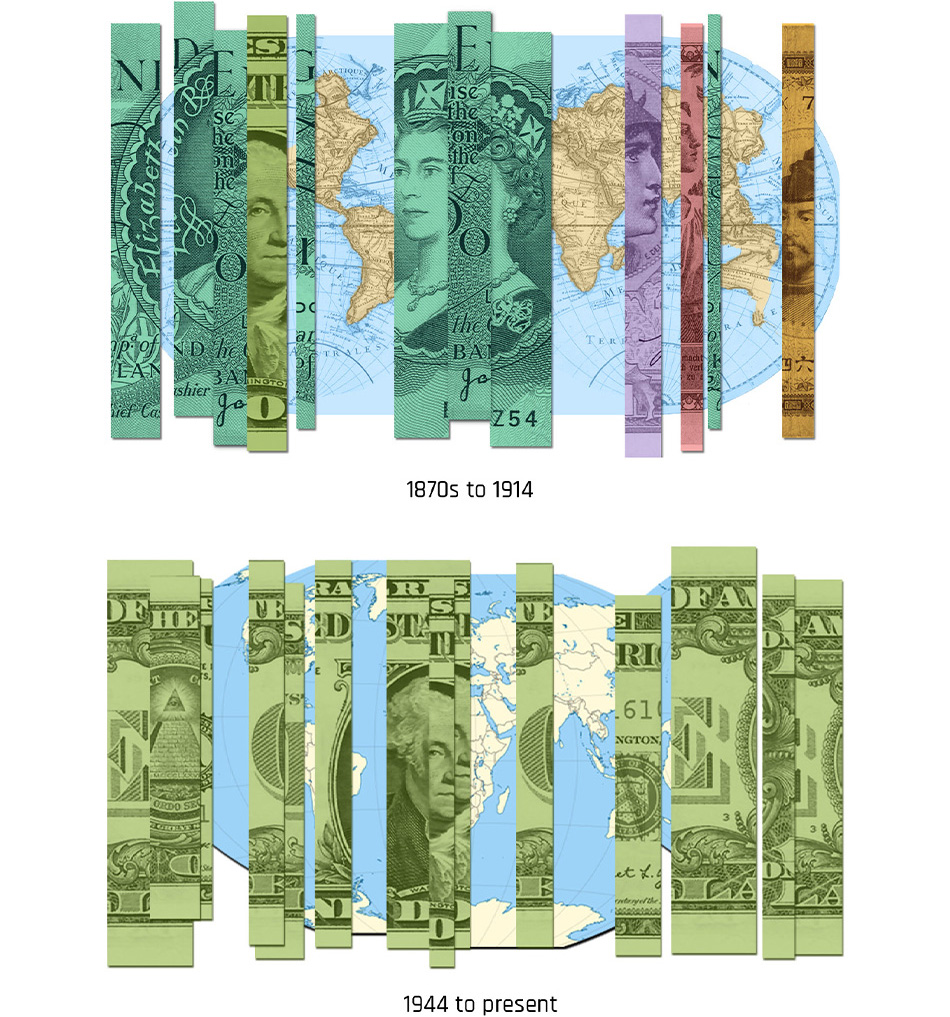
The Bretton Woods system marked the transition from a world of competing monetary zones linked to rival empires to a single, dollar-centred monetary order led by the United States. This process represented the shift from an inter-imperialist system, characterised by rivalry between multiple powers, to an imperialist model of unipolar order led by the United States in which one dominant power organised the system as a whole.9 This transition was neither automatic nor purely economic. It was the result of war, the destruction of rival powers, the military occupation of former empires such as Germany and Japan, and the construction of a vast network of military bases, alliances, and international institutions under US leadership.
The real consolidation of the dollar as the dominant currency was the result of a strategic project meticulously carried out by the United States during and immediately after the Second World War. The rise of the dollar was not a historical accident; it was the result of three decisive strategic moves.
The United States used its position as an ‘arsenal of democracy’, a term coined by US president Franklin D. Roosevelt, to structure global dependence on its currency. Initially, the Cash-and-Carry rule of 1937 required buyers of US supplies to pay immediately in dollars or gold and transport the goods themselves, a condition that favoured countries with access to hard currency, gold reserves, and naval capacity.
Later, the Lend-Lease mechanism allowed the United States to supply allied countries with military equipment, food, fuel, and other goods on credit or deferred payment rather than requiring immediate purchase. But it also had a deeper structural effect: by the end of the war, the Allied powers and dozens of other countries had accumulated massive debts denominated in dollars. Given their wartime vulnerability, dependence on US supplies, and limited bargaining power, the United States could impose the currency in which its credits would be denominated. This created a permanent structural demand for the US dollar. Countries now had to export real goods or contract new debts to obtain the dollars required to settle their debt obligations.10
The second pillar was to secure control over the energy source that would fuel postwar industrial capitalism. Oil transformed the logic of conflict from the First World War onwards. It became the central natural resource of the international system, and control over producing regions became a core element of global geopolitical disputes. More specifically, oil became the main fuel of the armed forces and assumed a decisive position in the world transport matrix, and its derivatives, such as fuel, plastics, fertilisers, synthetic materials, and petrochemicals, came to be widely used across countless production chains. This had further implications for international relations: oil became a recurring instrument on the diplomatic chessboard, functioning as a mechanism of pressure, retaliation, deterrence, support, or strategic backing. In other words, states could use access to oil, oil prices, and control over producing regions to reward allies, punish adversaries, and shape geopolitical outcomes.
By 1940 the United States was the dominant oil power, accounting for 63% of global oil production.11 As it became clear that the future centre of gravity of oil production would shift to the Middle East, the United States acted decisively. As early as 1933, US companies had acquired exploration rights in Saudi Arabia. In 1943, President Roosevelt incorporated the Kingdom of Saudi Arabia into the ‘dollar monetary territory’, authorising the financing of Ibn Saud’s kingdom through Lend-Lease. The United States’ intense diplomatic and military activity in the region, which consolidated its dominance over Saudi Arabia, laid the basis for oil from this new nerve centre to be priced and traded in dollars, a process that was institutionalised in the 1970s through the petrodollar system. Saudi Arabia was thus transformed into a US zone of influence and economic space and incorporated into the dollar’s monetary sphere.12 This decision compelled most countries, especially industrialised and energy-importing nations, to join the dollar’s monetary territory. In order to buy energy, they first had to obtain dollars.
In this sense, the imposition of a monetary architecture on the global oil market was more decisive than direct control over production. From the 1970s onwards, this move was institutionalised through the ‘petrodollar’, especially with the oil shocks (the sharp increases in oil prices that followed the 1973 Yom Kippur War and the oil embargo by Arab members of the Organisation of the Petroleum Exporting Countries, or OPEC). Oil-producing Arab states used oil as a political weapon and OPEC price increases helped quadruple the price of oil, pushing the world economy into a severe crisis. In this context, the Nixon administration negotiated a secret agreement with Saudi Arabia. The terms were: the Saudis would sell oil exclusively in dollars and invest their surpluses in US Treasury securities (US government debt instruments such as Treasury bonds). In return, the United States would guarantee military protection to the Saudi kingdom. The other OPEC countries soon followed the same model. By tying the world’s main commodity to its currency, the United States structurally expanded the international reach of the dollar.
In 1944, at Bretton Woods, the United States formalised and institutionalised its hegemony, especially in the economic sphere. In 1945, the Yalta Conference helped reorganise the geopolitical and military order after the war by setting the terms for the occupation of Germany, the division of spheres of influence in Europe, and the postwar balance between the major powers. In monetary terms, the Yalta agreements stipulated that German war reparations would be accounted for in dollars.
At Bretton Woods, two opposing visions of the postwar order collided. The British proposal, led by John Maynard Keynes, was radically different from the one that prevailed. Keynes proposed the ‘Bancor’, a supranational international unit of account that would be controlled by a multilateral body called the Clearing Union. His aim was to create a symmetrical system that would penalise both chronically deficit countries and chronically surplus countries. In essence, Keynes’s proposal sought to prevent the kind of ‘exorbitant privilege’ later associated with the dollar from passing from sterling to the dollar by ensuring that no single national currency could become the anchor of the international monetary system.
Keynes’s proposal was summarily defeated. Given the balance of forces, the US plan, led by Harry Dexter White, prevailed. White’s plan was centred on US power: the dollar would be defined as the international unit of account and would be the only currency with full convertibility into gold, at the fixed rate of US$35 per ounce of gold. All other currencies would maintain convertibility into the dollar at fixed but adjustable exchange rates.
To manage this new order, the International Monetary Fund (IMF) and the International Bank for Reconstruction and Development (IBRD, today the World Bank) were created. The capital of both institutions was defined in dollars, and their structure was designed to guarantee US control. The voting power of each member country was linked to its quota or capital subscription. In the IMF, these subscriptions were paid partly in gold and partly in national currency. In the IBRD, part of the capital had to be paid in gold or dollars. Since the United States held the largest share in both institutions, with Britain in second place, an asymmetrical decision-making structure was consolidated. In the case of the IMF, because crucial decisions require a qualified majority of 85% of the vote, the United States acquired, in practice, veto power over fundamental reforms.13
The Bretton Woods system, sometimes called the dollar-gold standard, consolidated the centrality of the dollar and of the United States in the world economy. But the system could not function by itself. It needed liquidity – enough dollars circulating internationally to allow trade, payments, and reconstruction to take place. The devastated economies of Europe and Japan did not have the dollars needed to import inputs, restart exports, or rebuild cities, infrastructure, and productive apparatuses.
The United States solved this problem through the Marshall Plan for Europe (1948–1952) and the Dodge Plan for Japan (1949), which provided the dollars needed to finance reconstruction. These plans ‘saved’ the Bretton Woods system by ensuring that rebuilding Washington’s strategic allies would integrate them fully into the dollar’s monetary territory from the start. At the same time, the United States encouraged the global expansion of its multinational corporations, which entered these reconstructed markets through dollar-denominated direct investment. Because the dollars supplied were, to a great extent, used to buy goods and services produced in the United States itself, the plans also won domestic support from various economic sectors. In a conjuncture of cooling domestic activity, aggravated by the growth of industrial capacity during the war years in Europe and the Pacific, this external demand helped sustain the US economy.
From a strategic standpoint, the United States not only made possible so-called reconstruction and growth ‘miracles’ in several countries, stabilising regions central to the logic of the Cold War, but also consolidated the hegemonic position of the dollar. In the decades that followed, the areas under its influence experienced a long cycle of expansion and prosperity anchored in the centrality of the dollar.
More concretely, while financing economic recovery in regions central to the containment of the USSR, the United States reinforced the primacy of the dollar by:
In addition, the United States tolerated unilateral controls on cross-border capital movements, accepted the non-convertibility of other currencies, did not react forcefully to protectionist policies, and even sent technical assistance missions. This tolerance was conditional: Washington permitted its allies to use state intervention and trade protections while keeping them within the dollar-centred order.
Despite its apparent solidity, the Bretton Woods system contained a fatal contradiction identified by the economist Robert Triffin. The ‘Triffin Dilemma’ exposed the logical flaw in using a national currency as an international one. The contradiction was as follows: for world trade and economic growth to expand, the world needed a growing supply of international liquidity – that is, more dollars. But in order to provide those dollars to the rest of the world, the United States had to run balance-of-payments deficits, meaning that it had to send more dollars abroad through spending, lending, investment, and imports than it received back from abroad. However, by issuing more and more dollars than it held in gold reserves, the United States would inevitably undermine global confidence in the dollar’s convertibility into gold.14 The system was therefore doomed. If the United States stopped running these deficits – that is, stopped supplying the world with dollars – world trade would stagnate. If it continued, confidence in the dollar would collapse.
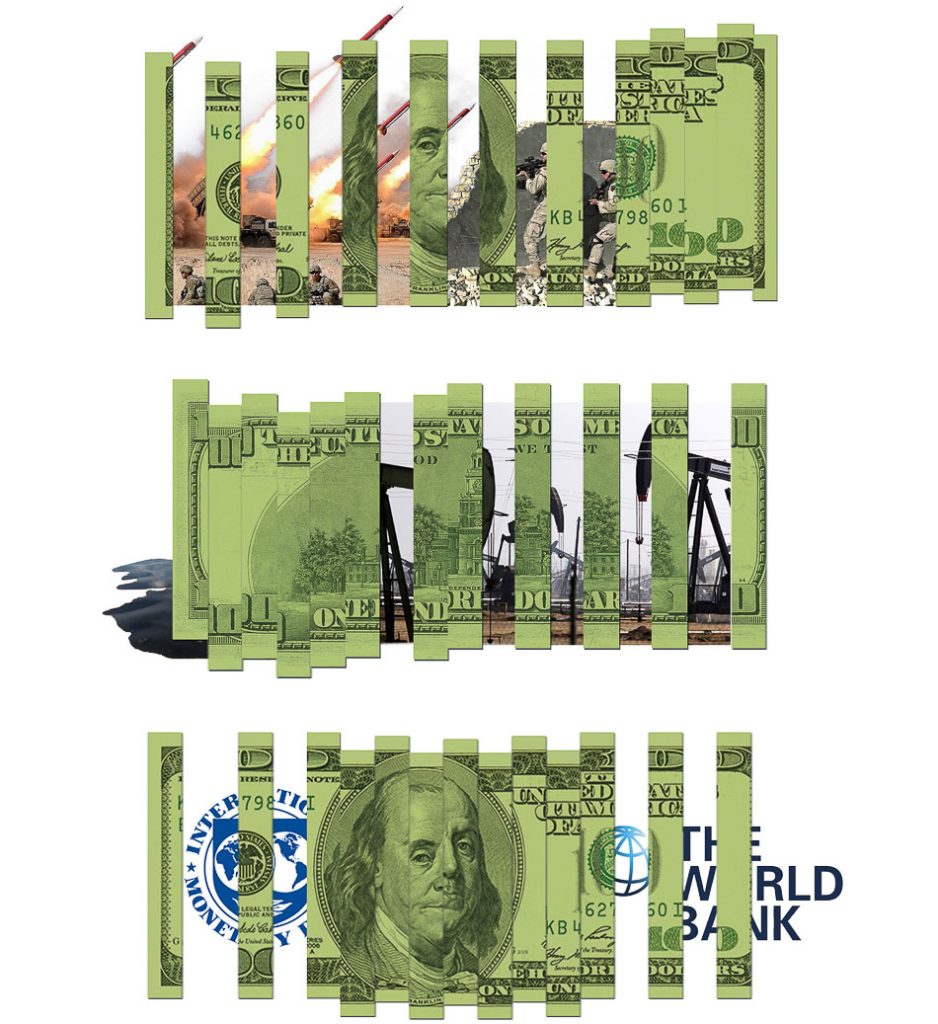
During the 1960s, this contradiction became critical. Massive increases in US public spending, driven simultaneously by the Vietnam War and domestic social programmes, led to growing deficits and uncontrolled money issuance. At the same time, US hegemony was being challenged by revolutions in the periphery and by criticism from European allies, especially the French. Even the IMF created Special Drawing Rights (SDRs) in 1969 – a synthetic supranational reserve asset nicknamed ‘paper gold’, whose value was based on a basket of currencies – in an attempt to create a source of liquidity that did not depend on US deficits.
In 1971, the Triffin Dilemma reached a breaking point. With surplus countries, led by France, exchanging dollars for gold, US reserves fell drastically. On 15 August 1971, President Richard Nixon acted. In a unilateral decision that reconfigured a system that had been created multilaterally, Nixon suspended the dollar’s convertibility into gold indefinitely. The dollar-gold standard was dead. The world entered a new era: that of flexible exchange rates, financialisation, and a fiat dollar. The hegemonic currency no longer had any backing in a physical commodity; its value was determined purely by confidence – or, more precisely, by the economic, financial, military, and geopolitical power of the United States.
After 1973, in the face of successive devaluations and instability in the dollar’s value, major capitalist countries adopted a regime of ‘floating exchange rates’. In other words, currencies ceased to have fixed parity with the dollar and their value came to be determined in each national economy’s foreign exchange market, where currencies are bought and sold according to demand, supply, interest rates, trade flows, and expectations about each economy.
Faced with growing challenges to the US economy, especially in the economic and monetary spheres, the United States resorted to what came to be known as the interest-rate coup. In response to domestic inflationary pressures and concern over the weakening dollar, Paul Volcker, then chair of the US central bank, the Federal Reserve, raised short-term US interest rates from around 10–11% in 1979 to nearly 20% by late 1980 and early 1981. This sharply increased borrowing costs across the world because much international credit was denominated in dollars or tied to US financial conditions.15
According to the Brazilian economist Maria da Conceição Tavares in her seminal text ‘A retomada da hegemonia norte-americana’ (The Resumption of North American Hegemony), before the interest-rate coup the private banking system had been operating largely beyond the control of central banks, especially the Federal Reserve.16 Transnational branch networks structured a regional division of labour within the firms themselves, often at odds with the national interests of the United States, and fostered growing competition among capitals that proved unfavourable to the US economy. Overall, a world economy without a clearly defined hegemonic pole contributed to the disorganisation of the postwar order and to the growing fragmentation of private and regional interests. From 1979 onwards, with the interest-rate coup, the conduct of US domestic and foreign economic policy moved precisely in the direction of reversing these tendencies and recovering command over international finance.
Tavares used the expression ‘the diplomacy of the strong dollar’ to refer to this unilateral US action, which made deliberate use of US monetary and financial power as an instrument of foreign policy and as a means of reconstructing US hegemony.17 The rise in interest rates cannot be understood only as a monetary policy measure aimed at dealing with domestic US macroeconomic problems. It was a central move in reasserting dollar hegemony and completely restructuring the international monetary and financial system.
When US interest rates are high, wealthy investors leave their positions in other countries and seek gains from the interest-rate differential offered by US public debt – that is, from the higher returns paid by US Treasury securities compared with assets elsewhere. As a result, the Eurodollar market, which had been developing in Europe outside the control of the US central bank, largely returned to the financial centre of Wall Street. That move reinforced US domination over financial capital and strengthened the power of its banking system. In this sense, the US currency was used as a geo-economic weapon: by controlling interest rates, liquidity, and access to international credit through the dollar-centred financial system, the United States disciplined allies, brought competitors into line, and deepened the dependence of the periphery. Thus, the policy of high interest rates and a strong dollar is not merely economics: it is a strategy of power.
This action, however, had consequences. First, it plunged the United States and the rest of the world into a prolonged recession as higher borrowing costs squeezed firms, households, banks, and indebted states. The result was a wave of bankruptcies, including among firms and even some US banks. Second, it caused a sudden contraction of international credit, inflicting damage especially on the capitalist periphery, which had taken advantage of the period of high international liquidity to accumulate dollar debts at floating interest rates – debts whose costs rose sharply once US rates increased. Third, the interest-rate coup led to the recentralisation of interbank credit and the large international banks in New York under the Federal Reserve’s umbrella, placing the international private banking system more firmly under US monetary command.
Another objective of the interest-rate coup was to bring US competitors in line. By the late 1970s and early 1980s, Japan had achieved strong industrial and technological dynamism, generating growing trade surpluses with the United States and appearing to be on a path to becoming the world’s largest creditor as the United States became (and remains) the world’s largest debtor. With high interest rates, the dollar remained overvalued and the enormous returns on US Treasury securities produced a capital inflow into the United States, including from Japan, with Japanese firms and banks buying US Treasury bonds. Even while running trade surpluses, Japan found itself in a position in which it financed the US deficit by buying dollar assets, and its own development became increasingly tied to the US financial system and asset cycle.
When the US trade deficit with Japan exploded and domestic political pressure increased, the second part of the disciplining process began. In 1985, the Reagan administration threatened heavy protectionist measures and forced a coordination agreement in the G5 in what became known as the Plaza Accord. The goal was to bring about a coordinated devaluation of the dollar against the yen and the German mark. The result came quickly: between September 1985 and April 1986, the yen appreciated by around 35% against the dollar, making Japanese exports more expensive, weakening Japan’s trade advantage, and helping contain the yen’s potential as a rival reserve currency.18 Then came the Louvre Accord of 1987, which sought to stabilise exchange-rate parities after this sharp correction. According to Brazilian economists Tavares and Luis Eduardo Melin, this was not a neutral technical adjustment but a political move aimed at consolidating US power: the United States used its position at the centre of the system to force Japan to accept a strong appreciation of the yen and a reorganisation of its growth pattern.19
The United States thus compelled Japan to adjust its growth path, exchange rate, and financial policy to suit the interests of US hegemony. This ensured that the yen would not become a rival reserve currency and that Japanese surpluses would be recycled in ways that benefited the financing of the US deficit and US financial leadership. Rather than a rupture, what occurred was Japan’s reabsorption into an order commanded by the dollar: the country retained high productive sophistication but under strong financial and geopolitical constraints defined in Washington.
The collapse of Bretton Woods, paradoxically, did not weaken the dollar. On the contrary, it freed the United States from any material constraint on its monetary policy and consolidated a new form of hegemony, no longer anchored in gold but in three new pillars: oil and petrodollar recycling; the depth and liquidity of US financial markets, especially the market for Treasury securities; and the weaponisation of dollar-based finance.
To understand the post-1971 order, it is crucial to turn to the Marxist analysis of financialisation. The abandonment of metallic backing (gold) was a watershed moment. It removed the material restriction on the limitless creation of money, which had previously been a representation of a commodity (gold) but became a representation of itself – mere numbers in computerised accounts. In other words, there was an autonomisation of the world currency. This allowed capital to migrate massively from the sphere of value production (investment in manufacturing, agriculture, and so on, based on the application of social labour) to the sphere of circulation – that of fictitious capital. Fictitious capital is investment in property titles (shares) and, above all, debt titles (mortgages and public debt), whose value is based not on value already produced but on the anticipation of future income. With the unlimited creation of fiat money (money issued by the state that is not convertible into a commodity such as gold), fictitious capital could feed itself, generating more fictitious capital that was no longer tied to the value base of social labour.
Though this process began in the 1930s and 1940s, as noted above, after 1971 it took on new importance as the United States reinforced its strategic and military alliance with Saudi Arabia and ensured that OPEC would continue to price and trade oil exclusively in dollars. This recreated structural demand: because every industrialised nation needs oil, every industrialised nation needs dollars. It also created a new recycling mechanism. Oil-producing countries in OPEC accumulated enormous dollar surpluses (petrodollars) from oil sales. These were deposited in Wall Street banks and reinvested in US government debt and other dollar assets, helping to finance US deficits.
Today, dollar dominance rests on a pragmatic fact: the dollar provides access to financial markets deep enough to absorb very large transactions without sharp price movements and liquid enough to allow assets to be bought and sold quickly. The central pillar of this system is US Treasury securities, which are universally regarded as global ‘safe-haven’ assets: high-grade financial assets with minimal credit risk and immediate liquidity. This allows the United States to completely subvert normal economic logic: it is the world’s largest debtor, yet its debt is treated by other countries as the most valuable asset.
In moments of global financial crisis – even crises that originate in the United States itself, as in 2008 – international capital does not flee the dollar; it rushes towards it, seeking the safety of Treasuries. This flight to Treasuries reinforces the Global Surplus Recycling Mechanism (GSRM), an expanded form of petrodollar recycling in which export surpluses – not only oil revenues – are recycled into US financial assets. It operates as follows:
Under this system, the rest of the world is forced to finance the twin deficits of the United States – trade and fiscal – thereby subsidising US consumption and, crucially, its global military power.
In Latin America, this process accelerated after the recommendations of the Washington Consensus, which urged countries to give up controls over their capital accounts (the channels through which investment, loans, and other cross-border financial flows enter and leave a country). This means that capital can enter and leave each country freely, but it has direct effects on the volatility of national exchange rates. Countries, in turn, seek to protect themselves from this volatility by accumulating foreign reserves in US public debt. That is why we can say that the dollar is a weapon of extortion against the periphery: to protect their domestic economies from exchange-rate volatility and capital flight, countries in the periphery must accumulate dollar reserves, often in US public debt. In doing so, they help finance the United States’ twin deficits (trade and fiscal), which in turn sustain US military spending, overseas bases, imperialist wars, and so on.
The crisis of 2008 was the moment when the ‘pyramids of private money’ (fictitious capital) built by Wall Street on top of this mechanism collapsed. Yet the crisis did not break the system. Instead, the Federal Reserve acted as the central bank of the world, supplying dollar swap lines (agreements that allowed other central banks to obtain dollars from the Federal Reserve and provide them to their own financial systems in moments of stress). This proved that, in the collapse, dependence on the dollar was total rather than showing that the dollar had become dispensable.
Because most global trade, finance, and commodity transactions – especially oil – are denominated in dollars and cleared through the US financial system, Washington has gained enormous coercive power. Dollar ‘diplomacy’ is used both to constrain strategic enemies and to reward allies. The United States can impose financial sanctions, freeze the reserves of foreign central banks – as it has done with Iran, Venezuela, and Russia, for instance – and exclude entire countries from the international payments system (SWIFT).
When a country is sanctioned, as happened to Cuba, Iran, Venezuela, Afghanistan, Russia, and many others, it can be excluded from dollar payment networks and may have its foreign assets frozen. This raises the cost of imports; blocks access to credit and payment systems; obstructs the purchase of food, fuel, medicine, and industrial inputs; and makes ordinary trade far more difficult. The dollar, therefore, is not merely an economic tool: it is a weapon of war, an instrument of geopolitical discipline that ensures US interests prevail.
Data on the currencies used in trade invoicing and international finance is scarce, and it is published with longer delays than other trade data.20 Even so, the available evidence indicates that the dollar’s predominance exceeds the weight of the United States’ share of global gross domestic product, trade, and international finance, reflecting a structural asymmetry in the international use of currencies.
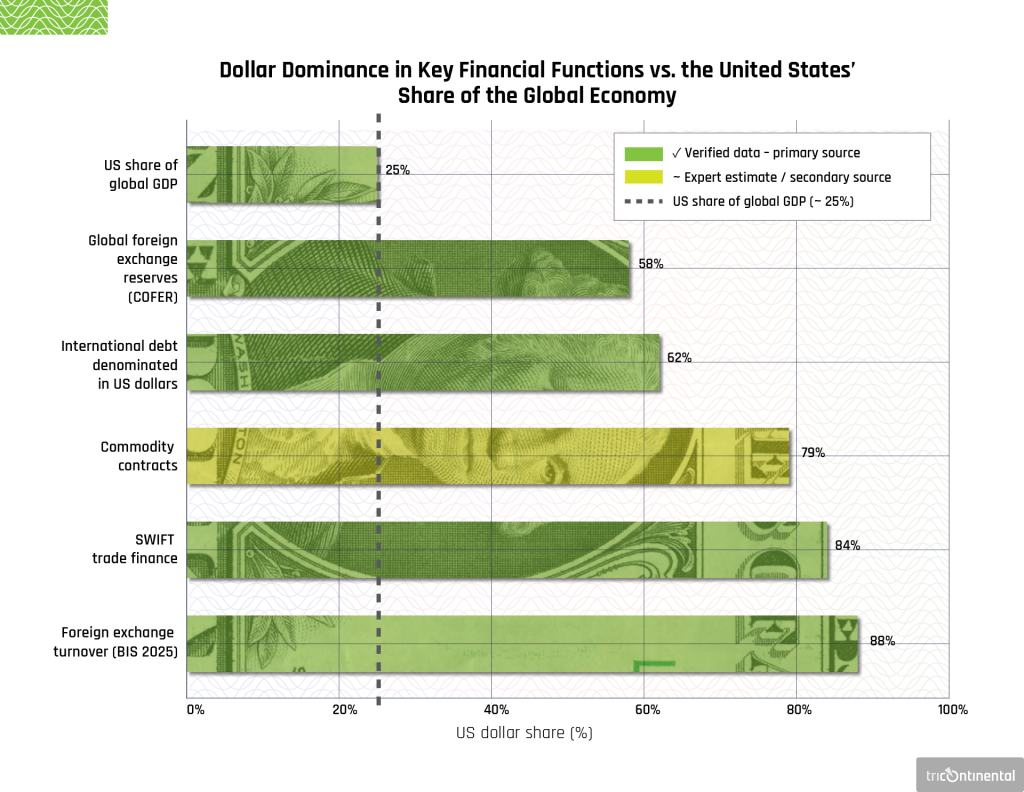
Sources: BIS Triennial Survey 2025 · SWIFT Watch 2024 · IMF COFER 2024 · Federal Reserve 2025
SWIFT data shows that the dollar is used in more than 80% of trade-finance transactions processed through its network, largely because a significant share of commodity trade continues to be invoiced and settled in dollars. In addition, the dollar still accounts for close to 60% of global foreign exchange reserves. On the other hand, the evolution of global foreign exchange reserves in 2022–2023 was marked by a significant increase in gold purchases by central banks. Considered a safe asset, gold offers protection against geopolitical risks, even though it has limitations as a means of payment. This pattern suggests that the intensification of gold purchases by certain central banks is associated with efforts to mitigate economic and geopolitical risks, especially those related to international sanctions. In China, for example, the share of gold in total reserves rose from less than 2% in 2015 to 4.3% in 2023, while the proportion of assets denominated in US Treasury and agency securities fell from around 44% to approximately 30%, reflecting a recomposition of the country’s reserve portfolio.21
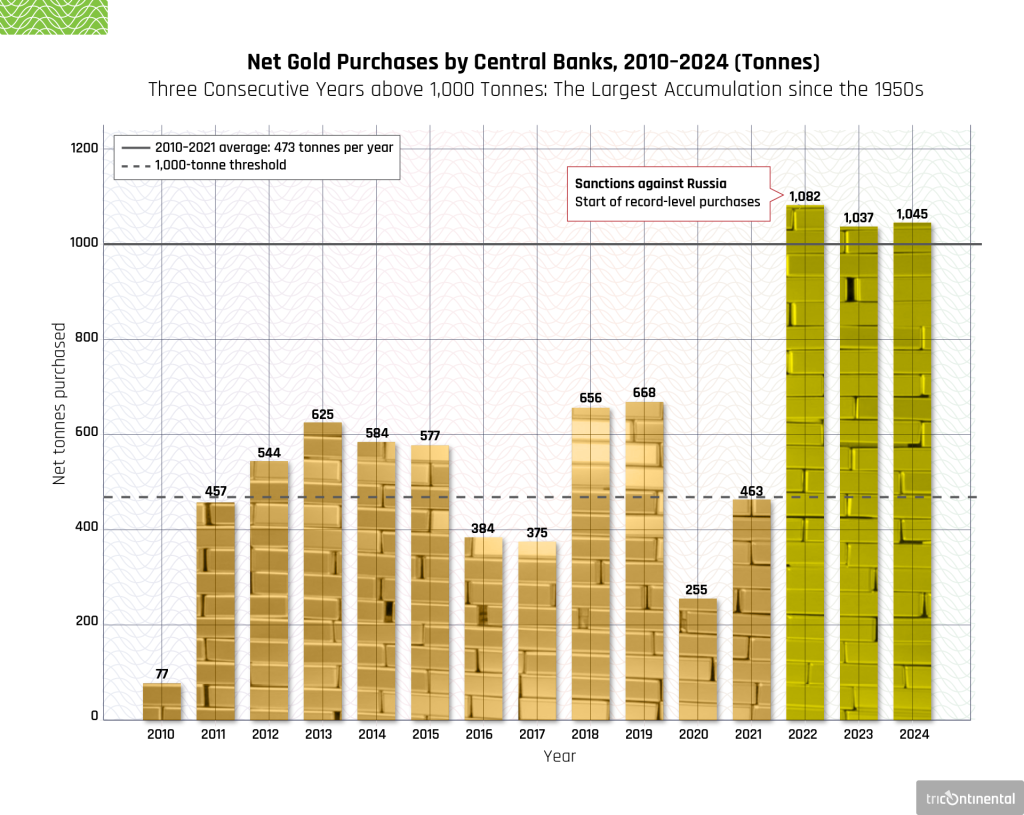
Source: World Gold Council, Gold Demand Trends: Full Year 2024 (gold.org)
Although a decline in the dollar’s share of global foreign exchange reserves has been observed in recent decades, the data indicates that this movement does not correspond to a direct substitution by another single currency. On the contrary, the reduction has been absorbed by a set of currencies that the IMF classifies as ‘non-traditional currencies’: the Australian dollar, Canadian dollar, South Korean won, Swedish krona, and, to a lesser extent, the Chinese renminbi. Taken together with the increase in gold reserves, this suggests that the process currently underway is not driven primarily by a coordinated political project of de-dollarisation but rather by portfolio diversification strategies adopted by monetary authorities oriented towards risk management and greater security in a context of growing global financial instability.
This movement can be interpreted as a response to the contradictions of US- and Europe-driven financialisation, whose dynamics tend to generate recurring volatility and asset bubbles (sharp rises in prices that often end in collapse). In this sense, reserve diversification (the spreading of foreign-exchange reserves across a wider range of currencies and assets) appears less as a political rupture than as a technical adjustment to the system’s fragilities. This makes the process of transforming the international monetary system both more robust and slower than more immediate geopolitical narratives suggest.
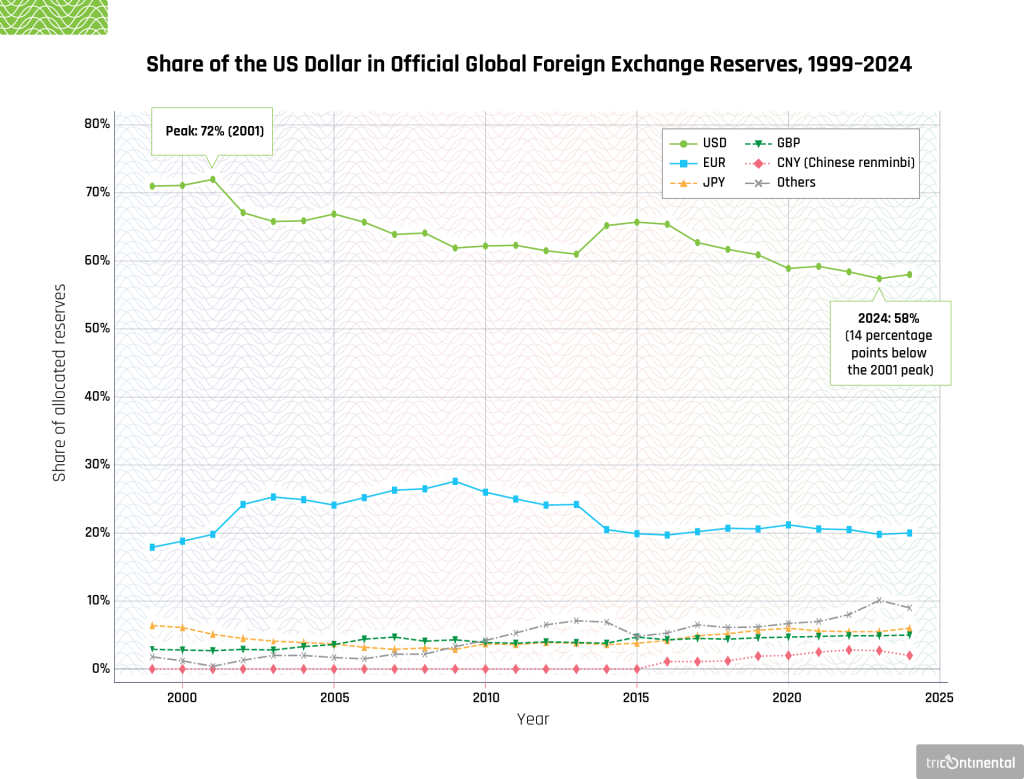
Source: IMF COFER | Federal Reserve, The International Role of the US Dollar, 2025 edition | The CNY series excludes data for the fourth quarter of 2016
An analysis of trade invoicing from 2000 to 2023 shows that the combined share of the dollar and the euro remained broadly stable. The dollar retained its dominant position, while the euro was used predominantly within the European Union. Although China has significantly expanded its share of world exports since 2000, approaching that of the United States, the renminbi remains limited as a currency for international trade invoicing and has not been fully internationalised.
These data demonstrate the resilience of the dollar in trade invoicing. They also show that, although the renminbi’s share of international reserves has grown notably, broader monetary diversification remains limited.
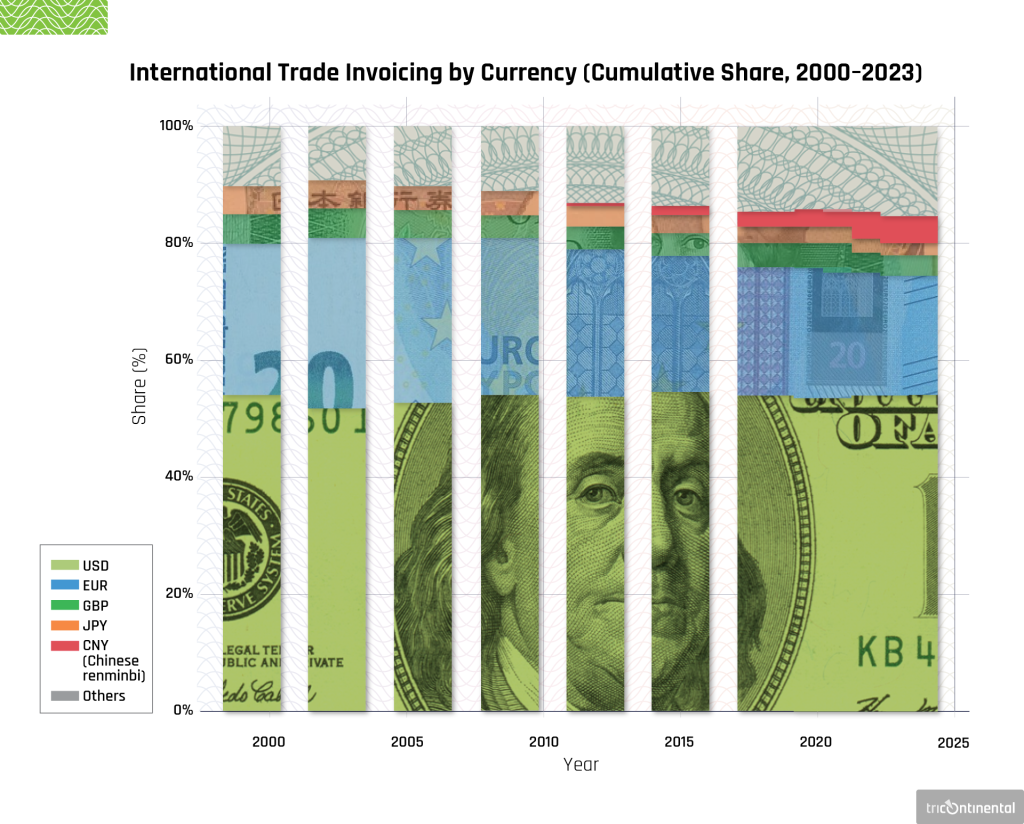
Source: IMF Working Paper (2025), Patterns of Invoicing Currency in Global Trade in a Fragmenting World Economy
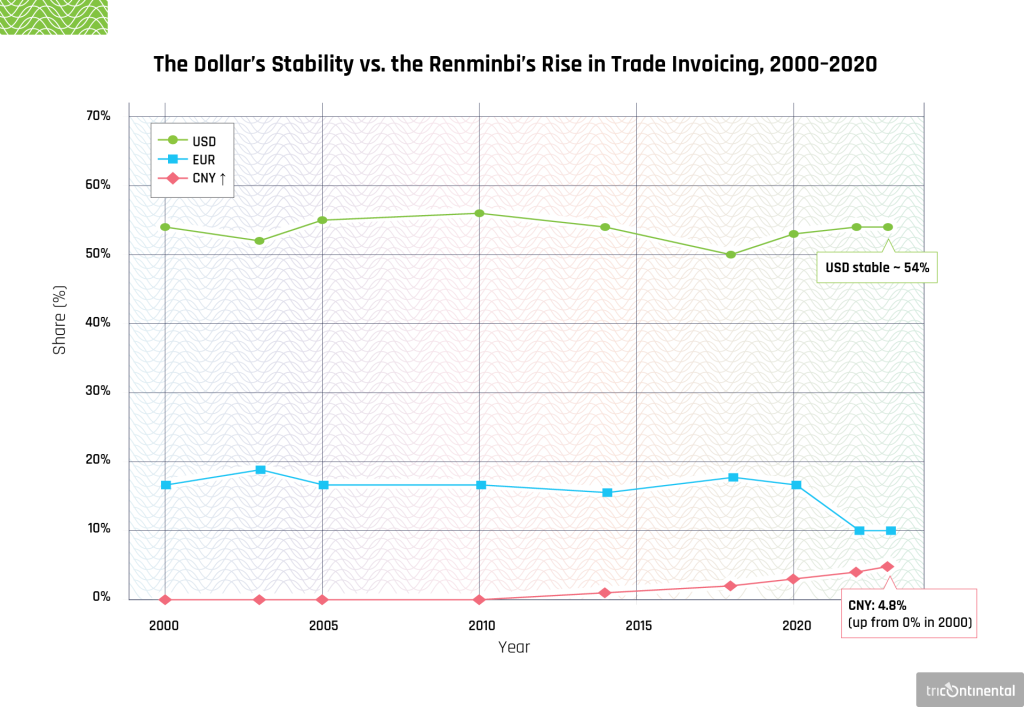
Source: IMF Working Paper (2025), Patterns of Invoicing Currency in Global Trade in a Fragmenting World Economy
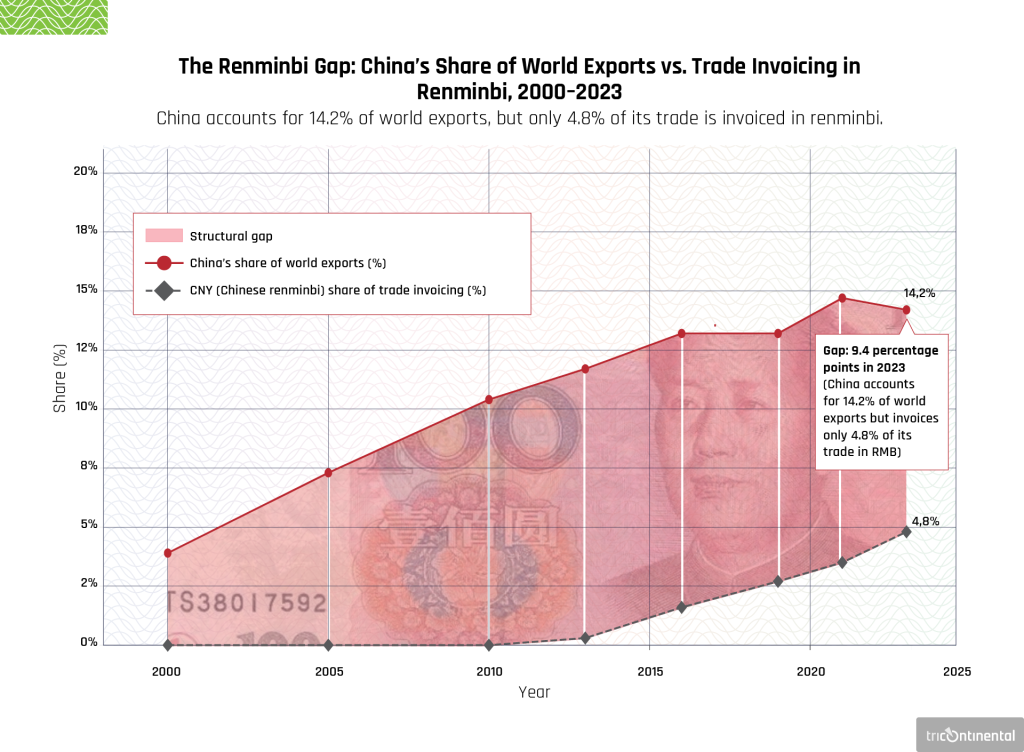
Source: IMF Working Paper (2025), Patterns of Invoicing Currency in Global Trade; IMF Direction of Trade Statistics (DOTS) Patterns of Invoicing Currency in Global Trade
Advances in financial technology and payment infrastructure are driving the rise of alternative systems of payment, asset custody, and settlement. These are becoming concrete alternatives to the dollar-centred international financial system. Far from being a recent debate, this is the materialisation of new institutional architectures capable of enabling transactions outside of the traditional circuits. Noteworthy initiatives include the Financial Messaging System (SPFS, developed by Russia) and the Cross-Border Interbank Payment System (CIPS, led by China), which expand the capacity for international settlement in local currencies and reduce dependence on infrastructures dominated by the core countries.
At the same time, the BRICS countries have intensified efforts to strengthen domestic digital payment systems and develop solutions for cross-border operations with the aim of expanding international trade denominated in local currencies and advancing the construction of a more multipolar monetary system.22 China, in particular, has expanded the international use of the renminbi by developing CIPS and participating in central bank digital currency (CBDC) projects.23 There has also been a rapid global spread of CBDC projects: 137 countries and monetary unions, representing around 98% of world GDP, are at some stage of developing these digital currencies.24
At the same time, initiatives such as mBridge (involving the People’s Bank of China, the Hong Kong Monetary Authority, the Central Bank of the United Arab Emirates, and the Bank of Thailand, with the support of the Bank for International Settlements) and the ACUMER system (developed by the Central Bank of Iran) signal the potential of new digital infrastructures for settlement in local currencies between central banks through CBDCs without the need for traditional intermediaries such as correspondent banks or systems like SWIFT.
Moreover, bilateral currency swap agreements have played a growing role, especially since the financial crisis of 2007–2008. These instruments have been used to provide liquidity in moments of stress and to reduce the costs associated with the accumulation of international reserves. This enables countries to access foreign currencies without relying exclusively on international financial markets. In this sense, currency swaps have become a central component of contemporary strategies for monetary diversification and for mitigating dependence on the dollar.25
In sum, the available data indicates that while the dollar remains dominant and relatively stable in the international monetary system, there are also important changes in the composition and functioning of that system. One significant example is the renminbi, whose share of international reserves rose from virtually zero at the start of the 2010s to around 2.2% in less than a decade – a historically unprecedented development for the currency of a country that still maintains important controls over its capital account. This growth in reserve holdings has not, however, been matched by a comparable expansion of the renminbi’s use in international trade invoicing.
An analysis of de-dollarisation therefore requires a distinction between different dimensions of the international monetary system. In the sphere of foreign exchange reserves, the process is slow and gradual and still far from amounting to a rupture with the centrality of the dollar. In the sphere of bilateral payments there is more dynamism, though still geographically concentrated in specific arrangements, such as transactions between Russia and China, which, according to a report published in November 2025, are settled 99.1% in roubles and yuan.26 Finally, in the field of financial infrastructure, which includes payment, clearing, and settlement systems, the process is still incipient but has a structural character, given that the creation of these platforms tends to reduce dependence on the dollar-centred financial system in a lasting way.
In this sense, the importance of de-dollarisation lies in the direction in which this transformation moves and, above all, in the construction of institutional and productive alternatives capable of reducing the costs of exiting the dollar system.
For the overwhelming majority of countries in the Global South, the international monetary and financial system centred on the dollar is not a safety net but a straitjacket. Insofar as countries need to accumulate international reserves – hard currencies such as the dollar – they are subjected to monetary extortion by the dollar system, since they must maintain those reserves and do so by purchasing US public debt. In doing so, they continue to finance the outsized capacity of the United States to act, including by funding wars. Furthermore, the system is also a mechanism of punishment, since the United States can, through sanctions, blockades, and exclusion from the international payments system, penalise countries that are not subservient to it. In recent decades, Washington has increased economic sanctions against the targets of its foreign policy by 933%.27
In practice, national currencies are not seen as stores of value but as volatile ‘financial assets’. International demand for them is speculative, subject to panic and capital flight. In addition, Global South countries suffer from the structural inability to issue external debt in their own currencies. They borrow in dollars but generate revenue in local currency, creating a devastating currency mismatch: when their currencies depreciate, they must use more local currency to obtain the same amount of dollars needed to service their external debts.
Dollar hegemony is therefore not limited to the dollar’s centrality as a means of payment or store of value. It also expresses itself in the way the dollar’s domestic dynamics are transmitted to the rest of the world. In moments of dollar appreciation, peripheral currencies tend to depreciate, making imports more expensive and putting pressure on domestic inflation, especially in economies that are dependent on energy, food, and intermediate goods. Because a large share of international commodities is priced in dollars, these effects are amplified even in the absence of variations in the real conditions of supply and demand.
In financial markets, decisions in US monetary policy, such as interest-rate hikes, frequently trigger capital flows towards dollar-denominated assets. This causes exchange-rate depreciations, raises the cost of external financing, and restricts the space for economic policy in countries of the Global South, which are often forced to adopt contractionary measures to contain inflation and stabilise their currencies – even in contexts of low growth. In economies with high levels of debt in foreign currency, dollar appreciation immediately raises the burden of that debt in domestic-currency terms, deepening structural fragilities. In order to attract volatile international capital, assets in the Global South must offer much higher interest rates than the ‘safe’ assets of the North. This results in a constant net transfer of wealth from poorer countries to the richest financial centres.
With neoliberal policies and the liberalisation of capital movements, the capacity of states to conduct macroeconomic policy has been weakened. Any government that attempts to implement expansionary fiscal or monetary policies, such as cutting interest rates to stimulate investment, is immediately punished by the ‘market’ through capital flight, which devalues the currency, generates inflation, and can lead to collapse. Governments become hostages to the confidence of financiers. To protect themselves from this volatility, Global South countries are forced to accumulate massive international reserves. Brazil, for instance, held more than US$358 billion in December 2025.28 These reserves are mostly invested in dollar assets, especially US Treasury securities. This is the final paradox: to defend themselves from the system, Global South countries are obliged to finance their oppressor, lending trillions of dollars to the US Treasury at low interest rates.
Dollar hegemony imposes unsustainable costs on the Global South. Dissatisfaction with this destabilising asymmetry is not new, but it has taken on renewed urgency in a world moving towards multipolarity. De-dollarisation has become a long-term structural trend, though one that faces immense structural obstacles. According to the economist Bruno de Conti, several developments may, in the medium or long term, trigger changes in the international monetary and financial system, namely:
The discussion of de-dollarisation, however, cannot be reduced to protection against sanctions or the mitigation of external vulnerabilities. A deeper analysis must ask what purpose de-dollarisation is meant to serve. The replacement of one hegemonic currency by another does not necessarily imply a qualitative transformation of the international order, nor does it guarantee greater stability or benefits for peripheral countries. Historical experience suggests that monetary hierarchy tends to reproduce itself, albeit in new configurations.
De-dollarisation must be understood not merely as a dispute between currencies but as part of a broader debate about the nature of international economic relations. For countries of the Global South, this means shifting the focus away from the mere substitution of instruments and towards the construction of structural alternatives involving new forms of participation in international trade, technological cooperation, productive integration, and political coordination. An effective transformation of the international monetary system would therefore require more than the creation of alternative financial mechanisms. It would require confronting the pillars that sustain dollar hegemony, including the centrality of commodity pricing, the dominance of dollar-denominated financial markets, and the capacity for geopolitical coercion.
De-dollarisation is not an end in itself but part of a broader struggle for economic sovereignty and for the construction of a more equitable international order capable of interrupting the systematic transfer of wealth from the Global South to the centres of power. The struggle for de-dollarisation, therefore, is not merely an accounting adjustment. It is a fundamental political struggle over sovereignty, development, and the right of the peoples of the Global South to organise their economies outside the discipline of imperial finance.
1 Batista Jr., ‘The BRICS and the Challenge of De-Dollarisation’.
2 Marx, Capital, vol. 1.
3 Marx, Capital, 1.
4 Patnaik and Patnaik, A Theory of Imperialism.
5 Saul, Studies in British Overseas Trade, 1870–1914, 58, 88, quoted in Patnaik and Patnaik, A Theory of Imperialism, 126.
6 Metri, História e diplomacia monetária.
7 Lenin, Imperialism.
8 Mazzucchelli, Os dias de sol.
9 Tricontinental, Hyper-Imperialism.
10 Metri, História e diplomacia monetária.
11 Quintas, ‘Os EUA e a geopolítica imperialista do petróleo’.
12 Metri, ‘A ascensão do dólar e a resistência da libra’.
13 Batista Jr., O Brasil não cabe no quintal de ninguém.
14 Akyüz, ‘Política de resposta à crise financeira global’.
15 Tavares, ‘A retomada da hegemonia norte-americana’, 157–67.
16 Tavares, ‘A retomada da hegemonia norte-americana’, 160.
17 Tavares, ‘A retomada da hegemonia norte-americana’.
18 Melin, ‘O enquadramento do iene’.
19 Tavares and Melin, ‘A reafirmação da hegemonia norte-americana’.
20 Gopinath, ‘Geopolitics and Its Impact on Global Trade and the Dollar’.
21 Gopinath, ‘Geopolitics and Its Impact on Global Trade and the Dollar’.
22 Atlantic Council, ‘Dollar Dominance Monitor’.
23 It is important to distinguish central bank digital currencies (CBDCs) from private cryptocurrencies. CBDCs are a form of money in the strict sense: they are issued and guaranteed by national monetary authorities and perform the classical functions of money. Private cryptocurrencies, such as Bitcoin, have no state backing; they are speculative assets without a productive basis, whose circulation and valuation remain subordinate to the dollar-based monetary order.
24 Atlantic Council, ‘Central Bank Digital Currency Tracker’.
25 Council on Foreign Relations, ‘Central Bank Currency Swaps Tracker’.
26 Politics Today, ‘Russia and China Settle 99% of Trade in National Currencies’.
27 Metri, História e diplomacia monetária.
28 Banco Central do Brasil, ‘Série Temporal 13621’.
29 Conti, ‘As iniciativas dos BRICS’.
Atlantic Council. ‘Dollar Dominance Monitor’. 2024, https://www.atlanticcouncil.org/programs/geoeconomics-center/dollar-dominance-monitor/.
Atlantic Council. ‘Central Bank Digital Currency Tracker’. 2024, https://www.atlanticcouncil.org/cbdctracker/.
Akyüz, Yılmaz. ‘Política de resposta à crise financeira global: questões fundamentais para os países em desenvolvimento’ [Policy Response to the Global Financial Crisis: Key Issues for Developing Countries]. Revista Tempo do Mundo 2, no. 3, December 2010: 147–85.
Banco Central do Brasil (BCB). ‘Série Temporal 13621: Investimento direto – passivo – ingresso líquido (US$ milhões)’ [Time Series 13621: Direct Investment – Liabilities – Net Inflow (US$ Millions)]. 2026, https://www3.bcb.gov.br/sgspub/consultarvalores/consultarValoresSeries.do?method=consultarSeries&series=13621.
Batista Jr., Paulo Nogueira. O Brasil não cabe no quintal de ninguém: bastidores da vida de um economista brasileiro no FMI e nos BRICS e outros textos sobre nacionalismo e nosso complexo de vira-lata [Brazil Does Not Fit in Anyone’s Backyard: Behind the Scenes of a Brazilian Economist’s Life at the IMF and the BRICS and Other Texts on Nationalism and Our Inferiority Complex]. LeYa, 2019.
Batista Jr., Paulo Nogueira. ‘The BRICS and the Challenge of De-Dollarisation’. Tricontinental: Institute for Social Research, 17 May 2024, https://dev.thetricontinental.org/wenhua-zongheng-2024-1-brics-dedollarisation-opportunities-challenges/.
Conti, Bruno de. ‘As iniciativas dos BRICS para a transformação do sistema monetário e financeiro internacional’ [BRICS Initiatives for the Transformation of the International Monetary and Financial System]. Nota no. 15. Projeto Transforma Economia – Unicamp, 2025, https://transformaeconomia.org/as-iniciativas-dos-brics-para-a-transformacao-do-sistema-monetario-e-financeiro-internacional/.
Council on Foreign Relations (CFR). ‘Central Bank Currency Swaps Tracker’. 2025, accessed 19 March 2026, https://www.cfr.org/trackers/central-bank-currency-swaps-tracker.
Gopinath, Gita. ‘Geopolitics and Its Impact on Global Trade and the Dollar’. International Monetary Fund, 8 May 2024, https://www.imf.org/en/news/articles/2024/05/07/sp-geopolitics-impact-global-trade-and-dollar-gita-gopinath.
International Monetary Fund (IMF). ‘2025 External Sector Report: Global Imbalances in a Shifting World’. July 2025, https://imf.org/-/media/files/publications/esr/2025/english/text.pdf.
International Monetary Fund (IMF). ‘Patterns of Invoicing Currency in Global Trade in a Fragmenting World Economy’. IMF Working Paper, 2025, https://www.imf.org/en/publications/wp/issues/2025/09/12/patterns-of-invoicing-currency-in-global-trade-in-a-fragmenting-world-economy-570297.
Lenin, Vladimir. Imperialism, the Highest Stage of Capitalism. International Publishers, 1939.
Marx, Karl. Capital: A Critique of Political Economy, Volume 1. Translated by Ben Fowkes. Penguin, 1976.
Mazzucchelli, Frederico. Os dias de sol: a trajetória do capitalismo no pós-guerra [Days of Sun: The Trajectory of Capitalism in the Post-war Period]. Facamp, 2013.
Melin, Luis Eduardo. ‘O enquadramento do iene: a trajetória do câmbio japonês desde 1971’ [The Framing of the Yen: The Trajectory of Japanese Exchange Rates since 1971]. In Poder e dinheiro [Power and Money], edited by José Luís Fiori. Vozes, 1997.
Metri, Maurício. ‘A ascensão do dólar e a resistência da libra: uma disputa político-diplomática’ [The Rise of the Dollar and the Resistance of the Pound: A Political-Diplomatic Dispute]. Revista Tempo do Mundo 1, no. 1, January 2015.
Metri, Maurício. História e diplomacia monetária [History and Monetary Diplomacy]. Dialética, 2023.
Patnaik, Utsa and Prabhat Patnaik. A Theory of Imperialism. New York: Columbia University Press, 2016.
Politics Today. ‘Russia and China Settle 99% of Trade in National Currencies’. 6 November 2025, https://politicstoday.org/russia-and-china-settle-99-of-trade-in-national-currencies/.
Quintas, Felipe Maruf. ‘Os EUA e a geopolítica imperialista do petróleo’ [The US and the Imperialist Geopolitics of Oil]. Associação dos Engenheiros da Petrobras (AEPET), n.d., https://aepet.org.br/artigo/os-eua-e-a-geopolitica-imperialista-do-petroleo/.
Saul, S. B. Studies in British Overseas Trade 1870–1914. Liverpool: Liverpool University Press, 1960.
Tavares, Maria da Conceição. ‘A retomada da hegemonia norte-americana’ [The Resumption of North American Hegemony]. Revista de Economia Política 5, no. 2 (18), April–June 1985: 157–67.
Tavares, Maria da Conceição and Luis Eduardo Melin. ‘A reafirmação da hegemonia norte-americana’ [The Reaffirmation of North American Hegemony]. In Poder e dinheiro [Power and Money], edited by José Luís Fiori. Vozes, 1997.
Tricontinental: Institute for Social Research. Hyper-Imperialism: A Dangerous Decadent New Stage. Studies on Contemporary Dilemmas no. 4, 23 January 2024. Compiled by Global South Insights (GSI), edited by Gisela Cernadas, Mikaela Nhondo Erskog, Tica Moreno, and Deborah Veneziale. https://dev.thetricontinental.org/studies-on-contemporary-dilemmas-4-hyper-imperialism/.
On 4 September 2025, the Nepalese government made a decision: ban twenty-six international internet platforms from operating in the country, including Facebook, X (formerly Twitter), and YouTube. The government’s intent was to control cyberspace. The result was catastrophic. Young people took to the streets — against the ban, but also, as People’s Dispatch reported, against the unemployment, corruption, and broken development model behind it. Clashes escalated; more than 70 were killed and over 2,000 injured. Prime Minister K.P. Sharma Oli was forced to resign; the government collapsed. Into the vacuum stepped Balendra Shah — rapper turned politician, leader of the four-year-old Rastriya Swatantra Party (RSP) — who swept the March 2026 elections with a near two-thirds majority. The RSP is part of newly ‘engineered forces’ that converted Gen Z’s digital anger into parliamentary seats. The left parties that had governed Nepal were reduced to single figures. An administrative decision around controlling social media platforms brought down a government. Social media built its replacement.
Nepal’s story reveals a fact: digital space has become part of national territory. If a government cannot establish effective sovereignty in digital space, its capacity to govern in the physical world will also disintegrate.
The cloud sounds weightless, dematerialised, floating above the planet. Tricontinental’s dossier no. 46, Big Tech and the Current Challenges Facing the Class Struggle writes plainly: ‘A data “cloud” sounds like an ethereal, magical place. It is, in reality, anything but that.’ The cloud is a set of extremely concrete, highly centralised infrastructure: server farms, submarine cables, chip fabrication plants, cooling towers – overwhelmingly located on US soil, subject to US law and US corporate control.
For most countries of the Global South, digital sovereignty remains a distant concept. They have not even begun to examine their own situation.
What does the landscape of global digital infrastructure look like?
Eighty per cent of Africa’s internet traffic travels through submarine cables owned and operated by European and US companies. The consequences of that dependence became visible in March 2024, when an underwater landslide off the coast of Côte d’Ivoire severed four cables simultaneously. Thirteen African countries along the western seaboard, including Ghana, Nigeria, and Côte d’Ivoire, lost internet access for weeks. Millions of users were cut off. The outage cost Nigeria alone over $590 million in four days. The companies that own the cables assumed no responsibility for the damage to African economies; repair timelines were determined by the cable owners, not by the countries affected. Afterwards, SpaceX’s Starlink rapidly expanded its market share in the region. Once dependency is established, crisis only deepens dependency.
As Bappa Sinha writes in Tricontinental’s Breaking the Stranglehold: How China is Shattering US Technological Hegemony, for over a century, the foundation of imperial power has been monopolistic control over the most advanced means of production, with military force and financial dominance as supporting instruments. From the industrial revolution through the age of digital platforms, successive imperial cores secured global dominance by capturing technological frontiers, extracting monopoly rents, and reinvesting those rents into further technological leadership, sustaining what appeared to be a self-reproducing hierarchy. The imperial core monopolises technology and capital; the periphery supplies labour and resources; unequal exchange continuously transfers value upward. This structure operates without formal colonial rule. When the Global South passed the New International Economic Order resolution at the United Nations in 1974, demanding technology transfer from North to South as a central provision, the response came two decades later through the Uruguay Round of the GATT: reverse engineering and technology transfer were made illegal. As Vijay Prashad writes in The Poorer Nations (Verso, 2012), what replaced the South’s demand was not a New International Economic Order but a North-led New International Property Order.
That order now governs the most advanced means of production of our own era: digital infrastructure. Chip manufacturing is concentrated in Taiwan and South Korea (using US-designed architectures). Operating systems are monopolised by Microsoft, Apple, and Google. The cloud computing market is dominated by Amazon AWS, Microsoft Azure, and Google Cloud. The global search engine market belongs almost entirely to Google. Countries, businesses, and citizens of the Global South use this infrastructure every day, but its physical location, jurisdiction, and control rest elsewhere.
Data is at the centre of all this. In April 2020, China’s State Council formally designated data as a fifth factor of production — alongside land, labour, capital, and technology. But the economic status of data is deeply ambiguous.
Current international accounting standards do not include data assets on corporate balance sheets. US tech giants, through their global platforms, continuously absorb data generated by users worldwide. No universally accepted method for valuing this data exists; what cannot be measured does not appear on any tax return. Facebook, Google, and Microsoft together avoided $2.8 billion in taxes across twenty developing countries in 2019 alone — a figure researchers describe as ‘the tip of the iceberg’. What is not measured is not taxed. What is not taxed is free.
This ‘unmeasurability’ is itself a mechanism of control. Global South countries cannot even quantify how much value they are losing, let alone assert rights over their data.
The Global South’s digital sovereignty predicament can be decomposed into three structural challenges. They reinforce each other and together constitute a structural trap.
From hardware to software to information security, Global South countries rely almost entirely on the US-provided technology stack. Consider Brazil. Its ICT market is $141.7 billion, 6.5 per cent of GDP (per Brasscom, Brazil’s ICT industry association), yet only 24.8 per cent of its software is domestically produced, per the BRICS Digital Sovereignty Index Report (citing ABES 2024). The cloud computing market is divided among Amazon, Microsoft, and Huawei. When data is stored on foreign companies’ servers under foreign legal jurisdiction, ‘sovereignty’ over that data amounts to a paper claim. South Africa’s situation is even more alarming. Scoring low on digital sovereignty assessments, South Africa is not pivoting toward autonomous construction; its EEIP framework, presented as a general policy for multinational ICT firms, would also address one of the principal regulatory obstacles to Starlink’s entry into the South African market.
Many Global South countries have enacted digital governance legislation, yet these measures have done little to alter the underlying relations of technological dependence. Brazil passed its General Data Protection Law (LGPD) in 2020; India enacted its Digital Personal Data Protection Act in 2023. But the gap between legal text and practical effect is enormous. Brazil’s detailed rules on international transfers of personal data only arrived in August 2024, with the ANPD’s Resolution CD/ANPD No. 19/2024 — years after the rest of the law took effect. India’s data protection law allows data to flow freely to any country except those on a government ‘blacklist’. Given US tech companies’ total penetration of India’s digital economy, this is an open door.
A 2020 World Economic Forum white paper went so far as to argue that governments only need ‘remote access’ to data held by companies; where the data is stored does not matter. The substance of this proposal is to maintain the status quo, ensuring Global South countries continue to hand all their data to US tech giants. Passivity in governance rules stems from asymmetry of power. When your infrastructure depends on others, your authority to make rules is limited.
This may be the most fundamental challenge. Brazil once pursued an ambitious strategy to build a domestic computing industry. Its 1984 Informatics Law reserved much of the domestic market for Brazilian firms, covering computer hardware, software, databases, and other digital products. By the late 1980s, this strategy had helped create a sizeable domestic computer sector. But under the Collor government in the early 1990s, trade liberalisation and the dismantling of market-reserve policies exposed local firms to foreign competition before they had reached technological maturity. Brazil was thus integrated into the global digital economy increasingly as a market for imported technologies rather than as a producer of them.
India followed a different path but reached a similar outcome. Semiconductor Complex Limited, approved in 1976 and producing chips by 1984, represented an early attempt to build indigenous semiconductor capacity. A major fire in 1989 destroyed much of the Mohali facility and set back the project, but the deeper problem was the absence of sustained state investment and industrial strategy after that rupture. As Taiwan, South Korea, and later China invested heavily in semiconductor fabrication, India’s economic reforms increasingly prioritised software and IT services over manufacturing. The consequences remain visible today: while China’s leading foundries are producing chips at 3-nanometre and below, India’s domestic fabrication capability remains concentrated in legacy process nodes, while advanced chips continue to be manufactured abroad. India became a global centre for software labour while remaining dependent on foreign firms for advanced semiconductor manufacturing.
In both cases, integration into global value chains occurred through subordinate positions: Brazil as a market for foreign digital products, India as a supplier of software services without control over the hardware base. The result was not simply technological backwardness, but the erosion of complete national digital ecosystems.
Industrial hollowing-out leads to brain drain, brain drain leads to declining policy judgment, declining judgment allows Western consulting firms to easily dominate the policy agenda. But what is most worrying is the shift in industrial elites’ own thinking. Nandan Nilekani, Chairperson of Infosys (one of India’s largest IT services firms), stated publicly at Meta’s ‘Build with AI’ summit in Bengaluru in 2024: ‘Our goal should not be to build one more LLM [large language model]. Let the big boys in Silicon Valley do it, spending billions of dollars. We will use it…’ The CEO of Tata Consultancy Services (TCS), India’s largest IT services company, said something similar. When the leaders of a country’s largest IT companies consider fundamental R&D to be someone else’s business, digital sovereignty is out of the question.
The three challenges reinforce each other. Infrastructure dependence weakens the material basis for autonomous governance. Passive acceptance of governance rules compresses the space for industrial policy. Digital capability gaps fundamentally undermine the capacity to recognise and address the first two problems. Together they constitute a structural trap.
Digital sovereignty varies enormously among Global South countries, and a blanket ‘South versus North’ narrative cannot capture this variation. To formulate effective policy, a measurement tool is needed, one that can systematically diagnose each country’s digital sovereignty condition.
The Digital Sovereignty Index (DSI) is such a tool. Developed in 2025 by Xiong Jie — senior researcher at Tricontinental and Secretary-General of the Global South Academic Forum — the DSI decomposes digital sovereignty into four dimensions and sixteen specific indicators, each evaluated on a five-level maturity scale.
Data ownership autonomy is the concentrated expression of digital sovereignty. Without ownership of data, nothing else is possible. This dimension includes four indicators: data ownership legislation (whether the state has established a clear legal framework for data property rights), domestic data storage requirements (whether critical data must be stored within national borders), cross-border data flow protection (whether adequate safeguards exist when data leaves the country), and data value public benefit inclusion (whether value generated by user data flows to the public rather than being extracted as private profit by foreign platforms).
But data ownership cannot be realised in a vacuum. It requires the support of digital infrastructure autonomy. This dimension examines the degree of independence across four layers: basic hardware (chips, servers, storage devices), basic software (operating systems, databases, middleware, cloud platforms), application software, and information security.
Digital space governance autonomy ensures that a country can shape, not merely accept, the rules of digital space. Those rules are currently written through a set of bodies where the US holds structural influence: the Internet Corporation for Assigned Names and Numbers (ICANN) over domain names and internet addressing, the Internet Engineering Task Force (IETF) over core protocols, the Institute of Electrical and Electronics Engineers (IEEE) over technical standards, and the World Trade Organization’s Agreement on Trade-Related Intellectual Property Rights (TRIPS) over intellectual property — the same framework Prashad names as the ‘New International Property Order’. This dimension measures a country’s capacity to legislate domestically and to contest those international arenas rather than inherit their outcomes.
All three dimensions above depend on digital capability autonomy. This dimension assesses cutting-edge technology R&D, university STEM talent cultivation, industrial engineering capacity, and the degree of coordination between digital technology and national development strategy.
A clear logical relationship exists among the four dimensions. Data ownership autonomy is the concentrated manifestation of digital sovereignty, but its realisation requires infrastructure autonomy as a material foundation and governance autonomy as an institutional guarantee. All three depend on digital capability autonomy as the fundamental support. The structure of the DSI framework itself reveals the operating mechanism of the structural trap: if digital capability is insufficient, infrastructure and governance cannot be autonomous; if infrastructure is not autonomous, data ownership can only be a paper claim.
Each indicator uses a five-level maturity scale: Level 1 ‘Initial’ (the issue of autonomy in this area has not been recognised); Level 2 ‘Aware’ (the importance has been recognised, initial actions are being taken); Level 3 ‘Developing’ (active progress is underway, but significant dependence remains); Level 4 ‘Competent’ (strong international competitiveness); Level 5 ‘Independent’ (largely autonomous, with little constraint from other countries).
In March 2026, the International Communication Research Institute at East China Normal University, the Global South Academic Forum, and the Institute for Digital Economy & Artificial Systems (IDEAS) officially released the BRICS Digital Sovereignty Index Report at the Zhongguancun Forum. The findings are striking: China leads across all four DSI dimensions; Russia and India show strength in specific areas. But most of the newly admitted BRICS member countries — drawn from the broader Global South — remain at the earliest stages on infrastructure and core technologies. The structural trap described above is not an abstraction. It is what the numbers show.
The BRICS Digital Sovereignty Index Report’s assessment results reveal a critical fact: beneath the uniform label of ‘Global South’, countries’ digital sovereignty conditions differ dramatically.
China (DSI average 4.25) is the only country besides the United States with relatively complete digital sovereignty. Most indicators reach ‘Competent’ or ‘Independent’ levels. China’s relative weakness lies in international digital space rule-making, though its influence in international standards organisations has been growing steadily.
Russia (3.25) presents a distinctive case. Western geopolitical pressure and sanctions have pushed Russia to pursue digital sovereignty more aggressively. Russia scores highly on application software (5/Independent), basic software (4/Competent), information security (4), and talent cultivation (4). But it faces a severe bottleneck: chips. Basic hardware autonomy scores only 3 (Developing), with heavy reliance on imports. In 2021, Russia held just 1,973 international patents, 0.35 per cent of the global total. This figure dropped sharply in 2022–23 under Western restrictions.
India (2.94) is a classic case of one strong leg. The digital capability dimension is its bright spot: 2.55 million STEM graduates in 2020, second globally behind China, with a massive IT services ecosystem. But India is severely lopsided: focused on the application layer, doing almost no fundamental R&D. Core hardware and basic software depend heavily on US supply. Data protection legislation was only recently enacted and remains untested. Government investment is limited; brain drain is severe.
Brazil (2.13) appears fragile across all dimensions. After abandoning its domestic ICT industry, both the industrial base and talent pool are thin. Building independent digital infrastructure in the short term would be extremely difficult. The DSI report states bluntly: Brazil’s digital sovereignty remains fragile, highly dependent on Western companies.
South Africa (1.94) has relatively complete data protection legislation and a clear digital strategy on paper, but the gap between paper and reality is vast: weak enforcement, deep dependence on foreign core infrastructure, and domestic R&D constrained by limited resources and brain drain. Policy intent and legal frameworks fall far short of achieving digital sovereignty. Rather than pivoting toward autonomous construction, South Africa’s policy framework would ease Starlink’s entry into its market — suggesting that the political will to pursue digital sovereignty is itself weak.
Placed side by side, several judgments emerge. China is the exception; the rule is that most Global South countries’ digital sovereignty falls far below what outsiders might imagine. Patent data is especially stark: the US holds 21.11 per cent of global patents, China 39.84 per cent, Russia 0.35 per cent, Brazil 0.04 per cent, South Africa 0.01 per cent. The STEM graduate gap is equally telling: China 3.57 million, India 2.55 million, US 820,000, Russia 520,000, Brazil 238,000. The DSI assessment quantifies a reality that has long been treated with vagueness, forcing into view what the dominant powers have preferred to leave unmeasured: the full depth of the Global South’s digital dispossession.
The DSI assessment does more than diagnose the present; it points toward a grim prospect. For most Global South countries, the historical window for independently building a complete ICT industry is narrowing. The capital threshold for the ICT industry is extreme. China and the United States each invest hundreds of billions of dollars annually in AI R&D. India’s national AI programme (IndiaAI) has a budget of $1.25 billion. The gap is two orders of magnitude.
But a narrowing window does not mean no options exist. Sinha notes that China’s development strategy centres on production, not rent extraction. Through long planning horizons, state coordination, mass technical education, and disciplined capital allocation, China has systematically built complete industrial ecosystems across multiple advanced sectors simultaneously. The socialist state has prevented domestic capital from consolidating into monopoly forms capable of extracting sustained super-profits. Firms are compelled to compete on cost, quality, and process innovation rather than relying on intellectual property rents. As a result, China has repeatedly transformed technologies that the imperial core treated as rent-generating monopolies into competitive, low-cost commodities.
This means Global South countries face a choice between two different logics. The US system operates on technological monopoly and rent extraction, using intellectual property regimes, trade agreements, and ‘multi-stakeholder’ governance frameworks to lock the Global South into permanent payment and permanent dependence. The alternative — demonstrated by China’s own development path — is production diffusion and technological democratisation: compressing monopoly rents into competitive costs, transferring capabilities rather than licensing access to them, building industrial ecosystems through state coordination rather than market extraction. South-South cooperation organised around this logic is not another form of dependency; it is the only credible path through a closing window.
The value of the DSI lies in enabling Global South countries to see their own full picture: which dimensions have foundations, which are weak points, where cooperation space exists, which links must remain under autonomous control. Measurement is the precondition for action. With diagnosis comes the possibility of strategy.

In the past, producing a podcast meant choosing a topic, writing a script, inviting guests, recording audio, and spending hours on post-production editing.
For independent creators this was extremely time-consuming. For small teams with limited capacity — no dedicated person to record and produce episodes — podcasting often fell off the agenda altogether. As a result, many valuable ideas were never turned into podcast episodes.
AI changes that.
Simply reading an article aloud is nothing more than text-to-speech.
An AI podcast goes much further. You feed in source material — PDFs, webpages, interview transcripts, and other documents — and the AI first understands the content, identifies the key ideas, reorganises them into a natural conversational script, and finally converts that script into an engaging audio programme.
The most valuable part of the process is therefore not the synthesised voice itself, but the content organisation that happens beforehand. A well-made AI podcast sounds like two people discussing ideas they have already digested and understood, rather than a machine reading directly from a document.
Research papers, technical blogs, course notes, and industry reports often stay locked in text, out of reach during a commute, a workout, or any other moment suited to audio. When the material piles up, reading all of it is hard to keep up with. Turning it into podcasts lowers the barrier to consuming information — you can listen instead of read.
AI podcasts also make content reuse much easier. A single document or research report can become notes, a blog article, and eventually a podcast, without rewriting everything from scratch each time.
And they dramatically reduce production costs, handling most of the repetitive work so you spend far less time recording, re-recording, and editing audio.
None of this is meant to replace traditional podcasts — it simply puts podcasting within reach when producing one the traditional way isn’t an option.
Today there are already several mature AI podcast solutions available. For most use cases, third-party tools with well-designed workflows can already produce podcast episodes quickly and consistently.
The best known and most capable of these is NotebookLM.
Its Audio Overview feature can automatically generate a podcast-style discussion from PDFs, webpages, video transcripts, and other uploaded materials.
You can access this feature through the NotebookLM web application.
Open the NotebookLM website at <https://notebooklm.google.com/> and click Create new notebook.
Paste a webpage URL into the dialogue box at the top, or upload downloaded documents into the NotebookLM workspace. In this example, we use Chapter 1 (pages 27–59) of Karl Marx’s Capital: A Critique of Political Economy, Volume I, published in 1867.
After the file is uploaded, NotebookLM automatically generates a summary, providing a quick overview of the document before you begin exploring it.
Hover over the Audio Overview button to see that NotebookLM can automatically transform the uploaded material into a podcast using AI.
Depending on the size of the source material, generation may take several minutes. For this 33 page excerpt, the process takes approximately 10 minutes.
Once generation is complete, the audio file appears in the lower-right corner. Click the play button to listen to the podcast.
NotebookLM also offers an Interactive Mode, making the listening experience much more engaging. Instead of passively listening, you can interrupt the AI hosts and ask questions at any point during the discussion.
Click Join to enter the conversation. The AI hosts pause the discussion, answer your question, and then seamlessly continue where they left off.
The podcast generated by NotebookLM carries a natural rhythm and clear delivery, weaving a paper’s core ideas into a fluid two-person dialogue. Compared to reading a lengthy research paper from start to finish, this format is far better suited to quickly absorbing the key takeaways during spare moments.
You can listen to the full podcast created by NotebookLM in the Bandung Circuits repository.
Compared to mature AI podcast platforms like NotebookLM, the greatest advantage of open-source projects lies in their higher degree of freedom and stronger controllability. Users can freely choose from different large language models according to their own needs, striking a better balance among generation quality, response speed, and cost.
At the same time, most open-source projects support local deployment, so data does not need to be uploaded to third-party platforms, making them more suitable for scenarios that require privacy, security, or corporate data compliance. In addition, such projects usually support custom podcast personas, automation workflows through APIs, and allow developers to extend features or modify source code based on actual needs, unrestricted by commercial platforms.
If you want to delve deeper into AI podcasts, carry out secondary development, or build your own AI podcasting system, open-source solutions undoubtedly offer greater playability and room for expansion.
The simplest open-source option is the ai-podcast-creation skill. Unlike NotebookLM, which produces a finished audio podcast, it generates the podcast script only. You can then bring that script to life however you prefer — record it yourselves, or convert it to audio with a text-to-speech tool. This suits a team whose hosts still want to voice the episode but would rather save the time writing the script.
Installing the skill is straightforward. Open Agent and enter the following command:
Please help me install this skill:
npx skills add inference-sh/skills@ai-podcast-creation
After installation finishes, restart VS Code to load the skill into your session. You can then generate a podcast script using a prompt such as:
/ai-podcast-creation Please generate a podcast for @project/AI-podcast/Capital-Volume-I-pages-27-59.pdf
The primary purpose of this skill is to generate podcast scripts, with the final output presented as a natural conversation between multiple hosts.
The full script is available in the Bandung Circuits repository.
Open Notebook has a very clear positioning: it aims to become the open-source alternative to NotebookLM.
Officially, it is defined as an AI platform for research, learning, and knowledge management, not merely a podcast generation tool. As a result, besides supporting AI podcast generation, it also offers common NotebookLM features such as AI Q&A, AI notes, and AI summarisation.
More importantly, Open Notebook is also very friendly to ordinary users. The project provides a complete Web UI, so even without any programming background, you can generate AI podcasts through a visual interface, just like using ordinary desktop software.
Before installing it, there is one prerequisite worth understanding: because Open Notebook runs on your own computer but still relies on external AI models, you will need an API key.
If you plan to try out local AI projects, an API key is essentially unavoidable. Although many AI applications run locally, the core capabilities that actually consume computing resources and determine output quality usually still come from third-party AI services.
Take AI podcasting as an example: the entire generation pipeline typically involves multiple steps such as article comprehension, content summarisation, script generation, and speech synthesis. If you rely entirely on local models to complete these tasks, not only will you need a fairly high hardware configuration, but the generation speed and final quality will often fall short compared to cloud-based models, making the overall cost-effectiveness quite low.
Therefore, most projects will call model services such as OpenAI, Google, Anthropic to handle these core tasks, and an API key is essentially the key to accessing these services. Only after configuring an API key in your local project can you successfully invoke the corresponding models. Of course, model providers will charge API fees based on actual usage.
It is recommended to use an AI agent to automatically complete the installation and configuration of Open Notebook. After opening VS Code, simply enter the prompt below.
Set up Open Notebook on this computer.
If Git is installed, clone https://github.com/lfnovo/open-notebook.git. Otherwise, download https://github.com/lfnovo/open-notebook/archive/refs/tags/v1.10.0.zip and extract it.
Follow the instructions in README.md to install dependencies and start the application.
After the installation completes, the Web UI will usually open automatically. If it does not start automatically, you can visit http://localhost:8502 in your browser.
Click the Models button in the lower left corner to enter the model configuration page.
Open Notebook supports multiple model service providers. Below we will use OpenAI as an example for configuration.
First, go to the OpenAI platform to create an API Key.
https://platform.openai.com/api-keys
Note that the OpenAI API and ChatGPT Plus subscription are not interchangeable; the API service requires a preloaded balance before it can be used normally.
https://platform.openai.com/settings/organization/billing/overview
Click Create new secret key to create a new API Key.
Fill in the API Key name, then click Create secret key.
The API Key will be shown only once, so it is recommended to copy and save it immediately. Its format is usually sk-xxxxx.
Then return to Open Notebook and click Add Configuration.
Fill in the Configuration Name and paste the API Key you just saved to complete the setup.
You can click Test to check whether the API can be called successfully. If the test fails, first verify that your API account balance is sufficient.
After confirming the configuration is successful, click Models to start adding models.
Open Notebook requires you to configure four types of models:
Below that, all models currently supported by OpenAI will be displayed.
If you are unfamiliar with the differences between these models, you can hand the model list over to AI and let it help recommend the most suitable configuration. (Replace [Model List] below with the actual model list.)
I need to select the most appropriate model for each of the following four task categories from the model list below, and I would like you to explain your recommendations.

The task categories are:

**Language (LLM):** General-purpose text generation, including conversational AI, question answering, reasoning, summarization, and content generation.

**Embedding:** Converting text into vector embeddings for semantic search, retrieval-augmented generation (RAG), similarity search, clustering, and related applications.

**TTS (Text-to-Speech):** Converting text into natural-sounding speech.

**STT (Speech-to-Text):** Transcribing spoken audio into text.

For each task category, please:

- Recommend the best-suited model.
- Briefly explain why it is recommended, considering factors such as capability, performance, latency, and cost.
- Clearly indicate if no suitable model exists for a particular category.
- If any listed model is deprecated or outdated (for example, `text-embedding-ada-002`), recommend the most appropriate modern replacement instead.

Using the following model list:
[Model List]
In this article, we will use the model combination recommended by GPT to generate a podcast:
For example, set Model Type to Language, choose gpt-5.5, then click Add to add the model.
After adding, you can select gpt-5.5 from the Chat Model dropdown above.
Follow the same method to add all the models required by Open Notebook one by one.
Then go to Podcasts → Profiles to configure the corresponding models for your podcast presets.
Here we take tech_discussion as an example; click Edit.
For all configuration items marked with *, select the models you have already added, such as gpt-5.5.
After completing the configuration, check whether the right side still shows Setup required. If this reminder disappears, it means the current template has been fully configured.
Continue configuring the remaining templates until all Setup required indicators have disappeared; then you can officially start generating podcasts.
First, click New → Notebook to create a new notebook.
Enter the notebook name and click Create New Notebook.
After creation, you will see the new notebook on the Notebooks page on the left.
Enter the notebook and click Add Source to import the article you want to convert into a podcast.
Open Notebook supports three import methods: entering a web page URL, uploading a local file, and pasting text directly. This article demonstrates the second method by uploading a local file.
After the system finishes parsing, the imported article will appear in the Sources section, indicating that the material has been successfully indexed.
After importing the materials, click New → Podcast again to create a new podcast project.
The Episode Settings on the right allows you to set the podcast style. Open Notebook provides three default presets:
In addition to the presets, you can add extra instructions in Additional instructions, such as requesting more humour, adjusting speech rate, controlling the episode length, or specifying the style of expression.
After confirming the settings, click Generate, and Open Notebook will start generating the podcast.
After the generation task is submitted, click the Podcasts page on the left to view the current task list.
Depending on the article length and model response speed, the entire generation process usually takes a few minutes. When the task is completed, the corresponding podcast will appear in the list.
After the podcast conversion is complete, click the play button at the bottom of the page to listen to the AI podcast generated by Open Notebook online.
If you are not satisfied with the podcast content, host style, or delivery, you can return to Episode Settings, adjust the preset template or modify the Additional instructions, and then regenerate.
Since Open Notebook supports freely choosing large language models and speech models, swapping different model combinations can also yield vastly different podcast results. For users who want to build a personalised AI podcast workflow, this high degree of configurability is one of the greatest advantages of the open-source approach.
You can listen to the full podcast created by Open Notebook in the Bandung Circuits repository.
AI has fundamentally changed the podcast production workflow. Instead of spending most of your time on scripting, recording, and editing, you can now begin with existing documents, allow AI to understand and reorganise the material, generate a conversational script, and finally produce a polished audio programme.
For most creators, the greatest value is not the synthesised voice itself, but AI’s ability to transform complex written material into engaging conversations. Whether you are working with research papers, technical documentation, course materials, or industry reports, AI makes it possible to repurpose knowledge into an accessible audio format with far less effort than traditional podcast production.
Assessment prepared in accordance with the methodological specifications of the Digital Sovereignty Index (DSI v2.0), under the academic cooperation framework of the Global South Academic Forum.
Argentina exhibits a paradoxical pattern of digital sovereignty: a regulatory scaffolding and a software-engineering capability that are comparatively sophisticated for the region coexist with a deep structural dependence on infrastructure, institutional enforcement capacity and capability autonomy — all of it cross-cut by a trajectory of active deregulation that operates as a ceiling factor during the assessment period (2024–2026, Milei administration). The country knows how to legislate on data, and to export software services, but it does not capture the economic value of its data, it does not enforce with deterrent effect, and, in the cross-border flow, it has ceded sovereignty through the adequacy commitment with the United States. The result is a mid-to-low-grade digital sovereignty, without a single indicator reaching the competence level (Level 4), and with two indicators collapsed to the initial level (Level 1).
On the DSI framework’s 1–5 scale, Argentina obtains a sovereignty score of 2.00 / 5.0 (a total of 32 out of 80). The score is computed as the arithmetic mean of the sixteen indicator ratings; no indicator exceeds Level 3. The distribution by dimension reveals that the weakness is concentrated in data ownership.
Table 1.1. Indicator ratings (UNGS_2026 corpus).
| Ind. | Title | Level | Confidence |
| 1.1 | Data ownership legislation | 3 — Developing | High |
| 1.2 | Domestic data storage | 2 — Aware | Medium |
| 1.3 | Protection of cross-border flows | 1 — Initial | High |
| 1.4 | Data value for public benefit | 1 — Initial | High |
| 2.1 | Basic hardware autonomy | 2 — Aware | Medium |
| 2.2 | System software autonomy | 2 — Aware | High |
| 2.3 | Application software autonomy | 2 — Aware | Medium |
| 2.4 | Information security autonomy | 2 — Aware | Low |
| 3.1 | Legislative capacity in digital matters | 2 — Aware | High |
| 3.2 | Enforcement capacity | 2 — Aware | High |
| 3.3 | Leadership in international technical rules | 2 — Aware | Low |
| 3.4 | Leadership in international conduct rules | 2 — Aware | Low |
| 4.1 | Frontier-technology research | 2 — Aware | Medium |
| 4.2 | University talent development | 2 — Aware | Low |
| 4.3 | Industrial engineering capacity | 3 — Developing | High |
| 4.4 | Alignment with national strategy | 2 — Aware | Medium |
Table 1.2. Averages by dimension.
| Dimension | Designation | Average | Qualitative reading |
| 1 | Data ownership | 1.75 | The weakest dimension; dragged down by the collapse of 1.3 and 1.4 |
| 2 | Digital infrastructure | 2.00 | Uniform awareness without substantive capacity; cross-cutting dependence |
| 3 | Digital governance | 2.00 | Operational institutions but without deterrent effect or international leadership |
| 4 | Digital capacity | 2.25 | The highest dimension, sustained by the software industry (4.3) |
Three principal strengths. First, a mature and long-standing data-protection framework: Law No. 25326 (Personal Data Protection Act), enacted in 2000, has been in continuous force, operated by a functional enforcement authority, and Argentina has retained the European Union’s adequacy status since 2003 1 — indicator 1.1 is the only one in the entire matrix that reaches Level 3 on its own legislative merit. Second, a software industry of international scale: revenue of USD 22,221 million and more than 158,000 registered jobs in 2024, with a domestic fintech subsector that commands 88% of digital banking 2 — indicator 4.3 is the second and last Level 3. Third, an installed base of policy recognition and bounded technical capacity in Dimension 2: a state GNU/Linux distribution, a national public cloud on open-source code, and citizen platforms authored by the State 3.
Three principal weaknesses. First, the collapse of cross-border flows: the commitment to recognise the United States as an adequate jurisdiction, formalised in November 2025 and February 2026, brings indicator 1.3 down to Level 1 through the mechanism of Principle #7 4. Second, the total absence of data value capture: Argentina gives its public data away for transparency but possesses no fiscal instrument, no B2G mandate, and no recognition of data as an economic asset, which places indicator 1.4 at Level 1 5. Third, a cross-cutting structural dependence in Dimensions 2 and 4: the country does not manufacture hardware, does not control its system-software stack, and exports its most capable talent abroad 6.
The cross-cutting finding that orders the entire assessment is the Milei administration’s deregulation trajectory as a ceiling factor. This is not a context that explains low ratings, but an active policy that subtracts capacity: 543 measures that modify or eliminate 2,519 norms across 15,144 articles 7, a cumulative real cut of 50.6% in the science-and-technology budget function 8, and the cession of sovereignty over data flows. Where other countries build, Argentina dismantles — and the DSI framework, through its trajectory clause and its Principle #7, registers that direction as a ceiling, not as a mitigating circumstance.
The Digital Sovereignty Index evaluates the degree to which a country has attained independence in the digital domain: the extent to which its data, its infrastructure, its governance and its capabilities are determined by the country itself and not by foreign actors, jurisdictions, or platforms. The operational definition, set out in the DSI methodological specifications, rests on the word ‘independence’: the index does not measure whether a country aspires to be sovereign, but whether, in fact, it is. The framework organises the assessment into a matrix of four dimensions by four indicators — sixteen indicators in total — defined in the Digital Sovereignty Index specifications coordinated by Global South Insights through the DSI Assessment Team, under the Global South Academic Forum. This Argentina assessment was prepared by UNGS as an associate university, applying those methodological specifications to the national situation: evidence collection from Argentine sources, the local implementation of the assessment pipeline, and the drafting of the analysis in academic Spanish constitute UNGS’s contribution to the global index compiled by GSI.
The four dimensions are: Dimension 1 — Independence in data ownership (1.1 Data-ownership legislation; 1.2 Domestic storage; 1.3 Protection of cross-border flows; 1.4 Data value for public benefit); Dimension 2 — Digital infrastructure independence (2.1 Basic hardware; 2.2 System software; 2.3 Application software; 2.4 Information security); Dimension 3 — Digital governance independence (3.1 Legislative capacity; 3.2 Enforcement capacity; 3.3 Leadership in international technical rules; 3.4 Leadership in international conduct rules); and Dimension 4 — Digital capacity independence (4.1 Frontier research; 4.2 University talent; 4.3 Industrial engineering; 4.4 National strategic alignment).
Each indicator is rated on a scale of five progressive levels of independence: 1 Initial (the issue has not been addressed; potentially complete dependence), 2 Aware (the importance of independence is recognised and discussions or actions have been initiated, typically at the planning stage), 3 Developing (work is actively underway towards independence, with policies implemented but still with strong external dependence), 4 Competent (international competitiveness and full potential autonomy) and 5 Independent (basic self-sufficiency, with minimal external constraints). The scale is applied per indicator and prohibits decimal ratings: each level must be tied to a defensible path through a four-node decision tree (existence of critical evidence → effective implementation → meaningful enforcement → international competitiveness vs. self-sufficiency).
Rating is governed by seven immutable principles that prevail over the decision tree when they come into tension with it: Facts over Law (effective implementation prevails over legal text), Effectiveness Supreme (laws that cannot be enforced receive lower ratings), Pragmatism (real status, not declared goals), Dependency Penalty (dependence on foreign platforms caps the ceiling), Corporate-Capture Degradation (legislative blocking by Big Tech lowers the rating), Context Explains but Does Not Excuse (geopolitical pressure explains but does not modify consequences), and the Digital Hegemony Reality Check — Principle #7 (designating the United States as an ‘adequate jurisdiction’ significantly lowers ratings). To the principles are added eight pitfalls, or rating traps — among them confusing activity with outcomes, underestimating weaknesses, and geographic presence without control — that must be cleared before finalising a rating, together with a horizontal-consistency check against the anchors of China, Russia, and Brazil.
The assessment is grounded in the UNGS_2026 corpus, built by the UNGS agent pipeline. The collector gathered 373 raw pieces of evidence across the three search rounds; the verifier removed 91 for verification failures (invalid URL, lack of content match, or suspected hallucination); the integrator consolidated the remainder by removing 41 duplicates through exact URL match, leaving 241 integrated pieces of evidence (AR-EV-001 to AR-EV-241) plus 31 documented gaps. The composition by type covers regulation, case studies, quantitative data, reports, analysis, policy, and gaps; confidence is distributed across 125 high-confidence items, 80 medium, and 36 low. The share of Tier-1 sources (official domains *.gob.ar, InfoLEG, Boletín Oficial (Official Gazette)) reaches 48.5%, above the 40% minimum but below the 60% target. Each [AR-EV-NNN] citation in this report is traceable to a verified URL in evidence_base_UNGS_2026.json.
One methodological element deserves anticipating because it proves decisive for indicator 1.3. Principle #7 does not function as a gradual downward adjustment but as a categorical-collapse mechanism: the active designation of the United States as an adequate jurisdiction for personal-data transfers relocates indicator 1.3’s rating to Level 1, overriding the result that the decision tree would have yielded on its own merits. The reasoning is that ceding adequacy to a jurisdiction without comprehensive federal privacy legislation and with statutory extraterritorial-access regimes (CLOUD Act) hollows out the protective purpose of the indicator, regardless of how sophisticated the rest of the framework may be.
The assessment acknowledges four limitations. First, 31 candidate items were discarded as URL_BLOCKED owing to anti-bot barriers, TLS, or 403 responses (ITU documentary databases, 3GPP partner listings, W3C sources); human re-retrieval is recommended for future runs, since these are transport limits, not veracity limits. Second, indicators 3.3 and 3.4 fell below the sufficiency threshold of 15 pieces of evidence (11 and 12 respectively) after the verifier’s removals, which limits their confidence to Low. Third, several de facto quantitative metrics rest on single Tier-3 sources or on inference (hyperscaler market shares, the brain-drain rate specific to computer science), which reduces confidence without invalidating the direction of the rating. Fourth, two items suspected of hallucination were removed by the verifier and do not appear in the library; this report does not reproduce their claims, in keeping with the anti-hallucination discipline that governs the pipeline.
Dimension 1 asks who owns, controls, and benefits from the data generated by Argentine residents, firms and institutions. It is the dimension where Argentina displays its sharpest internal contrast: it has the oldest and most recognised data-protection legislative framework in Latin America — the first regional adequacy status before the European Union, in 2003 9 — but that historical asset coexists with a flow protection collapsed by US adequacy and with a categorical absence of value-capture mechanisms. The relevant institutional landscape includes the AAIP (Agency for Access to Public Information) as the enforcement authority and the Law No. 25326 regime as the central piece. The dimension finding is unequivocal: with an average of 1.75, data ownership is Argentina’s weakest dimension, dragged down by the simultaneous collapse of two of its four indicators to Level 1.
Rating: 3 — Developing. Confidence: High.
Argentina has a general data-protection statute in continuous force since the year 2000 — Law No. 25326 10 — operationalised by Decree 1558/2001, verified as in force, and amended on thirty-two occasions 11, and administered by the AAIP, an autonomous statutory body with a permanent National Directorate for the Protection of Personal Data 12. The authority is not nominal: it issues resolutions of operational substance — security measures, model contractual clauses for transfers, and the tiering of sanctions 13 — and exhibits a multi-year activity trace (491 case files and 52 sanctions in 2022) 14. The framework retains current external recognition: the European Union’s adequacy status was reaffirmed in January 2024 15 and Convention 108+ was ratified by Law No. 27699 in 2022 16. This conjunction of an operative statute, a functional regulator, and international recognition defines the Level 3 profile.
What prevents an ascent to Level 4 is the conjunction of two independent failures. First: the modernised text is not in force. The reform bill (Message 87/2023), which incorporated breach notification, impact assessments, portability, and the data-protection officer, lost parliamentary status at the end of 2024 after more than thirty months without consideration 17; the post-GDPR-era provisions remain absent from the text in force 18. By Principle #1 (Facts over Law), a bill cannot anchor a higher rating. Second: enforcement is not deterrent. The fine cap was never updated by law and stands at around USD 70–100; AAIP Resolution 126/2024 graduated infractions but could not raise the legal ceiling, because an administrative resolution does not amend a law 19; the total of 2022 fines was some USD 30,621 20 and the mass leaks of 2024–2025 (Renaper, ARCA, ANSES) were not sanctioned 21. By Principle #2 (Effectiveness Supreme), enforcement without deterrent magnitude is capped at Level 3. It does not descend to Level 2 because the statute is in force — it is not a draft — the regulator operates and there is an enforcement trace: Argentina comfortably clears the band of ‘preliminary discussions or planning’. In the comparative frame, 1.1 sits well below the Chinese anchor (Level 5) and groups with Brazil (Level 3): both regimes are transplanted from external standards and their enforcement scaling has lagged, although the Argentine weakness is specific — an obsolete text from 2000 whose modernisation stalled. An ascent to Level 4 would require the modernised text to enter into force and the fine cap to reach deterrent magnitudes on the order of 2–4% of revenue; erosion towards Level 2 would only follow the dismantling of the AAIP or the repeal of the regime in force.
Rating: 2 — Aware. Confidence: Medium.
Argentina lacks a general data-localisation mandate. The personal-data regime (Law No. 25326, art. 12) governs cross-border flows through adequacy and contractual clauses, not through territorial storage, and the AAIP’s own security resolution imposes no geographic restriction whatsoever 22. The only operative sectoral rule is the Central Bank’s prudential regime on third-party control and delegated technology (BCRA (Central Bank of the Argentine Republic) Communication A 7724, updated by A 8401) 23, which structures the supervision of outsourced services but does not require storage in national territory. Two reform bills explicitly preserve the transfer-based model and decline to introduce a localisation mandate 24. A residual sovereign capacity exists — ARSAT’s Tier III data centre and the national public cloud on open-source code 25 — but it is niche, oriented to the public sector, and undergoing partial privatisation (49%) 26. This configuration — a sectoral-only rule, residual domestic infrastructure, non-localising bills — corresponds precisely to Level 2.
The indicator does not reach Level 3 because that would require effectively enforced localisation in multiple substantive sectors plus a domestic cloud industry with measurable share: Argentina meets neither. The installed national capacity (~32 MW) is orders of magnitude smaller than a single hyperscale facility 27, while the growth of the cloud market is captured by foreign providers — AWS’s Local Zone in Buenos Aires and the OpenAI/Sur Energy 500 MW project under the RIGI 28 — a configuration that the framework rates as geographic presence under foreign jurisdiction (CLOUD Act), not as sovereignty (Pitfall #8). State policy actively incentivises foreign-controlled infrastructure without a localisation counterpart 29. It does not descend to Level 1 because there coexist a sectoral mandate in force, an operative state alternative and documented legislative discussion — the presence of the three elements the criterion requires to clear the initial floor. Argentina groups with Brazil (Level 2): both lack a general mandate and see their markets dominated by hyperscalers, while Russia (Level 4, Law 242-FZ with documented enforcement) marks exactly the regime that the Argentine bills decline to adopt. An ascent to Level 3 would require a sectoral localisation mandate effectively audited in finance and health or government, together with a domestic cloud industry of non-residual share.
Rating: 1 — Initial. Confidence: High.
On paper, Argentina possesses a comprehensive and operationally exercised cross-border transfer regime: article 12 of Law No. 25326 prohibits transfers to jurisdictions without adequate protection 30, Decree 1558/2001 empowers the regulator to assess adequacy 31, Disposition 60-E/2016 publishes model contractual clauses 32, AAIP Resolution 34/2019 maintains a granular adequacy list from which the United States was explicitly absent 33, and the country retains European adequacy status since 2003, revalidated in January 2024 34. This conjunction of an operative statute, a functional regulator and international recognition defines the Level 3 profile.
However, the Joint Statement of 13 November 2025 and the USTR Fact Sheet 36, formalised by the signing of the Agreement on Reciprocal Trade and Investment on 5 February 2026 37, commit Argentina to recognising the United States as an adequate jurisdiction for personal-data transfers. By Principle #7 (Digital Hegemony Reality Check) and the indicator’s ‘collapse through extreme permissiveness’ mechanism, an active US adequacy designation caps the rating at Level 1, overriding the narrowing of the decision tree. Sophistication on paper does not anchor the rating; the operational reality of structural deference to a hegemonic jurisdiction does (Principle #1). This is a Level 1 by way of collapse, not by regulatory void: the regime exists and is exercised, but the adequacy designation to the dominant jurisdiction of data platforms removes the only protective barrier — historically, US Big Tech operated via contractual clauses, not by adequacy 38. In the comparative frame, the decisive separator with respect to China (≈5) and Russia (≈4) is exactly the variable that Principle #7 isolates: neither anchor grants adequacy to the United States, while Argentina now does. The result coincides with the BRICS 2025 baseline (also Level 1) by identical collapse reasoning. The only possible upward move would be the non-entry-into-force or the reversal of the US adequacy commitment; without it, no level above 1 is attainable.
Rating: 1 — Initial. Confidence: High.
Argentina sustains a mature and long-standing open-data programme — Decree 117/2016, Law No. 27275 on access to information, and the datos.gob.ar portal with 1,235 datasets from 42 agencies 39 — together with an active civic-tech ecosystem that reuses public data 40. But that programme operates entirely on a logic of transparency and reuse, not of economic value capture from the data. The conceptual distinction is decisive: a robust open-data programme ‘gives data away to enable innovation’, while the indicator measures ‘capturing the value of data for public benefit’. All of Argentina’s substantive positive evidence belongs to the first category.
The indicator’s critical enablers are absent and documented as gaps with Tier-1 search: there is no state recognition of data as a factor of production or economic asset 41, there is no operative B2G mandate requiring platforms to share datasets of public interest 42, there is no fiscal value-capture instrument — the PAIS tax was a consumption tax, excluded by criterion, and was moreover repealed in December 2024 43, and the OECD’s Pillar One and Pillar Two were not implemented 44 — antitrust is not applied to data monopolies — the CNDC (National Commission for the Defence of Competition) maintains a study group without sanctioning power, and none of the eleven concentrated markets under investigation is a digital-native platform 45 — and there are no institutional data trusts 46. Decree 780/2024, moreover, restricted the scope of active transparency: a regression, not an advance 47. By Principle #3 (Pragmatism), aspirational bills do not anchor higher levels; the categorical absence of the critical piece ends the decision tree at Level 1. The indicator does not ascend to Level 2 because there does not even exist governmental recognition of data as an asset — not merely civil-society discourse — in a strategy or bill. The sophistication of the open-data programme places Argentina at the high end of Level 1, above a country with no policy at all, but transparency is not value capture. Against China (Level 4–5: data as the fifth factor of production since 2019), Argentina exhibits a lag of several levels; even against Russia and Brazil it remains a step below, lacking the limited B2G mechanisms and the digital-services taxation that those countries possess. An ascent to Level 2 would require the BCRA’s Open Finance System to enter into force or a bill to recognise data as an economic asset.
Intra-dimensional analysis. Dimension 1 reveals the Argentine paradox in its pure state: indicator 1.1, the strongest of the entire matrix on its own merit (the only framework with 2003 European adequacy), coexists with the collapse of 1.3 to Level 1 through the 2026 US adequacy, and with the total void of 1.4. The common bottleneck is that Argentina built capacity for protection without capacity for exploitation: it legislates the data point, but neither retains it territorially, nor protects it on its way out to the hegemonic jurisdiction, nor captures its economic value. The regulatory sophistication of 1.1 does not compensate for, and in fact contrasts with, the cession of sovereignty of 1.3 and the absence of economic vision of 1.4.
Dimension 2 evaluates whether the country can operate its digital infrastructure without dependence on, or interruption by, foreign providers, across four layers: hardware, system software, application software and security. The relevant institutional landscape includes ARSAT and the national public cloud, the Tierra del Fuego regime, INTI, and INVAP on the technical plane, and CERT.ar in security. The dimension finding is notably uniform: all four indicators sit at Level 2 (average 2.00), a pattern of ‘awareness without substantive capacity’ in which Principle #4 (Dependency Penalty) — which the framework declares dominant for this dimension — operates across the board. Argentina recognises its dependencies and possesses real traces of capacity, but in each layer the structural dependence on the foreign stack caps the rating.
Rating: 2 — Aware. Confidence: Medium.
There is explicit recognition of hardware dependence in national-level instruments — the Compre Argentino (Buy Argentine) regime (Law No. 27437) and the Knowledge Economy promotion regime (Law No. 27506) 48 — and an at-scale capacity for assembling imported components under the Tierra del Fuego regime (Law No. 19640), where close to 93% of telephones, air conditioners, and televisions sold are assembled domestically 49. But assembly is not manufacturing: by the principle ‘assembly is not autonomy’, assembling imported boards is value-added activity, not the substitution of foreign capacity. There exists no funded foundational hardware programme reaching the hinge threshold of ~USD 1,000 million over five years oriented to chip design or wafer fabrication: the RIGI attracts foreign investment in an enclave model without a technology-transfer obligation 50, the Knowledge Economy benefits target software and services, not manufacturing 51, and the national science-and-technology strategy (CTI Guidelines 2025–2027) explicitly omits microelectronics and semiconductors 52. Semiconductor capacity is design-only: the INTI provides integrated-circuit design services that are synthesised in foreign foundries, and Argentina operates no wafer plant 53.
The trajectory, moreover, is downward within the band: Decree 333/2025 reduces the import tariff on mobile phones from 8% to 0% by January 2026 54, Decree 111/2025 dilutes the Fuegian promotion fund, and the Mirgor Group suspended around 360 workers in response 55. The indicator does not reach Level 3 because that requires a funded foundational programme in design or fabrication, or a domestic-supplier share of 10–30% in some hardware category designed in the country: Argentina meets neither. It does not descend to Level 1 because both policy recognition and an operative assembly capacity persist. In the comparative frame, Argentina sits alongside Brazil (Level 1–2, with its failed CEITEC plant) and on a par with the Russian anchor (Level 2); Level 3 in this region requires extraordinary evidence — a sustained fabrication programme with output measured in wafers. An ascent to Level 3 would require a funded foundational programme; erosion towards Level 1 would follow the complete collapse of the Fuegian assembly base.
Rating: 2 — Aware. Confidence: High.
Argentina presents the canonical Level 2 pattern: policy recognition and demonstrated engineering capacity, without a funded national programme or measurable domestic share. There is explicit recognition of software sovereignty — the ONTI Public Software initiative, ONTI Disposition 2/2019 requiring code to be shared under open licences across the entire National Public Sector, and Santa Fe’s provincial law on the preferential use of free software 56 — and a bounded implementation footprint: a state GNU/Linux distribution (Huayra, developed at EDUCAR) 57, a national public cloud on open-source code 58 and an ecosystem of official repositories (argob, 43 repositories) 59. This satisfies the existence and implementation nodes, but no piece crosses the Level 3 thresholds.
Foreign dominance is overwhelming and quantified: the domestic desktop operating system is marginal (Windows 81.64%, total Linux 2.21%) 60, the mobile market is more than 99.97% foreign 61 and the database market is dominated by Oracle, SAP, Microsoft, and IBM, with effectively zero domestic share 62. Decisively, ARSAT’s own state cloud runs its network operations centre on Red Hat OpenShift — control software from a US provider 63 — so the control plane is not domestic: the physical location of the data centre does not equate to autonomy (Principle #7). The only domestic operating-system footprint (Huayra) was confined to the education sector and was suspended and intervened in the Milei era: the Conectar Igualdad and Educ.ar platforms were left in ‘construction mode’ and Decree 963/2024 appointed an intervenor for EDUC.AR S.E. 64, downgrading that single case to symbolic status. Linux adoption is necessary but not sufficient, because its upstream is controlled from outside the country. It does not descend to Level 1 because a documented state distribution and a nationally scoped public-software regulation persist. Argentina is directly comparable to Brazil (Level 2) and remains a step below Russia (Level 3–4, with certified Astra Linux and sanctions-accelerated substitution). An ascent to Level 3 would require critical-infrastructure systems running on a domestic operating system with audited patching independence, or more than 5% domestic share in cloud, databases, or server operating systems.
Rating: 2 — Aware. Confidence: Medium.
Argentina presents the textbook Level 2 profile for this indicator: a capable software industry and genuine domestic dominance in several vertical categories, against complete foreign control of every horizontal category. On the vertical plane the evidence is strong and verified: Mercado Libre led national app downloads in 2024 (11.7 million) 65, Mercado Pago surpassed 50 million monthly active users in Latin America with USD 8,600 million in revenue 66, three domestic neobanks retain 88% of digital banking 67 and the State deploys self-authored citizen platforms at scale — Mi Argentina, with 21 million registered users 68. On the horizontal plane, dependence is almost total and quantified: WhatsApp with 93% penetration in messaging, Instagram with 86.7% 69, Google with 94.01% of searches 70, and productivity, ERP, and CRM dominated by Microsoft, SAP, Oracle, and Salesforce with no domestic provider of measurable share 71.
The decisive test of the indicator is horizontal share: an ascent to Level 3 requires ≥30% domestic share in at least one major horizontal category (office software, ERP, or industrial software). The Argentine shares above 30% are all in vertical categories — e-commerce, payments, digital banking — which the criterion explicitly excludes from the horizontal denominator. Policy is one of promotion, not substitution: Law No. 27506 sustains a service-export industry (USD 2,674 million in 2024, 46.9% to the United States) 72 rather than the substitution of horizontal products, and a domestic champion in a horizontal-adjacent category (Auth0, authentication) was acquired by the US firm Okta, reversing the sovereignty relationship (Principle #5) 73. It does not descend to Level 1 because there are measurable domestic products, policy recognition, and a substantive software industry. Argentina groups with the lower band of Brazil but below it, because Brazil has, in TOTVS, a domestic ERP provider with measurable horizontal share — exactly what Argentina lacks — and remains a level below Russia (Level 3, with 1C in ERP and MyOffice in office software). An ascent to Level 3 would require a domestic provider to reach 30% share in a horizontal category or the public-procurement preference for nationally originated software to be applied with auditing.
Rating: 2 — Aware. Confidence: Low.
Argentina possesses a comparatively rich cybersecurity institutional architecture but fails the three substantive tests that separate Level 2 from Level 3. There is a national CERT in regulation (CERT.ar, Disposition 1/2021) 74, operative on paper — it registered 438 incidents in 2024, 15% above 2023, with 61% in the state sector 75 — and internationally recognised through FIRST membership. The scope of that figure must be made explicit: CERT.ar’s mandate is confined to the National Public Sector, within a deliberately federated incident-response architecture. Alongside it operate a second national-level team at the Ministry of Security and a network of sub-national centres — among them the BA-CSIRT of the Autonomous City of Buenos Aires, the CSIRT of the Province of Buenos Aires, and that of the Province of Córdoba, several of them integrated into the OAS CSIRT Americas Network — each with its own jurisdiction and sectors. These teams do not aggregate into the national score of this indicator, which measures federal-level capacity; their existence, however, means that CERT.ar’s register must not be read as an exhaustive count of the country’s incident activity, but as the activity of the federal-level team. A layered regulatory regime governs the public sector: the PNICIC critical-infrastructure programme, minimum security requirements with a duty to notify the CERT within 48 hours (Administrative Decision 641/2021) 76, a second National Cybersecurity Strategy and the reorganisation of Decree 941/2025 that creates the National Cybersecurity Centre, and the Federal Cyberintelligence Agency 77. But, by Principles #1 and #2, strategies, and constitutive instruments are activity, not measured effectiveness.
The triple test fails simultaneously: the CERT’s capacity (438 total incidents — not ‘major’ — reported without standardised FIRST-type operational metrics — mean time to respond, severity classification, or a trace of advisories adopted; the count is a raw aggregate that, moreover, reflects only the National Public Sector perimeter, and does not evidence the handling of major incidents with disclosed timelines) 78; the market test (no measurable domestic share and no documented sovereign cryptographic research) 79; and the product test (no verifiable domestic security product in critical infrastructure) 80. Three major breaches of the period are reverse evidence that the regime does not protect: the leak of the national driver’s-licence database (~5.7–6 million records, 1.25 TB, April 2024) 81, the December 2024 defacement of Mi Argentina and SUBE — where the attackers reported the absence of two-factor authentication on central-government sites 82 — and the recurring RENAPER incidents 83. Confidence is capped at Low because the evidence subset (14 items) falls below the sufficiency threshold and the corpus entirely lacks market-share data. It does not descend to Level 1 because CERT.ar exists in a constitutive instrument and registers incidents, and a substantive strategy is published and under active reform. Argentina sits at the lower edge of the Brazilian band (Level 2–3) and well below Russia (Level 4, with Kaspersky and the sovereign GOST cryptography). An ascent to Level 3 would require a public trace of major incidents with response times, a domestic security-product industry of measurable share, and a sovereign cryptographic regime applied in critical infrastructure.
Intra-dimensional analysis. The four indicators of Dimension 2 share a single bottleneck: the Dependency Penalty. Argentina recognises every dependence — it has Compre Argentino, Public Software, a thriving software industry, and a CERT — but in each layer the real capacity is assembly (2.1), foreign upstream (2.2), vertical strength without horizontal substitution (2.3) or architecture without effectiveness (2.4). The symptomatic tension is that the dimension’s most visible asset — the software industry — feeds service exports to foreign clients and champions that are acquired by US firms, so that engineering capacity does not translate into infrastructure autonomy. The uniformity of Level 2 is no coincidence: it is the hallmark of an economy that is a net integrator of every layer of the digital stack.
Dimension 3 asks whether the country governs its digital space or is governed within others’ rules, through legislative capacity, enforcement, and leadership in international rules. The institutional landscape includes the Congreso de la Nación (National Congress), the AAIP, and the competition authority (CNDC, succeeded by the National Competition Authority), IRAM in technical standards and the Cancillería (Ministry of Foreign Affairs) in multilateral fora. The dimension finding (average 2.00) combines two high-confidence profiles — legislative capacity and enforcement, both capped at Level 2 by a subtractive trajectory and symbolic enforcement — with two low-confidence profiles owing to insufficient evidence (3.3 and 3.4), both also at Level 2: international participation without leadership.
Rating: 2 — Aware. Confidence: High.
Argentina possesses a foundational but dated digital legal corpus: a cybercrime law (Law No. 26388, 2008), electronic signature (Law No. 25506, 2001), grooming (Law No. 26904, 2013), a statute on internet-provider content (Law No. 25690, 2002) and the telecommunications framework (Law No. 27078, 2014) 84, alongside a data-protection statute (Law No. 25326, 2000) never substantively modernised. On a static reading, this corpus sits at the high end of Level 2: the foundational statutes are pre-2015 in substance, the frontier domains (artificial intelligence, platforms, statutory cybersecurity) are governed by executive instruments or non-binding guidance 85, and the modernisation bills remain pending without enactment 86.
Decisively, the trajectory is subtractive. The Ministry of Deregulation accumulates 543 measures that modify or eliminate 2,519 norms across 15,144 articles — verified textually against the official source 87 — article 15 of Law No. 27078 was repealed by decree in April 2024 88 and the national artificial-intelligence strategy was institutionally discontinued 89. By the indicator’s trajectory clause, a corpus under active dismantling cannot exceed Level 2 regardless of its historical base: this is the binding constraint, and it confirms Level 2 regardless of the static result of the decision tree. The indicator does not reach Level 3 because that would require at least one enacted — not proposed — frontier statute plus a trace of legislative modernisation in the last five years, conditions that the deliberate deregulatory trajectory (Argentina articulated as a ‘low-regulation hub’ for AI) 90 renders unattainable. It does not descend to Level 1 because a genuine digital corpus is in force and the Budapest Convention and Convention 108+ have been incorporated. Against Brazil (Level 3, with the operative LGPD and an AI bill advancing), Argentina remains a level below precisely because its frontier bills do not advance to enactment and its existing corpus is being dismantled. The convergence with the BRICS 2025 rating (also Level 2) validates the reading. An ascent to Level 3 would require the enactment of a frontier statute (AI or platforms) and the cessation of the subtractive trajectory.
Rating: 2 — Aware. Confidence: High.
Argentina has operative digital regulators with statutory sanctioning powers — the AAIP in data protection, the CNDC (replaced by the National Competition Authority on 17 November 2025) in competition, and the BCRA in financial cybersecurity — but enforcement is symbolic rather than consequential. The AAIP’s statutory fine scale runs from ARS 1,000 to ARS 100,000 (~USD 88–100 at its maximum) 91, orders of magnitude below the GDPR’s 4%-of-revenue standard; the largest sanction against a Big Tech firm ever imposed is the one against Google, for ARS 280,000 aggregated (~USD 215, 2020), equivalent to around 0.0001% of the offender’s revenue 92. The competition authority issued 89 merger-control decisions and a single procedural fine for late notification in 2024, with zero anticompetitive-conduct sanctions 93.
The binding fact is the closure of the flagship case: the CNDC shelved the abuse-of-dominant-position investigation against WhatsApp and Meta on 2 July 2025 without a final sanction, after four years and two rounds of precautionary measures confirmed judicially 94. A regulator that opened, litigated, and then abandoned its emblematic case against a foreign Big Tech firm without extracting any concession exemplifies the Level 2 ceiling. The indicator does not reach Level 3 because that requires at least one concluded enforcement action that produces documented behaviour change among the regulated, together with non-testimonial sanctions proportional to the infraction: the behaviour-change test is mandatory and fails resoundingly. It does not descend to Level 1 because the AAIP has concluded real monetary sanctions — even against a Big Tech firm — and the competition authority processes merger control at volume with professional staff. Argentina remains below Brazil (Level 2–3), whose CADE demonstrated the capacity to extract compliance even from foreign platforms (the X/Twitter episode), and well below China (Level 5, with the structural decisions against Alibaba and Didi). An ascent to Level 3 would require a concluded sanction with verifiable behaviour change and the updating of the fine cap to deterrent magnitudes.
Rating: 2 — Aware. Confidence: Low.
Argentina is an active participant in international technical-standards bodies, with a genuine contribution but without leadership. It maintains its level of access through the general standards ecosystem — IRAM is the sole national representative before ISO and, together with CEA/AEA, before IEC, as well as a representative in the regional bodies COPANT and AMN 95 — and the country rejoined IEC in 2001. The strongest and verified contribution is that of Verónica Marinelli, of IRAM’s SC 27 mirror committee, as one of three editors of the adopted international standard ISO/IEC 27002:2022 96; alongside her, editors from a single institution (UTN’s Santa Fe Regional Faculty) act as editors of at least five Y-series Recommendation projects of the ITU-T’s Study Group 20 97.
But the concentration in a single institution and a single body is exactly what the criterion caps at Level 2: an isolated editor/rapporteur contribution — the lowest leadership level — does not cross the frontier to Level 3, which requires multi-body adoptions and a handful of leadership roles. The chair leadership level is verifiably absent: there is no Argentine vice-chair in the 2025–2028 leadership roster of the ITU-T’s Study Group 20 98, nor any Argentine organisation among the 329 members of the W3C 99 — Argentina is a rule-taker in web protocols. The regional engagement (chair of CITEL’s Steering Committee in 2018) is real but, by Pitfall #5, regional harmonisation is categorically distinct from global rule-making and does not raise the global rating 100. Confidence is capped at Low because the corpus lost around ten candidate items to verification failures and ended up at 11 items, below the sufficiency threshold. Argentina groups with the Brazilian anchor (Level 2): both are regional leaders with limited global presence. An ascent to Level 3 would require contributions adopted in multiple bodies by multiple institutions, plus leadership roles above the editor level.
Rating: 2 — Aware. Confidence: Low.
Argentina is a recurrent and substantive participant in the main arenas of international digital governance — the UN Open-Ended Working Group on ICT security, the Ad Hoc Committee that produced the Convention on Cybercrime, the Council of Europe’s Convention 108 system and regional internet-governance fora — but the evidence shows participation without independent agenda-setting. The strongest signal, the election of Beatriz Anchorena to chair the Council of Europe’s Convention 108 Committee 101, is a genuine credential of treaty engagement, but it is a rotating institutional chairmanship over an instrument anchored in the European Union that advances the Council of Europe’s own work programme, not a doctrine of Argentine origin adopted by other States. The interventions in the Working Group were carried out explicitly ‘without co-sponsoring substantive thematic resolutions’ 102.
Decisively, a domestic–international coherence failure undermines any claim to independent normative leadership: a data-protection bill with extraterritorial scope and anti-CLOUD Act provisions (1948-D-2025) runs contemporaneously with the Framework Agreement that grants the United States data-adequacy status 103 — Argentina advocates data sovereignty while conceding it. The indicator does not reach Level 3 because that requires co-sponsorship of a substantive instrument with documented impact on the final text, visible independent positioning, and domestic–international coherence, and the surviving evidence satisfies none of these. As to the Argentine withdrawal from the Pact for the Future and the Global Digital Compact, it is treated qualitatively as dissent-without-alternative — Level 2 positioning, not Level 3 leadership — without reproducing the specific date or cohort, whose evidentiary carrier was removed by the verifier. It does not descend to Level 1 because Argentina is an active participant of substance, with recurrent delegations and a treaty-committee chairmanship. Against Brazil (Level 3, with NETmundial 2014 and sustained leadership in the IGF), Argentina remains just below, at the upper edge of Level 2, for lacking a flagship convened process and for exhibiting the incoherence that Brazil does not show. An ascent to Level 3 would require a co-sponsored instrument with documented influence and the resolution of the domestic–international incoherence.
Intra-dimensional analysis. Dimension 3 exposes a coherent internal hierarchy: legislative capacity (3.1) exceeds enforcement (3.2) in its historical base, but both are capped at Level 2 for distinct reasons — a subtractive trajectory in 3.1, the absence of deterrent effect in 3.2 — satisfying the cross-cutting consistency rule that requires enforcement ≤ legislation. International leadership (3.3 and 3.4) remains at participation without influence, consistent with the rule that requires influence in international rules ≤ domestic R&D capacity. The common bottleneck is that Argentina possesses real institutions that operate within others’ rules: it legislates but dismantles, it enforces but does not deter, it participates but does not lead. The domestic–international incoherence of 3.4 — advocating data sovereignty while conceding US adequacy — is the dimension’s sharpest cross-cutting symptom.
Dimension 4 analyses whether the country has the human, scientific, and industrial capacity to sustain digital sovereignty across generations, along four indicators: frontier research, university talent, industrial engineering, and strategic alignment. The institutional landscape includes CONICET, the free public university system, the MinCyT/Secretariat of Science and Technology, and the software industry. The dimension finding (average 2.25) makes it Argentina’s highest, sustained entirely by industrial engineering (4.3, the dimension’s only Level 3); the other three indicators remain at Level 2, cut across by the fiscal collapse of the period.
Rating: 2 — Aware. Confidence: Medium.
Argentina possesses genuine institutional infrastructure for frontier digital research: CONICET, the first governmental scientific institution in Latin America, and the twentieth in the world among governmental research bodies 104; a CNEA-CONICET superconducting-qubit programme (QUANTEC) 105; a sovereign high-performance computing facility (Clementina XXI, 15.3 PFLOPs, ranked 82nd in the TOP500) 106; and budgeted quantum-infrastructure calls 107. What it does not possess is the binding condition that Level 3 requires: sustained presence in top-tier global venues (NeurIPS, ICML, ICLR) at a non-trivial volume over a five-year window. Argentina’s aggregate output at these venues is documented as low and dependent on foreign co-authorship 108.
The existing artefacts are below the ‘more than a prototype’ threshold: QUANTEC targets 4–6 qubits, with coherent manipulation still a goal for 2025 109, and Clementina XXI is an acquired Lenovo cluster, a sovereign capacity but not a domestically designed artefact. The decisive modifier is a verified downward fiscal trajectory: R&D investment fell to 0.216% of GDP in 2024, a real decline of 31.3% and 55.4% below the 0.39% mandated by Law No. 27614 for that fiscal year 110, with that law’s progressivity articles suspended 111. By Pitfall #3, the rating reflects the downward trajectory, not the inherited institutional stock. It does not descend to Level 1 because CONICET operates a substantive research community and there are funded programmes and sovereign HPC. Argentina remains a level below Brazil (Level 3), whose differential is a longer trajectory of sustained investment; the 2024 fiscal collapse sharpens the gap rather than narrowing it. An ascent to Level 3 would require sustained presence in top-tier venues and a funding trajectory that is at least stable.
Rating: 2 — Aware. Confidence: Low.
Argentina operates a free and recognised university system that produces digital-technology graduates at a measurable but modest and declining volume, has no university among the world’s top 500 in computer science, and loses its most capable graduates to foreign labour markets through a structurally selective brain drain. The production system exists; the retention system has failed. The base is real: close to 6,500 engineering graduates per year nationally, with UTN producing 42.75% 112, and specialised postgraduate programmes in data science, and artificial intelligence emerging in several universities 113. A State policy for repatriating the diaspora (RAICES) and pipeline programmes (Sadosky, Numéricas) evidence recognition of talent as a strategic asset 114.
But the indicator does not reach Level 3 for four reasons. No Argentine university appears in the global top 500 in computer science (UBA at 555th) 115. The production of computer-science graduates is small and decreasing (a decline of 23.68% in the 2010–2019 decade). The brain drain is the dominant structural pattern: Argentina is among the 30 largest emitters of highly qualified talent, with close to 30,000 scientists and engineers in the United States alone, and the service-export model rents domestic talent to foreign clients via remote work 116. And the fiscal trajectory collapses: science-and-technology investment around 0.2% of GDP (the level of the 2002 crisis) and CONICET doctoral scholarships cut by around 30% in 2024 117. Confidence is capped at Low because the emigration rate specific to computer-science doctorates cannot be substantiated with Tier-1 sources and is sealed as a gap. It does not descend to Level 1 because the pipeline is operative and measurable. Argentina remains a level below Brazil (Level 3), whose sustained investment is the multi-year differential. An ascent to Level 3 would require a university in the top 200 in a digital discipline and the control of brain drain below the operational threshold.
Rating: 3 — Developing. Confidence: High.
Argentina sits firmly at Level 3 in industrial engineering capacity. The industry has substantive scale: software-industry revenue reached USD 22,221 million in 2024 (+13.1% year-on-year) with 158,179 registered jobs 118, and more than 140,000 formal sector employees exceed the automotive, oil, and mining industries combined 119. Software and IT-service exports reached a record USD 2,674 million in 2024 and the knowledge-based-services export complex was USD 8,047 million in 2022 120, placing Argentina second in Latin America among software exporters. At least one subsector is internationally competitive: fintech, where three domestically headquartered digital banks (Ualá, Brubank, Naranja X) retain 88% of the digital-banking market with 16.44 million clients 121, and where the 2024 venture-capital rounds were led by fintech 122. This comfortably exceeds Level 2: it is a real industry of products and services with domestically headquartered firms of national consequence. Argentina has produced more than a dozen unicorn-scale companies over the past decade, of which Auth0 — built by Argentine engineers and sold to the US firm Okta for some USD 6,500 million in 2021 — is the emblematic surviving case in the verified corpus 123.
But the configuration falls decidedly short of Level 4 owing to five verified structural limits. First, the export base is skewed towards services with a thin product layer: in the 2022 mix, software was 33%, professional services 30%, architecture and engineering 22%, and R&D only 8% 124, and the sector ‘tends more towards development than research’ 125. Second, the dominant exit pattern is foreign acquisition at the growth stage, not independent scaling: the Auth0→Okta case is the canonical pattern of the migration of intellectual property and decision rights abroad 126. Third, Argentina loses global market share — from 0.6% of world software sales in 2011 to 0.3% in 2021 127. Fourth, the capital base is fragile: venture capital fell from a peak of USD 1,337 million in 2021 to USD 412 million in 2024 128. Fifth, there is no autonomy of the foundational layer: the largest announced technology investment is the OpenAI/Sur Energy data centre under the RIGI — foreign hyperscaler capacity settled in the territory, not domestic cloud or foundational-model capacity 129. By Principle #4, an industry built on foreign cloud, models and design tools is engineering capacity deployed on others’ rails. Argentina sits on a par with Russia and Brazil (both Level 3) and well below China (Level 5); the differential with Brazil is precisely the Argentine capital fragility. An ascent to Level 4 would require service–product parity, autonomy of the foundational layer, a domestic venture-capital ecosystem at scale, and independent scaling without foreign-acquisition pressure.
Rating: 2 — Aware. Confidence: Medium.
Argentina possesses an abundant and sophisticated catalogue of digital and science-and-technology strategy instruments at the highest level of government: the National Science, Technology, and Innovation Plan 2030 enacted by Law No. 27738 130, the Digital Agenda 2030 by decree 131, the Strategic Guidelines 2025–2027 132, a National Artificial Intelligence Plan, and an inter-ministerial AI roundtable spanning ten jurisdictions 133. On the axis of the strategy document, the country is comprehensive. But on each execution axis that the indicator measures — budget alignment, statutorily funded coordination, indicator tracking, and continuity across administrations — the evidence shows symbolic strategy without execution.
The AI roundtable was created ‘without its own budget allocation’ 134 and the National AI Plan lacks a budget; the only funding dedicated to AI is an external IDB loan of USD 35 million 135, which by Principle #4 is execution driven by an external lender, not domestic strategic alignment. The science-and-technology budget function fell 50.6% in cumulative real terms across 2024–2026 136, the national budget has been carried over for two consecutive years 137, and the flagship programmes are cancelled and relaunched cyclically — Conectar Igualdad was created, suspended, relaunched, restored, and defunded across four administrations 138; the MinCyT was created, downgraded, restored, and downgraded again 139. The governing strategic posture is active deregulation (DNU 70/2023, which repealed or modified 366 norms, including Law No. 27078 Argentina Digital) 140 framed within an ambition to be a ‘low-regulation hub’ 141, which Principle #7 treats as hegemonic alignment, not as a sovereignty strategy. The indicator does not reach Level 3 because that requires a budget partially aligned with the priorities, coordination operating with funded decisions and sustained execution across at least one complete administrative mandate: the budget-alignment and continuity tests both fail. It does not descend to Level 1 because statutory-level strategies and a coordination architecture exist on paper. Argentina mirrors Brazil’s Level 2 through the same mechanism (political discontinuity) but in more acute form. An ascent to Level 3 would require a budget effectively aligned with strategy and the cessation of the cyclical-cancellation pattern.
Intra-dimensional analysis. Dimension 4 shows a broken synergy: Argentina has real human and industrial capacity (4.1, 4.2, 4.3) and abundant strategy (4.4), but the period’s fiscal collapse disarticulates them. Industrial engineering (4.3) sustains the dimension at Level 3, but its own ceiling — foundational-layer dependence, capital flight and talent flight — refers directly back to the weaknesses of 4.1 and 4.2. The explicit cross-cutting contradiction is that the AI strategy depends on a stock of university and research capacity that the same budget cuts are depleting, leaving the country, in the words of the evidence itself, as a data-centre operator rather than an AI innovator 142. The consistency rule that requires capacity ≤ infrastructure is satisfied: Dimension 4’s capacity does not exceed Dimension 2’s infrastructure, both anchored in structural dependence.
The dimension-by-dimension reading reveals a country of uneven but internally coherent digital sovereignty. Dimension 1 (1.75) is the weakest: the historical legislative asset (1.1) does not prevent the simultaneous collapse of flow protection (1.3) and value capture (1.4) to Level 1. Dimension 2 (2.00) exhibits uniform awareness without substantive capacity: all four indicators at Level 2, cut across by the Dependency Penalty that the framework declares dominant for infrastructure. Dimension 3 (2.00) combines operative institutions with the absence of deterrent effect (3.2) and of international leadership (3.3, 3.4), its legislative capacity (3.1) capped by the subtractive trajectory. Dimension 4 (2.25), the highest, rests entirely on the software industry (4.3); its other three indicators remain at Level 2 owing to the period’s fiscal collapse.
The DSI framework anchors horizontal consistency against China, Russia, and Brazil. Across the set of sixteen indicators, Argentina groups consistently with Brazil, sits systematically below Russia, and is at a wide structural distance from China. China operates as the ceiling in every dimension — an exporting and expanding legislative corpus, a domestic hardware and software ecosystem, international agenda-setting, and global industrial champions — sitting around Level 5 in most indicators. Russia occupies a Level 3–4 band, with sanctions-forced substitution that produced domestic foundational layers (Astra Linux, Yandex, GOST cryptography) that Argentina does not possess. Brazil is the closest comparator: both countries share transplanted data-protection regimes, Level 3 software and fintech industries, hyperscaler dependence in infrastructure, and regional participation without global leadership.
The key distinction between Argentina and Brazil is instructive. Brazil surpasses Argentina in three precise indicators: it has, in TOTVS, a domestic ERP provider with horizontal share (2.3), it advances an AI bill towards enactment (3.1) and it exhibits enforcement capacity that extracts compliance from foreign platforms (3.2). Argentina, in turn, retains an asset that Brazil does not have in the same form: the 2003 European adequacy and an older data-protection regime (1.1). But the decisive divergence is direction: where Brazil builds, Argentina — in the assessment period — dismantles. That directionality is what, via the trajectory clause (3.1) and Principle #7 (1.3), separates Argentina from the Level 3 band that Brazil reaches in several indicators.
Table 4.1. Approximate comparative positioning by dimension.
| Dimension | AR | BR | RU | CN |
| 1 — Data | 1.75 | ≈2 | ≈3-4 | ≈5 |
| 2 — Infrastructure | 2.00 | ≈2 | ≈3 | ≈5 |
| 3 — Governance | 2.00 | ≈3 | ≈3-4 | ≈5 |
| 4 — Capacity | 2.25 | ≈3 | ≈3 | ≈5 |
The digital sovereignty score is computed as the arithmetic mean of the sixteen indicator ratings on the 1–5 scale; the total is the sum of the sixteen ratings, with a maximum of 80. Argentina totals 32 out of 80, which yields a score of 2.00 / 5.0. The computation is transparent and consistent with the dimension averages: (1.75 + 2.00 + 2.00 + 2.25) / 4 = 2.00. The dimension that drags the score down most is Dimension 1 (data ownership), owing to its two indicators at Level 1; the one that most sustains it is Dimension 4, owing to the only Level 3 of industrial merit (4.3). The cross-cutting consistency check is satisfied on all its axes: enforcement (3.2, Level 2) does not exceed legislation (3.1, Level 2); international influence (3.3–3.4, Level 2) does not exceed R&D capacity (4.1, Level 2); and capacity (Dimension 4) is aligned with infrastructure (Dimension 2). No anomalous inversions are detected. The score of 2.00 places Argentina at the threshold between awareness and development: the country systematically recognises its sovereignty deficits but, except in two indicators, has not crossed over into the effective construction of independence.
The most significant cross-cutting finding is that the Milei administration’s trajectory operates as a ceiling factor that manifests independently in at least four indicators, through distinct methodological mechanisms. In indicator 1.3, the adequacy commitment with the United States activates the Principle #7 override and collapses the rating to Level 1 143. In indicator 3.1, the trajectory clause caps legislative capacity at Level 2 owing to the Ministry of Deregulation’s quantified normative dismantling — 543 measures over 2,519 norms 144. In indicators 4.1 and 4.4, the fiscal collapse — a real cut of 50.6% in the science-and-technology function and the suspension of the Law No. 27614 financing law 145 — invalidates the investment trajectory that Level 3 requires. The methodological distinction is important: the framework does not penalise the Argentine macroeconomic situation (that would be context, which by Principle #6 explains but does not excuse), but the active policy of capacity subtraction. Deregulation is not a circumstance Argentina suffers; it is a government decision that the index registers as direction.
The second cross-cutting finding is the paradox between the regulatory sophistication of the data point and the collapse of its sovereignty in the flow. Argentina possesses the most mature data-protection framework in Latin America — the only one with European Union adequacy since 2003 146, reaffirmed in 2024 147 — which earns it the only Level 3 of Dimension 1 on its own legislative merit (1.1). But that same country, in the same period, commits to the recognition of the United States as an adequate jurisdiction, bringing the protection of cross-border flows down to Level 1 (1.3). The contrast is not accidental: the Law No. 25326 regime was designed looking towards Europe — it is a transplant of the European standard — and adequacy flows towards Argentina (inbound recognition), while the new US adequacy flows from Argentina towards the hegemonic jurisdiction of platforms (outbound cession). Argentina knows how to write European-class data laws, but at the decisive moment it cedes sovereignty over the outflow of those data to where the platforms that exploit them reside. The paradox extends to 1.4: the country that best legislates the data point is also the one that least exploits it economically.
The multi-actor analysis confirms these patterns. The government of the period prioritises deregulation and the attraction of foreign investment (RIGI) over the construction of sovereign capacity. The large foreign platforms capture cloud growth (AWS, OpenAI/Sur Energy) 148 and acquire domestic champions (Auth0→Okta) 149, in a pattern that the framework reads as corporate capture and dependency penalty. Civil society and academia sustain real capacity — civic-tech, CONICET, the free university system — but without budget or retention: the most capable talent emigrates 150 and scientific investment collapses 151. The dominant geopolitical constraint is the realignment with the United States, which materialises the sovereignty cost of Principle #7. By Principle #6, these circumstances explain the pattern but do not raise any rating.
Should the deregulation trajectory be sustained through 2027 — fiscal cuts in science and technology, deepening of US adequacy, absence of legislative modernisation — Argentina’s average score would tend to decline from the current 2.00, driven by additional erosion in Dimensions 1 and 4 and by the downward pressure already noted in 2.1 (collapse of the Fuegian assembly base) and 4.1 (depletion of the research stock). Chapter 5 develops the scenarios and actions that could reverse this direction.
First: Argentina is a country of mid-to-low-grade digital sovereignty (2.00 / 5.0) without a single competent indicator. The matrix records no Level 4 or 5; its two high points (1.1 and 4.3) reach Level 3, and two low points (1.3 and 1.4) fall to Level 1. The country systematically recognises its deficits — it is ‘aware’ in ten of sixteen indicators — but awareness has not translated into effective capacity 152.
Second: data ownership is the central fracture. With an average of 1.75, Dimension 1 concentrates the Argentine weakness, not for absence of a legal framework but for its paradoxical use: a sophisticated protection regime (1.1) that does not retain data territorially (1.2), cedes them to the hegemonic jurisdiction (1.3), and does not capture their value (1.4) 153.
Third: structural dependence is cross-cutting and concentrated in infrastructure and capacity. Dimensions 2 and 4 show that Argentine engineering capacity — real and of international scale — is deployed on others’ rails: hardware assembled but not manufactured, software with foreign upstream, an industry that exports services, and exports its talent 154.
Fourth: the deregulation of the period operates as a ceiling factor, not as context. US adequacy (1.3), normative dismantling (3.1), and fiscal collapse (4.1, 4.4) are active policies that the framework registers as a downward direction, not as mitigating circumstances 155.
Fifth: Argentina groups with Brazil, separated by direction. The closest regional comparator surpasses Argentina in the indicators where it builds (domestic ERP, AI law, effective enforcement), while Argentina retains its historical advantage only where it inherited capacity (1.1). Directionality — construction versus dismantling — is the decisive separator 156.
Favourable scenario. If Congress enacted the data reform with deterrent caps, the Executive introduced safeguards to US adequacy and the budget restored the science-and-technology path, Argentina could recover Level 4 in 1.1 and Level 3 in 1.3 and 3.2, raising the average score towards 2.3–2.5 over a horizon of three to five years.
Continuity scenario. Should current trends hold — strategy without budget, stalled legislative modernisation, US adequacy in force — the score would hold around 2.00, with the industrial strength (4.3) compensating for the gradual erosion in other areas.
Unfavourable scenario. If deregulation were to deepen — collapse of the Fuegian assembly base, depletion of the research stock, statutory codification of US adequacy — the score would decline towards 1.7–1.8, with indicator 2.1 sliding to Level 1 and downward pressure across the whole of Dimension 4.
This report leaves open five lines that the evidence and time limitations did not allow to resolve. First: what is the emigration rate specific to doctorates in computer science and artificial intelligence, today sealed as a gap for lack of a Tier-1 source? Second: what effective share of public software spending corresponds to providers of national origin, a figure that neither COMPR.AR nor the AGN segments? Third: what are the rates of judicial confirmation and of effective collection of the administrative fines of the AAIP and the competition authority? Fourth: what operational impact will the new architecture of Decree 941/2025 (National Cybersecurity Centre, Federal Cyberintelligence Agency) have once it produces measurable activity? Fifth: how will Argentine participation in international technical standards evolve if the URL_BLOCKED items from ITU and 3GPP documentary databases, which the verifier could not access, are recovered?
The references are grouped by dimension and list, in ascending order, each evidence identifier actually cited in the body of the report. The complete library is kept in evidence_base_UNGS_2026.json. Corpus access date: 2026-05-29.
This report cites 120 distinct evidence identifiers from the UNGS_2026 corpus (out of a total of 241 integrated pieces of evidence). All cited identifiers exist and are traceable in evidence_base_UNGS_2026.json. The following table summarises the composition of the cited evidence by type and source tier; the detail by identifier appears in the preceding References section.
Table A.1. Composition of cited evidence by type (approximate count).
| Evidence type | Citations |
| Regulation | 41 |
| Data | 28 |
| CaseStudy | 21 |
| Policy | 19 |
| Gap | 11 |
| Report | 9 |
| Analysis | 6 |
Table A.2. Distribution by source tier.
| Tier | Description | Approximate share |
| Tier-1 | Official domains (*.gob.ar, InfoLEG, Boletín Oficial) | ~52% |
| Tier-2 | Academic, regional bodies, specialised press | ~30% |
| Tier-3 | Single market sources / industry analysis | ~18% |
Table A.3. Count of integrated evidence by indicator (full corpus, from evidence_index_UNGS_2026.json).
| Ind. | Evidence | Gaps | Ind. | Evidence | Gaps | |
| 1.1 | 15 | 1 | 3.1 | 21 | 1 | |
| 1.2 | 16 | 1 | 3.2 | 19 | 2 | |
| 1.3 | 22 | 1 | 3.3 | 11 | 3 | |
| 1.4 | 17 | 6 | 3.4 | 12 | 3 | |
| 2.1 | 15 | 2 | 4.1 | 17 | 1 | |
| 2.2 | 19 | 3 | 4.2 | 19 | 1 | |
| 2.3 | 16 | 2 | 4.3 | 16 | 1 | |
| 2.4 | 14 | 2 | 4.4 | 18 | 1 |
The UNGS_2026 corpus records 31 gaps under a strict policy (gap_policy_strict): confirmed absences of evidence after three rounds of search in Tier-1 sources, treated as evidence of a structural absence. They are enumerated by dimension.
This Argentina assessment is a product of academic cooperation developed under the Global South Academic Forum, with the following division of roles:
The application of the specifications to the Argentina assessment — what national evidence is sufficient, what evidentiary weight corresponds to each local regulatory action, and how the analysis is written in Spanish — constitutes UNGS’s substantive contribution to the global index, in line with the methodology established by GSI.
Corpus traceability. Run: UNGS_2026. Phase-gate results: Phase 1 (collection, 373 pieces of evidence) → verification (91 removed) → integration (41 duplicates removed, 241 integrated + 31 gaps) → Phase 4 (assessment, 16 indicators) → Phase 5 (generation of this report). The evidence base (evidence_base_UNGS_2026.json) and the indexes (evidence_index_UNGS_2026.json) constitute the audit trail; each [AR-EV-NNN] citation in the report is verifiable against a corpus URL. Report generation date: 29 May 2026. The 2025 assessment is preserved as a comparative baseline.
1 AR-EV-0035: ‘En enero de 2024 la Comisión Europea publicó el primer informe de revisión de las decisiones de…’ Policy. https://www.argentina.gob.ar/noticias/argentina-logro-la-nueva-adecuacion-por-parte-de-la-union-europea-para-el-flujo. Accessed 2026-05-29.
2 AR-EV-0212: ‘Argentina’s software industry reached USD 22,221 million in revenue in 2024 (+13.1% interannual)…’ Data. https://www.itsitio.com/ar/software/software-argentino-bate-records/. Accessed 2026-05-29.; AR-EV-0101: ‘El segmento de digital banking argentino está concentrado en tres jugadores domésticos: Ualá (6…’ Data. https://fintechnews.am/fintech-argentina/52228/argentinas-top-3-digital-banks-capture-nearly-90-market-share/. Accessed 2026-05-29.
3 AR-EV-0076: ‘Huayra GNU/Linux es el sistema operativo libre desarrollado en EDUCAR Sociedad del Estado, descrito…’ CaseStudy. https://huayra.educar.gob.ar/. Accessed 2026-05-29.; AR-EV-0079: ‘ARSAT desplegó la etapa 1 de la Nube Pública Nacional el 1° de abril de 2021, construida sobre…’ CaseStudy. https://www.canal-ar.com.ar/29335-ARSAT-lanzo-la-Nube-Publica-Nacional-y-ofrece-infraestructura-y-servicios-a-demanda.html. Accessed 2026-05-29.; AR-EV-0093: ‘Mi Argentina, la plataforma de identidad digital ciudadana, supera los 21 millones de personas…’ CaseStudy. https://www.argentina.gob.ar/noticias/se-renueva-mi-argentina-con-mas-y-mejores-servicios-para-la-ciudadania. Accessed 2026-05-29.
4 AR-EV-0031: ‘El 13 de noviembre de 2025, los presidentes Donald J. Trump y Javier Milei suscribieron el Joint…’ Policy. https://www.whitehouse.gov/briefings-statements/2025/11/joint-statement-on-framework-for-a-united-states-argentina-agreement-on-reciprocal-trade-and-investment/. Accessed 2026-05-29.; AR-EV-0032: ‘El 5 de febrero de 2026 en Washington D.C., la República Argentina y los Estados Unidos…’ Policy. https://www.cancilleria.gob.ar/es/destacados/argentina-y-estados-unidos-firmaron-un-acuerdo-sobre-comercio-e-inversiones-reciprocos. Accessed 2026-05-29.
5 AR-EV-0054: ‘No se identifica fuente Tier-1 que documente la existencia de un mandato general operativo de…’ Gap. Accessed 2026-05-29.; AR-EV-0055: ‘No se identifica fuente Tier-1 que documente reconocimiento estatal explícito de los datos como…’ Gap. Accessed 2026-05-29.; AR-EV-0057: ‘No se identifica fuente Tier-1 que documente la implementación por parte de Argentina de mecanismos…’ Gap. Accessed 2026-05-29.
6 AR-EV-0064: ‘El Instituto Nacional de Tecnología Industrial (INTI), a través de su área de Micro y…’ CaseStudy. https://www.inti.gob.ar/areas/desarrollo-tecnologico-e-innovacion/areas-de-conocimiento/micro-y-nanotecnologias. Accessed 2026-05-29.; AR-EV-0080: ‘ARSAT desplegó Red Hat OpenShift AI para apoyar operaciones de centro de operaciones de red (NOC)…’ CaseStudy. https://www.redhat.com/en/success-stories/arsat. Accessed 2026-05-29.; AR-EV-0200: ‘Argentina is in the top 30 nations with highly-skilled emigrants according to OECD data, with…’ Data. https://www.untref.edu.ar/mundountref/argentina-se-convirtio-en-un-polo-de-emigracion. Accessed 2026-05-29.
7 AR-EV-0133: ‘The Ministerio de Desregulación y Transformación del Estado (created July 2024 under Federico…’ Data. https://www.argentina.gob.ar/desregulacion. Accessed 2026-05-29.
8 AR-EV-0235: ‘La Función Ciencia y Tecnología del Presupuesto Nacional cayó un 11,4% adicional en el primer…’ Data. https://ciicti.org/el-2026-llego-con-mas-recortes-presupuestarios-a-la-ciencia-argentina/. Accessed 2026-05-29.
9 AR-EV-0035: ‘En enero de 2024 la Comisión Europea publicó el primer informe de revisión de las decisiones de…’ Policy. https://www.argentina.gob.ar/noticias/argentina-logro-la-nueva-adecuacion-por-parte-de-la-union-europea-para-el-flujo. Accessed 2026-05-29.
10 AR-EV-0001: ‘El artículo 12 de la Law No. 25326 prohíbe la transferencia de datos personales de cualquier tipo con…’ Regulation. https://servicios.infoleg.gob.ar/infolegInternet/anexos/60000-64999/64790/texact.htm. Accessed 2026-05-29.
11 AR-EV-0002: ‘El Decree 1558/2001, promulgado el 29 de noviembre de 2001 y publicado en el Boletín Oficial el 3…’ Regulation. https://servicios.infoleg.gob.ar/infolegInternet/verNorma.do?id=70368. Accessed 2026-05-29.
12 AR-EV-0003: ‘La AAIP se autodefine en su sitio oficial como garante de la protección de datos personales y la…’ Regulation. https://www.argentina.gob.ar/aaip/datospersonales. Accessed 2026-05-29.
13 AR-EV-0005: ‘La AAIP aprobó por Resolución 47/2018 (publicada 25-07-2018, vigente) las Medidas de Seguridad…’ Regulation. https://servicios.infoleg.gob.ar/infolegInternet/anexos/310000-314999/312662/norma.htm. Accessed 2026-05-29.; AR-EV-0028: ‘La Resolución AAIP 198/2023, publicada el 18 de octubre de 2023 y firmada por la directora Beatriz…’ Regulation. https://www.boletinoficial.gob.ar/detalleAviso/primera/296189/20231018. Accessed 2026-05-29.; AR-EV-0141: ‘La Resolución AAIP 126/2024, publicada en el Boletín Oficial el 24 de mayo de 2024 y en vigor desde…’ Regulation. https://servicios.infoleg.gob.ar/infolegInternet/anexos/395000-399999/399750/norma.htm. Accessed 2026-05-29.
14 AR-EV-0010: ‘Según el Informe Anual 2022 de la AAIP, la autoridad inició 491 expedientes por presuntas…’ Data. https://iapp.org/news/a/la-autoridad-de-proteccion-de-datos-de-argentina-publica-su-informe-anual-2022. Accessed 2026-05-29.
15 AR-EV-0007: ‘La AAIP publica como guía oficial vigente que los países considerados con legislación adecuada son…’ Report. https://www.argentina.gob.ar/aaip/datospersonales/transferencias-internacionales. Accessed 2026-05-29.
16 AR-EV-0008: ‘La Law No. 27699, sancionada el 9 de noviembre de 2022 y publicada en el Boletín Oficial el 30 de…’ Regulation. https://servicios.infoleg.gob.ar/infolegInternet/anexos/375000-379999/375738/norma.htm. Accessed 2026-05-29.
17 AR-EV-0004: ‘El Proyecto de Ley de Protección de Datos Personales presentado por el Poder Ejecutivo Nacional en…’ Policy. https://www.argentina.gob.ar/aaip/datospersonales/proyecto-ley-datos-personales. Accessed 2026-05-29.
18 AR-EV-0011: ‘El régimen vigente de la Law No. 25326 no contempla obligaciones operativas de notificación reglada de…’ Gap. Accessed 2026-05-29.
19 AR-EV-0141: ‘La Resolución AAIP 126/2024, publicada en el Boletín Oficial el 24 de mayo de 2024 y en vigor desde…’ Regulation. https://servicios.infoleg.gob.ar/infolegInternet/anexos/395000-399999/399750/norma.htm. Accessed 2026-05-29.
20 AR-EV-0010: ‘Según el Informe Anual 2022 de la AAIP, la autoridad inició 491 expedientes por presuntas…’ Data. https://iapp.org/news/a/la-autoridad-de-proteccion-de-datos-de-argentina-publica-su-informe-anual-2022. Accessed 2026-05-29.
21 AR-EV-0145: ‘El 19 de diciembre de 2025 la AAIP inició una investigación de oficio ante una presunta filtración…’ CaseStudy. https://www.argentina.gob.ar/noticias/la-aaip-inicio-una-investigacion-de-oficio-ante-presunta-filtracion-masiva-de-datos. Accessed 2026-05-29.
22 AR-EV-0021: ‘El régimen argentino de transferencias internacionales de datos personales se rige por el artículo…’ Regulation. https://www.argentina.gob.ar/transferencias-internacionales. Accessed 2026-05-29.; AR-EV-0005: ‘La AAIP aprobó por Resolución 47/2018 (publicada 25-07-2018, vigente) las Medidas de Seguridad…’ Regulation. https://servicios.infoleg.gob.ar/infolegInternet/anexos/310000-314999/312662/norma.htm. Accessed 2026-05-29.
23 AR-EV-0012: ‘La Comunicación A 7724 del BCRA, vigente desde el 6 de septiembre de 2023, establece requisitos…’ Regulation. https://www.grantthornton.com.ar/en/insights/articles/2023/communication-a7724-bcra/. Accessed 2026-05-29.; AR-EV-0023: ‘El BCRA emitió la Comunicación A 8401 (13/02/2026) — más reciente que la A 7724 — disponible en el…’ Regulation. https://www.bcra.gob.ar/archivos/Pdfs/comytexord/A8401.pdf. Accessed 2026-05-29.
24 AR-EV-0014: ‘El Poder Ejecutivo Nacional presentó al Congreso el 30 de junio de 2023 un proyecto de ley para…’ Policy. https://iapp.org/news/a/se-presento-ante-el-congreso-nacional-argentino-un-nuevo-proyecto-de-ley-para-reemplazar-la-actual-ley-de-proteccion-de-datos-personales. Accessed 2026-05-29.; AR-EV-0015: ‘El proyecto de ley 1948-D-2025, ingresado a la Cámara de Diputados en 2025, propone reemplazar la…’ Policy. https://www4.hcdn.gob.ar/dependencias/dsecretaria/Periodo2025/PDF2025/TP2025/1948-D-2025.pdf. Accessed 2026-05-29.
25 AR-EV-0013: ‘ARSAT opera el Centro Nacional de Datos en Benavídez (Buenos Aires), única instalación del país con…’ Report. https://www.arsat.com.ar/datacenter/. Accessed 2026-05-29.
26 AR-EV-0020: ‘El gobierno anunció en octubre de 2024 un plan de privatización parcial de ARSAT (hasta el 49% del…’ Policy. https://www.infobae.com/economia/2024/10/08/el-gobierno-buscara-privatizar-el-49-de-la-estatal-arsat-que-podria-salir-a-la-bolsa-en-2025/. Accessed 2026-05-29.
27 AR-EV-0016: ‘Argentina tiene 13 data centers comerciales identificados por CABASE con capacidad superior a 1 MW…’ Data. https://www.telesemana.com/blog/2026/05/06/argentina-busca-atraer-14-data-centers-y-ampliar-su-infraestructura-digital-para-la-era-de-la-ia/. Accessed 2026-05-29.
28 AR-EV-0018: ‘AWS anunció en marzo de 2022 Local Zones en seis ciudades latinoamericanas, incluida Buenos Aires…’ Report. https://aws.amazon.com/blogs/publicsector/aws-announces-local-zones-latin-america/. Accessed 2026-05-29.; AR-EV-0017: ‘El 10 de octubre de 2025 Sur Energy (Argentina) y OpenAI (Estados Unidos) firmaron una carta de…’ CaseStudy. https://chequeado.com/investigaciones/mega-data-centers-en-la-patagonia-promesas-millonarias-y-alerta-por-la-falta-de-regulacion/. Accessed 2026-05-29.
29 AR-EV-0019: ‘El Súper RIGI (Message 181/2026 al HCDN) propone exigir inversiones mínimas de US$ 1.000 millones…’ Policy. https://www.cronista.com/economia-politica/rigi-y-super-rigi-que-cambia-que-se-amplifica-y-que-se-elimina/. Accessed 2026-05-29.
30 AR-EV-0001: ‘El artículo 12 de la Law No. 25326 prohíbe la transferencia de datos personales de cualquier tipo con…’ Regulation. https://servicios.infoleg.gob.ar/infolegInternet/anexos/60000-64999/64790/texact.htm. Accessed 2026-05-29.
31 AR-EV-0025: ‘El Decreto Reglamentario 1558/2001 (anexo I, art. 12) faculta a la Dirección Nacional de Protección…’ Regulation. https://www.argentina.gob.ar/normativa/nacional/decreto-1558-2001-70368. Accessed 2026-05-29.
32 AR-EV-0026: ‘La Disposición DNPDP 60-E/2016, dictada el 16 de noviembre de 2016, aprueba dos conjuntos de…’ Regulation. https://servicios.infoleg.gob.ar/infolegInternet/anexos/265000-269999/267922/norma.htm. Accessed 2026-05-29.
33 AR-EV-0027: ‘La Resolución AAIP 34/2019, del 22 de febrero de 2019 y firmada por Eduardo Andrés Bertoni…’ Regulation. https://www.boletinoficial.gob.ar/detalleAviso/primera/202373/20190226. Accessed 2026-05-29.
34 AR-EV-0035: ‘En enero de 2024 la Comisión Europea publicó el primer informe de revisión de las decisiones de…’ Policy. https://www.argentina.gob.ar/noticias/argentina-logro-la-nueva-adecuacion-por-parte-de-la-union-europea-para-el-flujo. Accessed 2026-05-29.
35 AR-EV-0041: ‘No se identificó fuente Tier-1 que documente estadísticas cuantitativas específicas del régimen de…’ Gap. Accessed 2026-05-29.
36 AR-EV-0031: ‘El 13 de noviembre de 2025, los presidentes Donald J. Trump y Javier Milei suscribieron el Joint…’ Policy. https://www.whitehouse.gov/briefings-statements/2025/11/joint-statement-on-framework-for-a-united-states-argentina-agreement-on-reciprocal-trade-and-investment/. Accessed 2026-05-29.; AR-EV-0009: ‘El United States Trade Representative (USTR) publicó el 13 de noviembre de 2025 el Fact Sheet del…’ Policy. https://ustr.gov/about/policy-offices/press-office/fact-sheets/2025/november/fact-sheet-united-states-and-argentina-agree-framework-agreement-reciprocal-trade-and-investment. Accessed 2026-05-29.
37 AR-EV-0032: ‘El 5 de febrero de 2026 en Washington D.C., la República Argentina y los Estados Unidos…’ Policy. https://www.cancilleria.gob.ar/es/destacados/argentina-y-estados-unidos-firmaron-un-acuerdo-sobre-comercio-e-inversiones-reciprocos. Accessed 2026-05-29.
38 AR-EV-0040: ‘Microsoft, en su documentación oficial de cumplimiento publicada en learn.microsoft.com, declara…’ Report. https://learn.microsoft.com/en-us/compliance/regulatory/offering-pdpa-argentina. Accessed 2026-05-29.
39 AR-EV-0042: ‘El Decree 117/2016, suscrito el 12 de enero de 2016, instruye a los ministerios, secretarías y…’ Regulation. https://www.argentina.gob.ar/normativa/nacional/decreto-117-2016-257755. Accessed 2026-05-29.; AR-EV-0043: ‘La Law No. 27275 de Derecho de Acceso a la Información Pública, sancionada el 14 de septiembre de…’ Regulation. https://servicios.infoleg.gob.ar/infolegInternet/anexos/265000-269999/265949/norma.htm. Accessed 2026-05-29.; AR-EV-0045: ‘El portal nacional datos.gob.ar registra 1.235 datasets publicados por 42 organizaciones del sector…’ Data. https://datos.gob.ar/. Accessed 2026-05-29.
40 AR-EV-0053: ‘Organizaciones civiles argentinas — LA NACION Data junto con ACIJ, Directorio Legislativo y Poder…’ CaseStudy. https://www.lanacion.com.ar/sociedad/periodismo-de-datos-una-iniciativa-y-un-equipo-para-agregar-valor-e-innovar-nid2312192/. Accessed 2026-05-29.
41 AR-EV-0055: ‘No se identifica fuente Tier-1 que documente reconocimiento estatal explícito de los datos como…’ Gap. Accessed 2026-05-29.
42 AR-EV-0054: ‘No se identifica fuente Tier-1 que documente la existencia de un mandato general operativo de…’ Gap. Accessed 2026-05-29.
43 AR-EV-0047: ‘El impuesto PAIS, que añadía una alícuota del 8% sobre suscripciones a servicios digitales del…’ CaseStudy. https://chequeado.com/el-explicador/fin-del-impuesto-pais-que-impacto-tendra-en-las-compras-de-bienes-y-servicios-en-el-exterior-en-el-turismo-y-en-las-importaciones/. Accessed 2026-05-29.
44 AR-EV-0057: ‘No se identifica fuente Tier-1 que documente la implementación por parte de Argentina de mecanismos…’ Gap. Accessed 2026-05-29.
45 AR-EV-0048: ‘La Comisión Nacional de Defensa de la Competencia (CNDC) creó un Grupo de Investigación y Trabajo…’ CaseStudy. https://www.argentina.gob.ar/noticias/la-cndc-creo-el-grupo-de-investigacion-y-trabajo-sobre-mercados-digitales. Accessed 2026-05-29.; AR-EV-0049: ‘La CNDC investiga 11 mercados de alta concentración: aluminio, acero, petroquímica, comunicaciones…’ CaseStudy. https://www.casarosada.gob.ar/35904-once-mercados-con-altaconcentraci. Accessed 2026-05-29.
46 AR-EV-0058: ‘No se identifica fuente Tier-1 que documente la existencia operativa de data trusts, data…’ Gap. Accessed 2026-05-29.
47 AR-EV-0044: ‘El Decree 780/2024, firmado el 30 de agosto de 2024 (BO 02-09-2024), reglamentó modificaciones al…’ Regulation. https://www.boletinoficial.gov.ar/detalleAviso/primera/313139/20240902. Accessed 2026-05-29.
48 AR-EV-0059: ‘La Law No. 27437 de Compre Argentino y Desarrollo de Proveedores, promulgada en abril de 2018 y…’ Regulation. https://servicios.infoleg.gob.ar/infolegInternet/anexos/310000-314999/310020/norma.htm. Accessed 2026-05-29.; AR-EV-0063: ‘La Law No. 27506 del Régimen de Promoción de la Economía del Conocimiento (publicada en el Boletín…’ Regulation. https://servicios.infoleg.gob.ar/infolegInternet/anexos/320000-324999/324101/norma.htm. Accessed 2026-05-29.
49 AR-EV-0060: ‘La Law No. 19640, sancionada en 1972, estableció un régimen aduanero y fiscal especial para Tierra del…’ Regulation. https://prodyambiente.tierradelfuego.gob.ar/regimen-de-promocion-economica-y-fiscal-ley-19-640-2/. Accessed 2026-05-29.
50 AR-EV-0062: ‘Argentina no exhibe acuerdos bilaterales de transferencia tecnológica vigentes con jurisdicciones…’ Regulation. https://servicios.infoleg.gob.ar/infolegInternet/anexos/400000-404999/403230/norma.htm. Accessed 2026-05-29.
51 AR-EV-0063: ‘La Law No. 27506 del Régimen de Promoción de la Economía del Conocimiento (publicada en el Boletín…’ Regulation. https://servicios.infoleg.gob.ar/infolegInternet/anexos/320000-324999/324101/norma.htm. Accessed 2026-05-29.
52 AR-EV-0068: ‘Los Lineamientos Estratégicos de Innovación, Ciencia y Tecnología 2025-2027, aprobados por…’ Policy. https://www.argentina.gob.ar/ciencia/plan-nacional-cti/plan-cti. Accessed 2026-05-29.
53 AR-EV-0064: ‘El Instituto Nacional de Tecnología Industrial (INTI), a través de su área de Micro y…’ CaseStudy. https://www.inti.gob.ar/areas/desarrollo-tecnologico-e-innovacion/areas-de-conocimiento/micro-y-nanotecnologias. Accessed 2026-05-29.
54 AR-EV-0061: ‘El Decree 333/2025, publicado en el Boletín Oficial el 20 de mayo de 2025, reduce a 8% el Derecho…’ Regulation. https://www.boletinoficial.gob.ar/detalleAviso/primera/325601/20250520. Accessed 2026-05-29.
55 AR-EV-0066: ‘El Grupo Mirgor adquirió en 2021 la operación de Brightstar en Tierra del Fuego, sumando a IATEC y…’ CaseStudy. https://mirgor.com/mirgor-adquiere-brightstar-tierra-del-fuego/. Accessed 2026-05-29.
56 AR-EV-0081: ‘La iniciativa de Software Público de la Subsecretaría de Gobierno Digital (ONTI, dependiente de…’ Policy. https://argentina.gob.ar/jefatura/innovacion-publica/ssetic/onti/software-publico. Accessed 2026-05-29.; AR-EV-0082: ‘La Disposición ONTI 2/2019 aprobó el Código de Buenas Prácticas para el desarrollo de software…’ Policy. https://www.boletinoficial.gob.ar/detalleAviso/primera/206660/20190430. Accessed 2026-05-29.; AR-EV-0083: ‘La Provincia de Santa Fe sancionó la Law No. 12360 el 15 de diciembre de 2004, reglamentada por…’ Regulation. https://www.santafe.gob.ar/index.php/web/content/view/full/3601. Accessed 2026-05-29.
57 AR-EV-0076: ‘Huayra GNU/Linux es el sistema operativo libre desarrollado en EDUCAR Sociedad del Estado, descrito…’ CaseStudy. https://huayra.educar.gob.ar/. Accessed 2026-05-29.
58 AR-EV-0079: ‘ARSAT desplegó la etapa 1 de la Nube Pública Nacional el 1° de abril de 2021, construida sobre…’ CaseStudy. https://www.canal-ar.com.ar/29335-ARSAT-lanzo-la-Nube-Publica-Nacional-y-ofrece-infraestructura-y-servicios-a-demanda.html. Accessed 2026-05-29.
59 AR-EV-0086: ‘La organización oficial ‘argob’ en GitHub aloja 43 repositorios; los más populares corresponden a…’ Data. https://github.com/argob. Accessed 2026-05-29.
60 AR-EV-0074: ‘El sistema operativo de escritorio dominante en Argentina al mes de abril de 2026 es Windows con…’ Data. https://gs.statcounter.com/os-market-share/desktop/argentina. Accessed 2026-05-29.
61 AR-EV-0075: ‘El mercado de sistemas operativos móviles en Argentina al mes de abril de 2026 está dominado por…’ Data. https://gs.statcounter.com/os-market-share/mobile/argentina. Accessed 2026-05-29.
62 AR-EV-0084: ‘El mercado latinoamericano de sistemas de gestión de bases de datos está dominado por Oracle…’ Data. https://www.informesdeexpertos.com/informes/mercado-latinoamericano-de-sistemas-de-gestion-de-bases-de-datos. Accessed 2026-05-29.
63 AR-EV-0080: ‘ARSAT desplegó Red Hat OpenShift AI para apoyar operaciones de centro de operaciones de red (NOC)…’ CaseStudy. https://www.redhat.com/en/success-stories/arsat. Accessed 2026-05-29.
64 AR-EV-0077: ‘In January 2024 the Milei government suspended access to Conectar Igualdad and Educ.ar —…’ CaseStudy. https://www.ambito.com/politica/el-gobierno-bloqueo-las-plataformas-conectar-igualdad-y-educar-n5931668. Accessed 2026-05-29.; AR-EV-0078: ‘El Decree 963/2024, publicado en el Boletín Oficial el 31 de octubre de 2024, designa a Gastón…’ Regulation. https://www.boletinoficial.gob.ar/detalleAviso/primera/316281/20241031. Accessed 2026-05-29.
65 AR-EV-0098: ‘Mercado Libre lideró el ranking de aplicaciones más descargadas en Argentina en 2024 con 11,7…’ CaseStudy. https://mobiletime.la/noticias/23/01/2025/apps-mas-descargadas-2024/. Accessed 2026-05-29.
66 AR-EV-0099: ‘Mercado Pago superó los 50 millones de usuarios activos mensuales en LATAM en 2024 y reportó USD…’ Data. https://investor.mercadolibre.com/. Accessed 2026-05-29.
67 AR-EV-0101: ‘El segmento de digital banking argentino está concentrado en tres jugadores domésticos: Ualá (6…’ Data. https://fintechnews.am/fintech-argentina/52228/argentinas-top-3-digital-banks-capture-nearly-90-market-share/. Accessed 2026-05-29.
68 AR-EV-0093: ‘Mi Argentina, la plataforma de identidad digital ciudadana, supera los 21 millones de personas…’ CaseStudy. https://www.argentina.gob.ar/noticias/se-renueva-mi-argentina-con-mas-y-mejores-servicios-para-la-ciudadania. Accessed 2026-05-29.
69 AR-EV-0102: ‘WhatsApp (Meta) tiene una penetración del 93% entre usuarios mayores de 16 años en Argentina, e…’ Data. https://www.infobae.com/tecno/2025/04/04/radiografia-digital-que-hacen-los-argentinos-en-internet-y-en-que-redes-sociales-pasan-mas-tiempo/. Accessed 2026-05-29.
70 AR-EV-0103: ‘Google posee el 94,01% del mercado de búsquedas en Argentina a abril de 2026 (Bing 4,13%, Yahoo…’ Data. https://gs.statcounter.com/search-engine-market-share/all/argentina. Accessed 2026-05-29.
71 AR-EV-0107: ‘No se identificó fuente Tier-1 que documente cifras consolidadas y auditables de participación de…’ Gap. Accessed 2026-05-29.
72 AR-EV-0096: ‘El sector argentino de software y servicios informáticos exportó USD 2.674 millones en 2024, un…’ Data. https://cessi.org.ar/2025/05/21/el-software-argentino-genero-mas-de-6-000-empleos-y-alcanzo-un-record-de-exportaciones/. Accessed 2026-05-29.; AR-EV-0097: ‘Argentina’s Law No. 27506 (Régimen de Promoción de la Economía del Conocimiento), in force since 1…’ Regulation. https://www.argentina.gob.ar/normativa/nacional/ley-27506-324101/actualizacion. Accessed 2026-05-29.
73 AR-EV-0104: ‘Auth0, empresa argentina de autenticación digital fundada en 2013, fue adquirida en 2021 por Okta…’ CaseStudy. https://www.infobae.com/economia/2021/06/23/otra-tech-argentina-se-convirtio-en-unicornio-y-es-el-sexto-local-que-hace-y-quien-es-el-millennial-autodidacta-que-la-fundo/. Accessed 2026-05-29.
74 AR-EV-0108: ‘La Disposición 1/2021 de la Dirección Nacional de Ciberseguridad crea el Centro Nacional de…’ Regulation. https://www.boletinoficial.gob.ar/detalleAviso/primera/241077/20210222. Accessed 2026-05-29.
75 AR-EV-0109: ‘Durante 2024, el CERT.ar registró 438 incidentes de ciberseguridad, una cifra 15% superior a los…’ Data. https://www.argentina.gob.ar/jefatura/innovacion-ciencia-y-tecnologia/ciberseguridad/informes-de-la-direccion-nacional-de. Accessed 2026-05-29.
76 AR-EV-0112: ‘La Decisión Administrativa 641/2021 aprueba los Requisitos Mínimos de Seguridad de la Información…’ Regulation. https://servicios.infoleg.gob.ar/infolegInternet/anexos/350000-354999/351345/norma.htm. Accessed 2026-05-29.
77 AR-EV-0114: ‘Por Decree 941/2025 del Poder Ejecutivo (publicado el 2 de enero de 2026 en el Boletín Oficial) se…’ Regulation. https://www.boletinoficial.gob.ar/detalleAviso/primera/337032/20260102. Accessed 2026-05-29.
78 AR-EV-0109: ‘Durante 2024, el CERT.ar registró 438 incidentes de ciberseguridad, una cifra 15% superior a los…’ Data. https://www.argentina.gob.ar/jefatura/innovacion-ciencia-y-tecnologia/ciberseguridad/informes-de-la-direccion-nacional-de. Accessed 2026-05-29.
79 AR-EV-0120: ‘No se identificó fuente Tier-1 que documente investigación criptográfica argentina con publicación…’ Gap. Accessed 2026-05-29.
80 AR-EV-0121: ‘No se identificó capacidad documentada de ciberseguridad ofensiva soberana (red team gubernamental…’ Gap. Accessed 2026-05-29.
81 AR-EV-0116: ‘En abril de 2024 se difundió en Telegram una base con datos de aproximadamente 5,7-6 millones de…’ CaseStudy. https://www.lanacion.com.ar/seguridad/la-venden-a-us-3700-hackearon-la-base-de-datos-nacional-de-licencias-de-conducir-y-muestran-las-de-nid16042024/. Accessed 2026-05-29.
82 AR-EV-0117: ‘El 25-26 de diciembre de 2024 los sitios oficiales Mi Argentina y la plataforma de la tarjeta SUBE…’ CaseStudy. https://www.infobae.com/politica/2024/12/26/lo-hicimos-por-diversion-los-hackers-que-atacaron-los-sitios-del-gobierno-dijeron-que-no-tenian-segundo-factor-de-autenticacion/. Accessed 2026-05-29.
83 AR-EV-0119: ‘El RENAPER detectó en 2021 el uso indebido de una clave otorgada a un organismo público (Ministerio…’ CaseStudy. https://www.argentina.gob.ar/noticias/el-renaper-detecto-el-uso-indebido-de-una-clave-otorgada-un-organismo-publico-y-formalizo. Accessed 2026-05-29.
84 AR-EV-0122: ‘La Law No. 26388 de Delitos Informáticos, sancionada el 4 de junio de 2008, incorporó al Código Penal…’ Regulation. https://www.argentina.gob.ar/normativa/nacional/ley-26388-141790/texto. Accessed 2026-05-29.; AR-EV-0125: ‘Law No. 25506 (2001) establishes the legal validity of digital and electronic signatures in Argentina…’ Regulation. https://servicios.infoleg.gob.ar/infolegInternet/anexos/70000-74999/70749/norma.htm. Accessed 2026-05-29.; AR-EV-0126: ‘Article 15 of Law No. 27078 — which had designated TIC services as ‘essential and strategic public…’ Regulation. https://servicios.infoleg.gob.ar/infolegInternet/anexos/235000-239999/239771/texact.htm. Accessed 2026-05-29.
85 AR-EV-0131: ‘Resolución AAIP 161/2023 created the ‘Programa de Transparencia y Protección de Datos Personales en…’ Policy. https://www.boletinoficial.gob.ar/detalleAviso/primera/293363/20230904. Accessed 2026-05-29.; AR-EV-0134: ‘Argentina lacks a horizontal platform-regulation statute. The intermediary-liability bill…’ CaseStudy. https://rest.hcdn.gob.ar/web/proyectos/290487/adjuntos/104934. Accessed 2026-05-29.; AR-EV-0135: ‘Argentina’s cybersecurity-incident response framework rests on dispositions of the Dirección…’ Regulation. https://www.argentina.gob.ar/jefatura/innovacion-publica/direccion-nacional-ciberseguridad/normativa. Accessed 2026-05-29.
86 AR-EV-0004: ‘El Proyecto de Ley de Protección de Datos Personales presentado por el Poder Ejecutivo Nacional en…’ Policy. https://www.argentina.gob.ar/aaip/datospersonales/proyecto-ley-datos-personales. Accessed 2026-05-29.; AR-EV-0178: ‘A Personal Data Protection bill (HCDN 1948-D-2025) introduced in the Argentine Chamber of Deputies…’ Analysis. https://iapp.org/news/a/novedades-legislativas-en-argentina-sobre-protecci-n-de-datos-personales-e-inteligencia-artificial. Accessed 2026-05-29.
87 AR-EV-0133: ‘The Ministerio de Desregulación y Transformación del Estado (created July 2024 under Federico…’ Data. https://www.argentina.gob.ar/desregulacion. Accessed 2026-05-29.
88 AR-EV-0126: ‘Article 15 of Law No. 27078 — which had designated TIC services as ‘essential and strategic public…’ Regulation. https://servicios.infoleg.gob.ar/infolegInternet/anexos/235000-239999/239771/texact.htm. Accessed 2026-05-29.
89 AR-EV-0139: ‘The Argentina national AI ecosystem framework — the Plan Nacional de Inteligencia Artificial…’ Report. https://oecd-opsi.org/wp-content/uploads/2021/02/Argentina-National-AI-Strategy.pdf. Accessed 2026-05-29.
90 AR-EV-0132: ‘President Javier Milei has publicly positioned Argentina to compete as a ‘low-regulation AI hub’…’ CaseStudy. https://chequeado.com/el-explicador/argentina-polo-de-inteligencia-artificial-que-propone-el-gobierno-de-javier-milei-y-que-chances-hay-de-que-suceda/. Accessed 2026-05-29.
91 AR-EV-0140: ‘La Resolución AAIP 126/2024, en vigor desde el 1 de junio de 2024, aprueba el régimen sancionatorio…’ Regulation. https://www.boletinoficial.gob.ar/detalleAviso/primera/308122/20240524. Accessed 2026-05-29.
92 AR-EV-0144: ‘La AAIP sancionó a Google Argentina SRL y Google LLC mediante la Resolución 69/2020 por…’ CaseStudy. https://www.argentina.gob.ar/noticias/sancion-google-por-negar-el-derecho-de-acceso. Accessed 2026-05-29.
93 AR-EV-0148: ‘En 2024 la CNDC emitió 89 decisiones en control de concentraciones y una única multa por…’ Data. https://legalblogs.wolterskluwer.com/competition-blog/main-developments-in-competition-law-and-policy-2024-argentina/. Accessed 2026-05-29.
94 AR-EV-0142: ‘La Comisión Nacional de Defensa de la Competencia (CNDC) archivó el 2 de julio de 2025 la…’ CaseStudy. https://www.lanacion.com.ar/tecnologia/la-cndc-archivo-la-investigacion-contra-whatsapp-y-meta-por-presunto-abuso-de-posicion-dominante-nid08072025/. Accessed 2026-05-29.
95 AR-EV-0158: ‘IRAM (Instituto Argentino de Normalización y Certificación), founded in 1935, is Argentina’s sole…’ Report. https://www.iram.org.ar/en/who-we-are/. Accessed 2026-05-29.
96 AR-EV-0162: ‘Verónica Marinelli, coordinator of IRAM’s Subcommittee on Information Security, Cybersecurity and…’ CaseStudy. https://www.iram.org.ar/novedades/novedades-en-seguridad-de-la-informacion/. Accessed 2026-05-29.
97 AR-EV-0160: ‘Editors from Universidad Tecnológica Nacional (UTN, Santa Fe Regional Faculty) serve as editor or…’ CaseStudy. https://uit.frsf.utn.edu.ar/. Accessed 2026-05-29.
98 AR-EV-0161: ‘The official ITU-T Study Group 20 management roster for the 2025-2028 study period (period 18)…’ Data. https://www.itu.int/net4/ITU-T/lists/mgmt.aspx?Group=20&Period=18. Accessed 2026-05-29.
99 AR-EV-0168: ‘No organisation domiciled in Argentina appears among the 329 (as of May 2026) Member organisations…’ Gap. https://www.w3.org/membership/list/. Accessed 2026-05-29.
100 AR-EV-0163: ‘Argentina was elected President of CITEL’s Steering Committee (COM/CITEL) at the VII CITEL Assembly…’ Report. https://www.argentina.gob.ar/jefatura/innovacion-publica/ssetic/citel. Accessed 2026-05-29.
101 AR-EV-0171: ‘In November 2024 Beatriz Anchorena, head of Argentina’s Access to Public Information Agency (AAIP)…’ CaseStudy. https://www.argentina.gob.ar/noticias/beatriz-anchorena-titular-de-la-aaip-fue-electa-presidenta-del-comite-del-convenio-108-del. Accessed 2026-05-29.
102 AR-EV-0170: ‘Argentina participated in the second cycle of the UN Open-Ended Working Group (OEWG) on Security of…’ Report. https://www.argentina.gob.ar/noticias/argentina-participo-en-naciones-unidas-de-un-grupo-de-trabajo-sobre-tic-y-seguridad. Accessed 2026-05-29.
103 AR-EV-0178: ‘A Personal Data Protection bill (HCDN 1948-D-2025) introduced in the Argentine Chamber of Deputies…’ Analysis. https://iapp.org/news/a/novedades-legislativas-en-argentina-sobre-protecci-n-de-datos-personales-e-inteligencia-artificial. Accessed 2026-05-29.; AR-EV-0169: ‘On 5 February 2026 the Argentine Foreign Ministry announced the signature of the United…’ Policy. https://www.cancilleria.gob.ar/es/actualidad/noticias/argentina-y-estados-unidos-firmaron-un-acuerdo-sobre-comercio-e-inversiones. Accessed 2026-05-29.
104 AR-EV-0191: ‘En el Ranking Scimago Institutions 2024, CONICET figura como la principal institución gubernamental…’ Report. https://www.scimagoir.com/rankings.php?country=ARG. Accessed 2026-05-29.
105 AR-EV-0187: ‘El proyecto QUANTEC del Grupo de Circuitos Cuánticos del Centro Atómico Bariloche (CNEA-CONICET)…’ CaseStudy. https://www.argentina.gob.ar/noticias/cientificos-del-centro-atomico-bariloche-buscan-crear-un-procesador-cuantico-con-circuitos. Accessed 2026-05-29.
106 AR-EV-0186: ‘Clementina XXI, supercomputadora adquirida por Argentina vía Iniciativa Nacional de Supercómputo…’ CaseStudy. https://www.argentina.gob.ar/noticias/argentina-pone-en-funcionamiento-la-supercomputadora-clementina-xxi. Accessed 2026-05-29.
107 AR-EV-0188: ‘La convocatoria 2023 de Proyectos de Fortalecimiento de Infraestructura Experimental en CyT…’ Policy. https://www.argentina.gob.ar/ciencia/financiamiento/fort-exper-cytcuanticas-2023. Accessed 2026-05-29.
108 AR-EV-0193: ‘Existen grupos argentinos publicando trabajos de aprendizaje automático y visión por computadora…’ Analysis. https://scholar.google.com/citations?user=ArqlkTUAAAAJ&hl=en. Accessed 2026-05-29.
109 AR-EV-0187: ‘El proyecto QUANTEC del Grupo de Circuitos Cuánticos del Centro Atómico Bariloche (CNEA-CONICET)…’ CaseStudy. https://www.argentina.gob.ar/noticias/cientificos-del-centro-atomico-bariloche-buscan-crear-un-procesador-cuantico-con-circuitos. Accessed 2026-05-29.
110 AR-EV-0181: ‘Argentina’s R&D investment fell to 0.216% of GDP in 2024, the lowest historical figure on record…’ Data. https://periferia.com.ar/indicios/la-inversion-en-ciencia-y-tecnologia-llego-a-su-mayor-deterioro-historico-en-2024/. Accessed 2026-05-29.
111 AR-EV-0182: ‘Law No. 27614 (Ley de Financiamiento del Sistema Nacional de Ciencia, Tecnología e Innovación…’ Regulation. https://www.iade.org.ar/noticias/ley-de-financiamiento-del-sistema-nacional-de-ciencia-tecnologia-e-innovacion-en-argentina. Accessed 2026-05-29.
112 AR-EV-0198: ‘Universidad Tecnológica Nacional (UTN) produces 42.75% of Argentina’s engineering graduates…’ Data. https://frba.utn.edu.ar/dia-de-la-ingenieria-la-utn-forma-mas-del-40-de-los-ingenieros-que-se-graduan-en-el-pais/. Accessed 2026-05-29.
113 AR-EV-0198: ‘Universidad Tecnológica Nacional (UTN) produces 42.75% of Argentina’s engineering graduates…’ Data. https://frba.utn.edu.ar/dia-de-la-ingenieria-la-utn-forma-mas-del-40-de-los-ingenieros-que-se-graduan-en-el-pais/. Accessed 2026-05-29.
114 AR-EV-0203: ‘The RAICES Programme (Red de Argentinos Investigadores y Científicos en el Exterior), created in…’ Policy. https://www.argentina.gob.ar/ciencia/seppcti/raices. Accessed 2026-05-29.
115 AR-EV-0207: ‘In the EduRank Latin America Computer Science ranking, UBA is #1 in Argentina and #555 worldwide…’ Data. https://edurank.org/cs/la/. Accessed 2026-05-29.
116 AR-EV-0200: ‘Argentina is in the top 30 nations with highly-skilled emigrants according to OECD data, with…’ Data. https://www.untref.edu.ar/mundountref/argentina-se-convirtio-en-un-polo-de-emigracion. Accessed 2026-05-29.; AR-EV-0202: ‘Argentine remote workers for foreign employers earn between USD 2,500 and USD 5,000 per month on…’ Data. https://www.infobae.com/economia/2024/09/15/los-argentinos-que-trabajan-para-el-exterior-ganan-entre-2500-y-5000-dolares-por-mes/. Accessed 2026-05-29.
117 AR-EV-0197: ‘Argentina’s 2025 budget projects Science and Technology investment at approximately 0.2% of GDP —…’ Data. https://periferia.com.ar/indicios/el-presupuesto-2025-deja-la-inversion-en-ciencia-y-tecnologia-al-nivel-del-2002/. Accessed 2026-05-29.; AR-EV-0196: ‘In 2024 CONICET cut doctoral scholarship allocations by approximately 30%, awarded 950 scholarships…’ Policy. https://www.scidev.net/america-latina/news/mas-becas-en-un-clima-incierto-para-hacer-ciencia-en-argentina/. Accessed 2026-05-29.
118 AR-EV-0212: ‘Argentina’s software industry reached USD 22,221 million in revenue in 2024 (+13.1% interannual)…’ Data. https://www.itsitio.com/ar/software/software-argentino-bate-records/. Accessed 2026-05-29.
119 AR-EV-0222: ‘Argentina’s software industry employs more than 140,000 people formally — exceeding employment in…’ Report. https://fund.ar/publicacion/introduccion-a-la-industria-del-software/. Accessed 2026-05-29.
120 AR-EV-0096: ‘El sector argentino de software y servicios informáticos exportó USD 2.674 millones en 2024, un…’ Data. https://cessi.org.ar/2025/05/21/el-software-argentino-genero-mas-de-6-000-empleos-y-alcanzo-un-record-de-exportaciones/. Accessed 2026-05-29.; AR-EV-0214: ‘In 2022 Argentine SBC exports were USD 8,047 million, with software making up 33%, professional…’ Data. https://argendata.fund.ar/topico/servicios-basados-en-el-conocimiento/. Accessed 2026-05-29.
121 AR-EV-0101: ‘El segmento de digital banking argentino está concentrado en tres jugadores domésticos: Ualá (6…’ Data. https://fintechnews.am/fintech-argentina/52228/argentinas-top-3-digital-banks-capture-nearly-90-market-share/. Accessed 2026-05-29.
122 AR-EV-0218: ‘Argentine startups raised USD 412 million across 62 funding rounds in 2024 (46 seed rounds at USD…’ Data. https://www.lanacion.com.ar/economia/negocios/los-emprendedores-argentinos-levantaron-mas-de-us412-millones-en-2024-nid11062025/. Accessed 2026-05-29.
123 AR-EV-0217: ‘Auth0 — co-founded in 2013 by Argentine engineers Eugenio Pace (ITBA) and Matías Woloski…’ CaseStudy. https://www.roadshow.com.ar/como-nacio-auth0-el-unicornio-argentino-que-se-vendio-en-us-6500-millones/. Accessed 2026-05-29.
124 AR-EV-0214: ‘In 2022 Argentine SBC exports were USD 8,047 million, with software making up 33%, professional…’ Data. https://argendata.fund.ar/topico/servicios-basados-en-el-conocimiento/. Accessed 2026-05-29.
125 AR-EV-0220: ‘Within Argentina’s R&D ecosystem the software industry accounts for 14% of total business R&D…’ Data. https://www.argentina.gob.ar/noticias/el-potencial-de-id-en-sectores-productivos-de-la-economia-del-conocimiento-software-y-ag-0. Accessed 2026-05-29.
126 AR-EV-0217: ‘Auth0 — co-founded in 2013 by Argentine engineers Eugenio Pace (ITBA) and Matías Woloski…’ CaseStudy. https://www.roadshow.com.ar/como-nacio-auth0-el-unicornio-argentino-que-se-vendio-en-us-6500-millones/. Accessed 2026-05-29.
127 AR-EV-0215: ‘Argentina has been losing global software-export market share — from 0.6% of global sales in 2011…’ Analysis. https://www.lanacion.com.ar/economia/despertar-el-potencial-de-la-industria-del-software-una-estrategia-para-el-futuro-nid14082024/. Accessed 2026-05-29.
128 AR-EV-0218: ‘Argentine startups raised USD 412 million across 62 funding rounds in 2024 (46 seed rounds at USD…’ Data. https://www.lanacion.com.ar/economia/negocios/los-emprendedores-argentinos-levantaron-mas-de-us412-millones-en-2024-nid11062025/. Accessed 2026-05-29.
129 AR-EV-0219: ‘Law No. 27742 ‘Bases y Puntos de Partida para la Libertad de los Argentinos’ (sanctioned July 2024)…’ Policy. https://chequeado.com/el-explicador/openai-invertira-us-25-000-millones-en-un-data-center-para-ia-en-la-argentina-las-claves-del-anuncio/. Accessed 2026-05-29.
130 AR-EV-0225: ‘La Law No. 27738, sancionada el 10 de octubre de 2023 y publicada en el Boletín Oficial el 23 de…’ Regulation. https://www.boletinoficial.gob.ar/detalleAviso/primera/296574/20231023. Accessed 2026-05-29.
131 AR-EV-0230: ‘La Agenda Digital 2030 fue presentada por el gobierno de Mauricio Macri el 5 de noviembre de 2018…’ Policy. https://www.argentina.gob.ar/noticias/el-gobierno-presento-la-nueva-agenda-digital-2030. Accessed 2026-05-29.
132 AR-EV-0226: ‘La Resolución 282/2025 de la Secretaría de Innovación, Ciencia y Tecnología (Jefatura de Gabinete)…’ Regulation. https://www.boletinoficial.gob.ar/detalleAviso/primera/333751/20251031. Accessed 2026-05-29.
133 AR-EV-0227: ‘La Decisión Administrativa 899/2024, publicada el 24 de septiembre de 2024, crea la Mesa…’ Regulation. https://www.boletinoficial.gob.ar/detalleAviso/primera/314465/20240924. Accessed 2026-05-29.
134 AR-EV-0227: ‘La Decisión Administrativa 899/2024, publicada el 24 de septiembre de 2024, crea la Mesa…’ Regulation. https://www.boletinoficial.gob.ar/detalleAviso/primera/314465/20240924. Accessed 2026-05-29.
135 AR-EV-0229: ‘El Banco Interamericano de Desarrollo aprobó en 2023 un préstamo por USD 35 millones a Argentina…’ CaseStudy. https://www.argentina.gob.ar/noticias/nuevo-programa-de-35-millones-de-dolares-para-el-desarrollo-de-la-inteligencia-artificial. Accessed 2026-05-29.
136 AR-EV-0235: ‘La Función Ciencia y Tecnología del Presupuesto Nacional cayó un 11,4% adicional en el primer…’ Data. https://ciicti.org/el-2026-llego-con-mas-recortes-presupuestarios-a-la-ciencia-argentina/. Accessed 2026-05-29.
137 AR-EV-0240: ‘El Poder Legislativo no sancionó la Ley de Presupuesto Nacional 2025: el Decree 425/2025 y la…’ Data. https://chequeado.com/el-explicador/presupuesto-2025-las-5-claves-para-entender-la-prorroga-definida-por-el-gobierno-de-javier-milei/. Accessed 2026-05-29.
138 AR-EV-0236: ‘El programa Conectar Igualdad —creado en 2010 por Decree 459/10, suspendido durante la…’ CaseStudy. https://palabrasdelderecho.com.ar/articulo/5007/Prorrogaron-la-vigencia-del-Programa-Conectar-Igualdad-por-dos-meses. Accessed 2026-05-29.
139 AR-EV-0234: ‘El Ministerio de Ciencia, Tecnología e Innovación fue creado por Decree 21/2007 bajo la…’ CaseStudy. https://es.wikipedia.org/wiki/Ministerio_de_Ciencia,Tecnolog%C3%ADa_e_Innovaci%C3%B3n(Argentina). Accessed 2026-05-29.
140 AR-EV-0232: ‘El Decreto de Necesidad y Urgencia 70/2023, emitido el 20 de diciembre de 2023, declaró la…’ Regulation. https://www.boletinoficial.gob.ar/detalleAviso/primera/301122/20231221. Accessed 2026-05-29.
141 AR-EV-0237: ‘El gobierno argentino articula públicamente la ambición de convertir al país en ‘uno de los cuatro…’ Policy. https://www.telesemana.com/blog/2024/12/02/argentina-trabaja-en-desregulacion-energia-y-analisis-de-marcos-normativos-para-convertirse-en-el-hub-de-la-inteligencia-artificial-de-sudamerica/. Accessed 2026-05-29.
142 AR-EV-0238: ‘La fundación Fundar argumenta que la estrategia de IA del gobierno Milei tiene un ‘talón de…’ Analysis. https://fund.ar/publicacion/la-estrategia-de-milei-en-inteligencia-artificial-tiene-un-talon-de-aquiles/. Accessed 2026-05-29.
143 AR-EV-0031: ‘El 13 de noviembre de 2025, los presidentes Donald J. Trump y Javier Milei suscribieron el Joint…’ Policy. https://www.whitehouse.gov/briefings-statements/2025/11/joint-statement-on-framework-for-a-united-states-argentina-agreement-on-reciprocal-trade-and-investment/. Accessed 2026-05-29.; AR-EV-0032: ‘El 5 de febrero de 2026 en Washington D.C., la República Argentina y los Estados Unidos…’ Policy. https://www.cancilleria.gob.ar/es/destacados/argentina-y-estados-unidos-firmaron-un-acuerdo-sobre-comercio-e-inversiones-reciprocos. Accessed 2026-05-29.
144 AR-EV-0133: ‘The Ministerio de Desregulación y Transformación del Estado (created July 2024 under Federico…’ Data. https://www.argentina.gob.ar/desregulacion. Accessed 2026-05-29.
145 AR-EV-0235: ‘La Función Ciencia y Tecnología del Presupuesto Nacional cayó un 11,4% adicional en el primer…’ Data. https://ciicti.org/el-2026-llego-con-mas-recortes-presupuestarios-a-la-ciencia-argentina/. Accessed 2026-05-29.; AR-EV-0182: ‘Law No. 27614 (Ley de Financiamiento del Sistema Nacional de Ciencia, Tecnología e Innovación…’ Regulation. https://www.iade.org.ar/noticias/ley-de-financiamiento-del-sistema-nacional-de-ciencia-tecnologia-e-innovacion-en-argentina. Accessed 2026-05-29.
146 AR-EV-0035: ‘En enero de 2024 la Comisión Europea publicó el primer informe de revisión de las decisiones de…’ Policy. https://www.argentina.gob.ar/noticias/argentina-logro-la-nueva-adecuacion-por-parte-de-la-union-europea-para-el-flujo. Accessed 2026-05-29.
147 AR-EV-0007: ‘La AAIP publica como guía oficial vigente que los países considerados con legislación adecuada son…’ Report. https://www.argentina.gob.ar/aaip/datospersonales/transferencias-internacionales. Accessed 2026-05-29.
148 AR-EV-0018: ‘AWS anunció en marzo de 2022 Local Zones en seis ciudades latinoamericanas, incluida Buenos Aires…’ Report. https://aws.amazon.com/blogs/publicsector/aws-announces-local-zones-latin-america/. Accessed 2026-05-29.; AR-EV-0219: ‘Law No. 27742 ‘Bases y Puntos de Partida para la Libertad de los Argentinos’ (sanctioned July 2024)…’ Policy. https://chequeado.com/el-explicador/openai-invertira-us-25-000-millones-en-un-data-center-para-ia-en-la-argentina-las-claves-del-anuncio/. Accessed 2026-05-29.
149 AR-EV-0104: ‘Auth0, empresa argentina de autenticación digital fundada en 2013, fue adquirida en 2021 por Okta…’ CaseStudy. https://www.infobae.com/economia/2021/06/23/otra-tech-argentina-se-convirtio-en-unicornio-y-es-el-sexto-local-que-hace-y-quien-es-el-millennial-autodidacta-que-la-fundo/. Accessed 2026-05-29.; AR-EV-0217: ‘Auth0 — co-founded in 2013 by Argentine engineers Eugenio Pace (ITBA) and Matías Woloski…’ CaseStudy. https://www.roadshow.com.ar/como-nacio-auth0-el-unicornio-argentino-que-se-vendio-en-us-6500-millones/. Accessed 2026-05-29.
150 AR-EV-0200: ‘Argentina is in the top 30 nations with highly-skilled emigrants according to OECD data, with…’ Data. https://www.untref.edu.ar/mundountref/argentina-se-convirtio-en-un-polo-de-emigracion. Accessed 2026-05-29.
151 AR-EV-0181: ‘Argentina’s R&D investment fell to 0.216% of GDP in 2024, the lowest historical figure on record…’ Data. https://periferia.com.ar/indicios/la-inversion-en-ciencia-y-tecnologia-llego-a-su-mayor-deterioro-historico-en-2024/. Accessed 2026-05-29.
152 AR-EV-0212: ‘Argentina’s software industry reached USD 22,221 million in revenue in 2024 (+13.1% interannual)…’ Data. https://www.itsitio.com/ar/software/software-argentino-bate-records/. Accessed 2026-05-29.; AR-EV-0001: ‘El artículo 12 de la Law No. 25326 prohíbe la transferencia de datos personales de cualquier tipo con…’ Regulation. https://servicios.infoleg.gob.ar/infolegInternet/anexos/60000-64999/64790/texact.htm. Accessed 2026-05-29.
153 AR-EV-0031: ‘El 13 de noviembre de 2025, los presidentes Donald J. Trump y Javier Milei suscribieron el Joint…’ Policy. https://www.whitehouse.gov/briefings-statements/2025/11/joint-statement-on-framework-for-a-united-states-argentina-agreement-on-reciprocal-trade-and-investment/. Accessed 2026-05-29.; AR-EV-0055: ‘No se identifica fuente Tier-1 que documente reconocimiento estatal explícito de los datos como…’ Gap. Accessed 2026-05-29.
154 AR-EV-0064: ‘El Instituto Nacional de Tecnología Industrial (INTI), a través de su área de Micro y…’ CaseStudy. https://www.inti.gob.ar/areas/desarrollo-tecnologico-e-innovacion/areas-de-conocimiento/micro-y-nanotecnologias. Accessed 2026-05-29.; AR-EV-0080: ‘ARSAT desplegó Red Hat OpenShift AI para apoyar operaciones de centro de operaciones de red (NOC)…’ CaseStudy. https://www.redhat.com/en/success-stories/arsat. Accessed 2026-05-29.; AR-EV-0200: ‘Argentina is in the top 30 nations with highly-skilled emigrants according to OECD data, with…’ Data. https://www.untref.edu.ar/mundountref/argentina-se-convirtio-en-un-polo-de-emigracion. Accessed 2026-05-29.
155 AR-EV-0133: ‘The Ministerio de Desregulación y Transformación del Estado (created July 2024 under Federico…’ Data. https://www.argentina.gob.ar/desregulacion. Accessed 2026-05-29.; AR-EV-0235: ‘La Función Ciencia y Tecnología del Presupuesto Nacional cayó un 11,4% adicional en el primer…’ Data. https://ciicti.org/el-2026-llego-con-mas-recortes-presupuestarios-a-la-ciencia-argentina/. Accessed 2026-05-29.
156 AR-EV-0035: ‘En enero de 2024 la Comisión Europea publicó el primer informe de revisión de las decisiones de…’ Policy. https://www.argentina.gob.ar/noticias/argentina-logro-la-nueva-adecuacion-por-parte-de-la-union-europea-para-el-flujo. Accessed 2026-05-29.
157 AR-EV-0004: ‘El Proyecto de Ley de Protección de Datos Personales presentado por el Poder Ejecutivo Nacional en…’ Policy. https://www.argentina.gob.ar/aaip/datospersonales/proyecto-ley-datos-personales. Accessed 2026-05-29.; AR-EV-0141: ‘La Resolución AAIP 126/2024, publicada en el Boletín Oficial el 24 de mayo de 2024 y en vigor desde…’ Regulation. https://servicios.infoleg.gob.ar/infolegInternet/anexos/395000-399999/399750/norma.htm. Accessed 2026-05-29.
158 AR-EV-0032: ‘El 5 de febrero de 2026 en Washington D.C., la República Argentina y los Estados Unidos…’ Policy. https://www.cancilleria.gob.ar/es/destacados/argentina-y-estados-unidos-firmaron-un-acuerdo-sobre-comercio-e-inversiones-reciprocos. Accessed 2026-05-29.
159 AR-EV-0227: ‘La Decisión Administrativa 899/2024, publicada el 24 de septiembre de 2024, crea la Mesa…’ Regulation. https://www.boletinoficial.gob.ar/detalleAviso/primera/314465/20240924. Accessed 2026-05-29.; AR-EV-0182: ‘Law No. 27614 (Ley de Financiamiento del Sistema Nacional de Ciencia, Tecnología e Innovación…’ Regulation. https://www.iade.org.ar/noticias/ley-de-financiamiento-del-sistema-nacional-de-ciencia-tecnologia-e-innovacion-en-argentina. Accessed 2026-05-29.; AR-EV-0240: ‘El Poder Legislativo no sancionó la Ley de Presupuesto Nacional 2025: el Decree 425/2025 y la…’ Data. https://chequeado.com/el-explicador/presupuesto-2025-las-5-claves-para-entender-la-prorroga-definida-por-el-gobierno-de-javier-milei/. Accessed 2026-05-29.
160 AR-EV-0097: ‘Argentina’s Law No. 27506 (Régimen de Promoción de la Economía del Conocimiento), in force since 1…’ Regulation. https://www.argentina.gob.ar/normativa/nacional/ley-27506-324101/actualizacion. Accessed 2026-05-29.; AR-EV-0217: ‘Auth0 — co-founded in 2013 by Argentine engineers Eugenio Pace (ITBA) and Matías Woloski…’ CaseStudy. https://www.roadshow.com.ar/como-nacio-auth0-el-unicornio-argentino-que-se-vendio-en-us-6500-millones/. Accessed 2026-05-29.
161 AR-EV-0196: ‘In 2024 CONICET cut doctoral scholarship allocations by approximately 30%, awarded 950 scholarships…’ Policy. https://www.scidev.net/america-latina/news/mas-becas-en-un-clima-incierto-para-hacer-ciencia-en-argentina/. Accessed 2026-05-29.; AR-EV-0186: ‘Clementina XXI, supercomputadora adquirida por Argentina vía Iniciativa Nacional de Supercómputo…’ CaseStudy. https://www.argentina.gob.ar/noticias/argentina-pone-en-funcionamiento-la-supercomputadora-clementina-xxi. Accessed 2026-05-29.; AR-EV-0187: ‘El proyecto QUANTEC del Grupo de Circuitos Cuánticos del Centro Atómico Bariloche (CNEA-CONICET)…’ CaseStudy. https://www.argentina.gob.ar/noticias/cientificos-del-centro-atomico-bariloche-buscan-crear-un-procesador-cuantico-con-circuitos. Accessed 2026-05-29.
162 AR-EV-0001: ‘El artículo 12 de la Law No. 25326 prohíbe la transferencia de datos personales de cualquier tipo con…’ Regulation. https://servicios.infoleg.gob.ar/infolegInternet/anexos/60000-64999/64790/texact.htm. Accessed 2026-05-29.
163 AR-EV-0002: ‘El Decree 1558/2001, promulgado el 29 de noviembre de 2001 y publicado en el Boletín Oficial el 3…’ Regulation. https://servicios.infoleg.gob.ar/infolegInternet/verNorma.do?id=70368. Accessed 2026-05-29.
164 AR-EV-0003: ‘La AAIP se autodefine en su sitio oficial como garante de la protección de datos personales y la…’ Regulation. https://www.argentina.gob.ar/aaip/datospersonales. Accessed 2026-05-29.
165 AR-EV-0004: ‘El Proyecto de Ley de Protección de Datos Personales presentado por el Poder Ejecutivo Nacional en…’ Policy. https://www.argentina.gob.ar/aaip/datospersonales/proyecto-ley-datos-personales. Accessed 2026-05-29.
166 AR-EV-0005: ‘La AAIP aprobó por Resolución 47/2018 (publicada 25-07-2018, vigente) las Medidas de Seguridad…’ Regulation. https://servicios.infoleg.gob.ar/infolegInternet/anexos/310000-314999/312662/norma.htm. Accessed 2026-05-29.
167 AR-EV-0007: ‘La AAIP publica como guía oficial vigente que los países considerados con legislación adecuada son…’ Report. https://www.argentina.gob.ar/aaip/datospersonales/transferencias-internacionales. Accessed 2026-05-29.
168 AR-EV-0008: ‘La Law No. 27699, sancionada el 9 de noviembre de 2022 y publicada en el Boletín Oficial el 30 de…’ Regulation. https://servicios.infoleg.gob.ar/infolegInternet/anexos/375000-379999/375738/norma.htm. Accessed 2026-05-29.
169 AR-EV-0009: ‘El United States Trade Representative (USTR) publicó el 13 de noviembre de 2025 el Fact Sheet del…’ Policy. https://ustr.gov/about/policy-offices/press-office/fact-sheets/2025/november/fact-sheet-united-states-and-argentina-agree-framework-agreement-reciprocal-trade-and-investment. Accessed 2026-05-29.
170 AR-EV-0010: ‘Según el Informe Anual 2022 de la AAIP, la autoridad inició 491 expedientes por presuntas…’ Data. https://iapp.org/news/a/la-autoridad-de-proteccion-de-datos-de-argentina-publica-su-informe-anual-2022. Accessed 2026-05-29.
171 AR-EV-0011: ‘El régimen vigente de la Law No. 25326 no contempla obligaciones operativas de notificación reglada de…’ Gap. Accessed 2026-05-29.
172 AR-EV-0012: ‘La Comunicación A 7724 del BCRA, vigente desde el 6 de septiembre de 2023, establece requisitos…’ Regulation. https://www.grantthornton.com.ar/en/insights/articles/2023/communication-a7724-bcra/. Accessed 2026-05-29.
173 AR-EV-0013: ‘ARSAT opera el Centro Nacional de Datos en Benavídez (Buenos Aires), única instalación del país con…’ Report. https://www.arsat.com.ar/datacenter/. Accessed 2026-05-29.
174 AR-EV-0014: ‘El Poder Ejecutivo Nacional presentó al Congreso el 30 de junio de 2023 un proyecto de ley para…’ Policy. https://iapp.org/news/a/se-presento-ante-el-congreso-nacional-argentino-un-nuevo-proyecto-de-ley-para-reemplazar-la-actual-ley-de-proteccion-de-datos-personales. Accessed 2026-05-29.
175 AR-EV-0015: ‘El proyecto de ley 1948-D-2025, ingresado a la Cámara de Diputados en 2025, propone reemplazar la…’ Policy. https://www4.hcdn.gob.ar/dependencias/dsecretaria/Periodo2025/PDF2025/TP2025/1948-D-2025.pdf. Accessed 2026-05-29.
176 AR-EV-0016: ‘Argentina tiene 13 data centers comerciales identificados por CABASE con capacidad superior a 1 MW…’ Data. https://www.telesemana.com/blog/2026/05/06/argentina-busca-atraer-14-data-centers-y-ampliar-su-infraestructura-digital-para-la-era-de-la-ia/. Accessed 2026-05-29.
177 AR-EV-0017: ‘El 10 de octubre de 2025 Sur Energy (Argentina) y OpenAI (Estados Unidos) firmaron una carta de…’ CaseStudy. https://chequeado.com/investigaciones/mega-data-centers-en-la-patagonia-promesas-millonarias-y-alerta-por-la-falta-de-regulacion/. Accessed 2026-05-29.
178 AR-EV-0018: ‘AWS anunció en marzo de 2022 Local Zones en seis ciudades latinoamericanas, incluida Buenos Aires…’ Report. https://aws.amazon.com/blogs/publicsector/aws-announces-local-zones-latin-america/. Accessed 2026-05-29.
179 AR-EV-0019: ‘El Súper RIGI (Message 181/2026 al HCDN) propone exigir inversiones mínimas de US$ 1.000 millones…’ Policy. https://www.cronista.com/economia-politica/rigi-y-super-rigi-que-cambia-que-se-amplifica-y-que-se-elimina/. Accessed 2026-05-29.
180 AR-EV-0020: ‘El gobierno anunció en octubre de 2024 un plan de privatización parcial de ARSAT (hasta el 49% del…’ Policy. https://www.infobae.com/economia/2024/10/08/el-gobierno-buscara-privatizar-el-49-de-la-estatal-arsat-que-podria-salir-a-la-bolsa-en-2025/. Accessed 2026-05-29.
181 AR-EV-0021: ‘El régimen argentino de transferencias internacionales de datos personales se rige por el artículo…’ Regulation. https://www.argentina.gob.ar/transferencias-internacionales. Accessed 2026-05-29.
182 AR-EV-0023: ‘El BCRA emitió la Comunicación A 8401 (13/02/2026) — más reciente que la A 7724 — disponible en el…’ Regulation. https://www.bcra.gob.ar/archivos/Pdfs/comytexord/A8401.pdf. Accessed 2026-05-29.
183 AR-EV-0025: ‘El Decreto Reglamentario 1558/2001 (anexo I, art. 12) faculta a la Dirección Nacional de Protección…’ Regulation. https://www.argentina.gob.ar/normativa/nacional/decreto-1558-2001-70368. Accessed 2026-05-29.
184 AR-EV-0026: ‘La Disposición DNPDP 60-E/2016, dictada el 16 de noviembre de 2016, aprueba dos conjuntos de…’ Regulation. https://servicios.infoleg.gob.ar/infolegInternet/anexos/265000-269999/267922/norma.htm. Accessed 2026-05-29.
185 AR-EV-0027: ‘La Resolución AAIP 34/2019, del 22 de febrero de 2019 y firmada por Eduardo Andrés Bertoni…’ Regulation. https://www.boletinoficial.gob.ar/detalleAviso/primera/202373/20190226. Accessed 2026-05-29.
186 AR-EV-0028: ‘La Resolución AAIP 198/2023, publicada el 18 de octubre de 2023 y firmada por la directora Beatriz…’ Regulation. https://www.boletinoficial.gob.ar/detalleAviso/primera/296189/20231018. Accessed 2026-05-29.
187 AR-EV-0031: ‘El 13 de noviembre de 2025, los presidentes Donald J. Trump y Javier Milei suscribieron el Joint…’ Policy. https://www.whitehouse.gov/briefings-statements/2025/11/joint-statement-on-framework-for-a-united-states-argentina-agreement-on-reciprocal-trade-and-investment/. Accessed 2026-05-29.
188 AR-EV-0032: ‘El 5 de febrero de 2026 en Washington D.C., la República Argentina y los Estados Unidos…’ Policy. https://www.cancilleria.gob.ar/es/destacados/argentina-y-estados-unidos-firmaron-un-acuerdo-sobre-comercio-e-inversiones-reciprocos. Accessed 2026-05-29.
189 AR-EV-0035: ‘En enero de 2024 la Comisión Europea publicó el primer informe de revisión de las decisiones de…’ Policy. https://www.argentina.gob.ar/noticias/argentina-logro-la-nueva-adecuacion-por-parte-de-la-union-europea-para-el-flujo. Accessed 2026-05-29.
190 AR-EV-0040: ‘Microsoft, en su documentación oficial de cumplimiento publicada en learn.microsoft.com, declara…’ Report. https://learn.microsoft.com/en-us/compliance/regulatory/offering-pdpa-argentina. Accessed 2026-05-29.
191 AR-EV-0041: ‘No se identificó fuente Tier-1 que documente estadísticas cuantitativas específicas del régimen de…’ Gap. Accessed 2026-05-29.
192 AR-EV-0042: ‘El Decree 117/2016, suscrito el 12 de enero de 2016, instruye a los ministerios, secretarías y…’ Regulation. https://www.argentina.gob.ar/normativa/nacional/decreto-117-2016-257755. Accessed 2026-05-29.
193 AR-EV-0043: ‘La Law No. 27275 de Derecho de Acceso a la Información Pública, sancionada el 14 de septiembre de…’ Regulation. https://servicios.infoleg.gob.ar/infolegInternet/anexos/265000-269999/265949/norma.htm. Accessed 2026-05-29.
194 AR-EV-0044: ‘El Decree 780/2024, firmado el 30 de agosto de 2024 (BO 02-09-2024), reglamentó modificaciones al…’ Regulation. https://www.boletinoficial.gov.ar/detalleAviso/primera/313139/20240902. Accessed 2026-05-29.
195 AR-EV-0045: ‘El portal nacional datos.gob.ar registra 1.235 datasets publicados por 42 organizaciones del sector…’ Data. https://datos.gob.ar/. Accessed 2026-05-29.
196 AR-EV-0047: ‘El impuesto PAIS, que añadía una alícuota del 8% sobre suscripciones a servicios digitales del…’ CaseStudy. https://chequeado.com/el-explicador/fin-del-impuesto-pais-que-impacto-tendra-en-las-compras-de-bienes-y-servicios-en-el-exterior-en-el-turismo-y-en-las-importaciones/. Accessed 2026-05-29.
197 AR-EV-0048: ‘La Comisión Nacional de Defensa de la Competencia (CNDC) creó un Grupo de Investigación y Trabajo…’ CaseStudy. https://www.argentina.gob.ar/noticias/la-cndc-creo-el-grupo-de-investigacion-y-trabajo-sobre-mercados-digitales. Accessed 2026-05-29.
198 AR-EV-0049: ‘La CNDC investiga 11 mercados de alta concentración: aluminio, acero, petroquímica, comunicaciones…’ CaseStudy. https://www.casarosada.gob.ar/35904-once-mercados-con-altaconcentraci. Accessed 2026-05-29.
199 AR-EV-0053: ‘Organizaciones civiles argentinas — LA NACION Data junto con ACIJ, Directorio Legislativo y Poder…’ CaseStudy. https://www.lanacion.com.ar/sociedad/periodismo-de-datos-una-iniciativa-y-un-equipo-para-agregar-valor-e-innovar-nid2312192/. Accessed 2026-05-29.
200 AR-EV-0054: ‘No se identifica fuente Tier-1 que documente la existencia de un mandato general operativo de…’ Gap. Accessed 2026-05-29.
201 AR-EV-0055: ‘No se identifica fuente Tier-1 que documente reconocimiento estatal explícito de los datos como…’ Gap. Accessed 2026-05-29.
202 AR-EV-0057: ‘No se identifica fuente Tier-1 que documente la implementación por parte de Argentina de mecanismos…’ Gap. Accessed 2026-05-29.
203 AR-EV-0058: ‘No se identifica fuente Tier-1 que documente la existencia operativa de data trusts, data…’ Gap. Accessed 2026-05-29.
204 AR-EV-0059: ‘La Law No. 27437 de Compre Argentino y Desarrollo de Proveedores, promulgada en abril de 2018 y…’ Regulation. https://servicios.infoleg.gob.ar/infolegInternet/anexos/310000-314999/310020/norma.htm. Accessed 2026-05-29.
205 AR-EV-0060: ‘La Law No. 19640, sancionada en 1972, estableció un régimen aduanero y fiscal especial para Tierra del…’ Regulation. https://prodyambiente.tierradelfuego.gob.ar/regimen-de-promocion-economica-y-fiscal-ley-19-640-2/. Accessed 2026-05-29.
206 AR-EV-0061: ‘El Decree 333/2025, publicado en el Boletín Oficial el 20 de mayo de 2025, reduce a 8% el Derecho…’ Regulation. https://www.boletinoficial.gob.ar/detalleAviso/primera/325601/20250520. Accessed 2026-05-29.
207 AR-EV-0062: ‘Argentina no exhibe acuerdos bilaterales de transferencia tecnológica vigentes con jurisdicciones…’ Regulation. https://servicios.infoleg.gob.ar/infolegInternet/anexos/400000-404999/403230/norma.htm. Accessed 2026-05-29.
208 AR-EV-0063: ‘La Law No. 27506 del Régimen de Promoción de la Economía del Conocimiento (publicada en el Boletín…’ Regulation. https://servicios.infoleg.gob.ar/infolegInternet/anexos/320000-324999/324101/norma.htm. Accessed 2026-05-29.
209 AR-EV-0064: ‘El Instituto Nacional de Tecnología Industrial (INTI), a través de su área de Micro y…’ CaseStudy. https://www.inti.gob.ar/areas/desarrollo-tecnologico-e-innovacion/areas-de-conocimiento/micro-y-nanotecnologias. Accessed 2026-05-29.
210 AR-EV-0066: ‘El Grupo Mirgor adquirió en 2021 la operación de Brightstar en Tierra del Fuego, sumando a IATEC y…’ CaseStudy. https://mirgor.com/mirgor-adquiere-brightstar-tierra-del-fuego/. Accessed 2026-05-29.
211 AR-EV-0068: ‘Los Lineamientos Estratégicos de Innovación, Ciencia y Tecnología 2025-2027, aprobados por…’ Policy. https://www.argentina.gob.ar/ciencia/plan-nacional-cti/plan-cti. Accessed 2026-05-29.
212 AR-EV-0074: ‘El sistema operativo de escritorio dominante en Argentina al mes de abril de 2026 es Windows con…’ Data. https://gs.statcounter.com/os-market-share/desktop/argentina. Accessed 2026-05-29.
213 AR-EV-0075: ‘El mercado de sistemas operativos móviles en Argentina al mes de abril de 2026 está dominado por…’ Data. https://gs.statcounter.com/os-market-share/mobile/argentina. Accessed 2026-05-29.
214 AR-EV-0076: ‘Huayra GNU/Linux es el sistema operativo libre desarrollado en EDUCAR Sociedad del Estado, descrito…’ CaseStudy. https://huayra.educar.gob.ar/. Accessed 2026-05-29.
215 AR-EV-0077: ‘In January 2024 the Milei government suspended access to Conectar Igualdad and Educ.ar —…’ CaseStudy. https://www.ambito.com/politica/el-gobierno-bloqueo-las-plataformas-conectar-igualdad-y-educar-n5931668. Accessed 2026-05-29.
216 AR-EV-0078: ‘El Decree 963/2024, publicado en el Boletín Oficial el 31 de octubre de 2024, designa a Gastón…’ Regulation. https://www.boletinoficial.gob.ar/detalleAviso/primera/316281/20241031. Accessed 2026-05-29.
217 AR-EV-0079: ‘ARSAT desplegó la etapa 1 de la Nube Pública Nacional el 1° de abril de 2021, construida sobre…’ CaseStudy. https://www.canal-ar.com.ar/29335-ARSAT-lanzo-la-Nube-Publica-Nacional-y-ofrece-infraestructura-y-servicios-a-demanda.html. Accessed 2026-05-29.
218 AR-EV-0080: ‘ARSAT desplegó Red Hat OpenShift AI para apoyar operaciones de centro de operaciones de red (NOC)…’ CaseStudy. https://www.redhat.com/en/success-stories/arsat. Accessed 2026-05-29.
219 AR-EV-0081: ‘La iniciativa de Software Público de la Subsecretaría de Gobierno Digital (ONTI, dependiente de…’ Policy. https://argentina.gob.ar/jefatura/innovacion-publica/ssetic/onti/software-publico. Accessed 2026-05-29.
220 AR-EV-0082: ‘La Disposición ONTI 2/2019 aprobó el Código de Buenas Prácticas para el desarrollo de software…’ Policy. https://www.boletinoficial.gob.ar/detalleAviso/primera/206660/20190430. Accessed 2026-05-29.
221 AR-EV-0083: ‘La Provincia de Santa Fe sancionó la Law No. 12360 el 15 de diciembre de 2004, reglamentada por…’ Regulation. https://www.santafe.gob.ar/index.php/web/content/view/full/3601. Accessed 2026-05-29.
222 AR-EV-0084: ‘El mercado latinoamericano de sistemas de gestión de bases de datos está dominado por Oracle…’ Data. https://www.informesdeexpertos.com/informes/mercado-latinoamericano-de-sistemas-de-gestion-de-bases-de-datos. Accessed 2026-05-29.
223 AR-EV-0086: ‘La organización oficial argob en GitHub aloja 43 repositorios; los más populares corresponden a…’ Data. https://github.com/argob. Accessed 2026-05-29.
224 AR-EV-0093: ‘Mi Argentina, la plataforma de identidad digital ciudadana, supera los 21 millones de personas…’ CaseStudy. https://www.argentina.gob.ar/noticias/se-renueva-mi-argentina-con-mas-y-mejores-servicios-para-la-ciudadania. Accessed 2026-05-29.
225 AR-EV-0096: ‘El sector argentino de software y servicios informáticos exportó USD 2.674 millones en 2024, un…’ Data. https://cessi.org.ar/2025/05/21/el-software-argentino-genero-mas-de-6-000-empleos-y-alcanzo-un-record-de-exportaciones/. Accessed 2026-05-29.
226 AR-EV-0097: ‘Argentina Law No. 27506 (Régimen de Promoción de la Economía del Conocimiento), in force since 1…’ Regulation. https://www.argentina.gob.ar/normativa/nacional/ley-27506-324101/actualizacion. Accessed 2026-05-29.
227 AR-EV-0098: ‘Mercado Libre lideró el ranking de aplicaciones más descargadas en Argentina en 2024 con 11,7…’ CaseStudy. https://mobiletime.la/noticias/23/01/2025/apps-mas-descargadas-2024/. Accessed 2026-05-29.
228 AR-EV-0099: ‘Mercado Pago superó los 50 millones de usuarios activos mensuales en LATAM en 2024 y reportó USD…’ Data. https://investor.mercadolibre.com/. Accessed 2026-05-29.
229 AR-EV-0101: ‘El segmento de digital banking argentino está concentrado en tres jugadores domésticos: Ualá (6…’ Data. https://fintechnews.am/fintech-argentina/52228/argentinas-top-3-digital-banks-capture-nearly-90-market-share/. Accessed 2026-05-29.
230 AR-EV-0102: ‘WhatsApp (Meta) tiene una penetración del 93% entre usuarios mayores de 16 años en Argentina, e…’ Data. https://www.infobae.com/tecno/2025/04/04/radiografia-digital-que-hacen-los-argentinos-en-internet-y-en-que-redes-sociales-pasan-mas-tiempo/. Accessed 2026-05-29.
231 AR-EV-0103: ‘Google posee el 94,01% del mercado de búsquedas en Argentina a abril de 2026 (Bing 4,13%, Yahoo…’ Data. https://gs.statcounter.com/search-engine-market-share/all/argentina. Accessed 2026-05-29.
232 AR-EV-0104: ‘Auth0, empresa argentina de autenticación digital fundada en 2013, fue adquirida en 2021 por Okta…’ CaseStudy. https://www.infobae.com/economia/2021/06/23/otra-tech-argentina-se-convirtio-en-unicornio-y-es-el-sexto-local-que-hace-y-quien-es-el-millennial-autodidacta-que-la-fundo/. Accessed 2026-05-29.
233 AR-EV-0107: ‘No se identificó fuente Tier-1 que documente cifras consolidadas y auditables de participación de…’ Gap. Accessed 2026-05-29.
234 AR-EV-0108: ‘La Disposición 1/2021 de la Dirección Nacional de Ciberseguridad crea el Centro Nacional de…’ Regulation. https://www.boletinoficial.gob.ar/detalleAviso/primera/241077/20210222. Accessed 2026-05-29.
235 AR-EV-0109: ‘Durante 2024, el CERT.ar registró 438 incidentes de ciberseguridad, una cifra 15% superior a los…’ Data. https://www.argentina.gob.ar/jefatura/innovacion-ciencia-y-tecnologia/ciberseguridad/informes-de-la-direccion-nacional-de. Accessed 2026-05-29.
236 AR-EV-0112: ‘La Decisión Administrativa 641/2021 aprueba los Requisitos Mínimos de Seguridad de la Información…’ Regulation. https://servicios.infoleg.gob.ar/infolegInternet/anexos/350000-354999/351345/norma.htm. Accessed 2026-05-29.
237 AR-EV-0114: ‘Por Decree 941/2025 del Poder Ejecutivo (publicado el 2 de enero de 2026 en el Boletín Oficial) se…’ Regulation. https://www.boletinoficial.gob.ar/detalleAviso/primera/337032/20260102. Accessed 2026-05-29.
238 AR-EV-0116: ‘En abril de 2024 se difundió en Telegram una base con datos de aproximadamente 5,7-6 millones de…’ CaseStudy. https://www.lanacion.com.ar/seguridad/la-venden-a-us-3700-hackearon-la-base-de-datos-nacional-de-licencias-de-conducir-y-muestran-las-de-nid16042024/. Accessed 2026-05-29.
239 AR-EV-0117: ‘El 25-26 de diciembre de 2024 los sitios oficiales Mi Argentina y la plataforma de la tarjeta SUBE…’ CaseStudy. https://www.infobae.com/politica/2024/12/26/lo-hicimos-por-diversion-los-hackers-que-atacaron-los-sitios-del-gobierno-dijeron-que-no-tenian-segundo-factor-de-autenticacion/. Accessed 2026-05-29.
240 AR-EV-0119: ‘El RENAPER detectó en 2021 el uso indebido de una clave otorgada a un organismo público (Ministerio…’ CaseStudy. https://www.argentina.gob.ar/noticias/el-renaper-detecto-el-uso-indebido-de-una-clave-otorgada-un-organismo-publico-y-formalizo. Accessed 2026-05-29.
241 AR-EV-0120: ‘No se identificó fuente Tier-1 que documente investigación criptográfica argentina con publicación…’ Gap. Accessed 2026-05-29.
242 AR-EV-0121: ‘No se identificó capacidad documentada de ciberseguridad ofensiva soberana (red team gubernamental…’ Gap. Accessed 2026-05-29.
243 AR-EV-0122: ‘La Law No. 26388 de Delitos Informáticos, sancionada el 4 de junio de 2008, incorporó al Código Penal…’ Regulation. https://www.argentina.gob.ar/normativa/nacional/ley-26388-141790/texto. Accessed 2026-05-29.
244 AR-EV-0125: ‘Law No. 25506 (2001) establishes the legal validity of digital and electronic signatures in Argentina…’ Regulation. https://servicios.infoleg.gob.ar/infolegInternet/anexos/70000-74999/70749/norma.htm. Accessed 2026-05-29.
245 AR-EV-0126: ‘Article 15 of Law No. 27078 — which had designated TIC services as essential and strategic public…’ Regulation. https://servicios.infoleg.gob.ar/infolegInternet/anexos/235000-239999/239771/texact.htm. Accessed 2026-05-29.
246 AR-EV-0131: ‘Resolución AAIP 161/2023 created the Programa de Transparencia y Protección de Datos Personales en…’ Policy. https://www.boletinoficial.gob.ar/detalleAviso/primera/293363/20230904. Accessed 2026-05-29.
247 AR-EV-0132: ‘President Javier Milei has publicly positioned Argentina to compete as a low-regulation AI hub…’ CaseStudy. https://chequeado.com/el-explicador/argentina-polo-de-inteligencia-artificial-que-propone-el-gobierno-de-javier-milei-y-que-chances-hay-de-que-suceda/. Accessed 2026-05-29.
248 AR-EV-0133: ‘The Ministerio de Desregulación y Transformación del Estado (created July 2024 under Federico…’ Data. https://www.argentina.gob.ar/desregulacion. Accessed 2026-05-29.
249 AR-EV-0134: ‘Argentina lacks a horizontal platform-regulation statute. The intermediary-liability bill…’ CaseStudy. https://rest.hcdn.gob.ar/web/proyectos/290487/adjuntos/104934. Accessed 2026-05-29.
250 AR-EV-0135: ‘Argentina cybersecurity-incident response framework rests on dispositions of the Dirección…’ Regulation. https://www.argentina.gob.ar/jefatura/innovacion-publica/direccion-nacional-ciberseguridad/normativa. Accessed 2026-05-29.
251 AR-EV-0139: ‘The Argentina national AI ecosystem framework — the Plan Nacional de Inteligencia Artificial…’ Report. https://oecd-opsi.org/wp-content/uploads/2021/02/Argentina-National-AI-Strategy.pdf. Accessed 2026-05-29.
252 AR-EV-0140: ‘La Resolución AAIP 126/2024, en vigor desde el 1 de junio de 2024, aprueba el régimen sancionatorio…’ Regulation. https://www.boletinoficial.gob.ar/detalleAviso/primera/308122/20240524. Accessed 2026-05-29.
253 AR-EV-0141: ‘La Resolución AAIP 126/2024, publicada en el Boletín Oficial el 24 de mayo de 2024 y en vigor desde…’ Regulation. https://servicios.infoleg.gob.ar/infolegInternet/anexos/395000-399999/399750/norma.htm. Accessed 2026-05-29.
254 AR-EV-0142: ‘La Comisión Nacional de Defensa de la Competencia (CNDC) archivó el 2 de julio de 2025 la…’ CaseStudy. https://www.lanacion.com.ar/tecnologia/la-cndc-archivo-la-investigacion-contra-whatsapp-y-meta-por-presunto-abuso-de-posicion-dominante-nid08072025/. Accessed 2026-05-29.
255 AR-EV-0144: ‘La AAIP sancionó a Google Argentina SRL y Google LLC mediante la Resolución 69/2020 por…’ CaseStudy. https://www.argentina.gob.ar/noticias/sancion-google-por-negar-el-derecho-de-acceso. Accessed 2026-05-29.
256 AR-EV-0148: ‘En 2024 la CNDC emitió 89 decisiones en control de concentraciones y una única multa por…’ Data. https://legalblogs.wolterskluwer.com/competition-blog/main-developments-in-competition-law-and-policy-2024-argentina/. Accessed 2026-05-29.
257 AR-EV-0158: ‘IRAM (Instituto Argentino de Normalización y Certificación), founded in 1935, is Argentina sole…’ Report. https://www.iram.org.ar/en/who-we-are/. Accessed 2026-05-29.
258 AR-EV-0160: ‘Editors from Universidad Tecnológica Nacional (UTN, Santa Fe Regional Faculty) serve as editor or…’ CaseStudy. https://uit.frsf.utn.edu.ar/. Accessed 2026-05-29.
259 AR-EV-0161: ‘The official ITU-T Study Group 20 management roster for the 2025-2028 study period (period 18)…’ Data. https://www.itu.int/net4/ITU-T/lists/mgmt.aspx?Group=20&Period=18. Accessed 2026-05-29.
260 AR-EV-0162: ‘Verónica Marinelli, coordinator of IRAM Subcommittee on Information Security, Cybersecurity and…’ CaseStudy. https://www.iram.org.ar/novedades/novedades-en-seguridad-de-la-informacion/. Accessed 2026-05-29.
261 AR-EV-0163: ‘Argentina was elected President of CITEL Steering Committee (COM/CITEL) at the VII CITEL Assembly…’ Report. https://www.argentina.gob.ar/jefatura/innovacion-publica/ssetic/citel. Accessed 2026-05-29.
262 AR-EV-0168: ‘No organisation domiciled in Argentina appears among the 329 (as of May 2026) Member organisations…’ Gap. https://www.w3.org/membership/list/. Accessed 2026-05-29.
263 AR-EV-0169: ‘On 5 February 2026 the Argentine Foreign Ministry announced the signature of the United…’ Policy. https://www.cancilleria.gob.ar/es/actualidad/noticias/argentina-y-estados-unidos-firmaron-un-acuerdo-sobre-comercio-e-inversiones. Accessed 2026-05-29.
264 AR-EV-0170: ‘Argentina participated in the second cycle of the UN Open-Ended Working Group (OEWG) on Security of…’ Report. https://www.argentina.gob.ar/noticias/argentina-participo-en-naciones-unidas-de-un-grupo-de-trabajo-sobre-tic-y-seguridad. Accessed 2026-05-29.
265 AR-EV-0171: ‘In November 2024 Beatriz Anchorena, head of Argentina Access to Public Information Agency (AAIP)…’ CaseStudy. https://www.argentina.gob.ar/noticias/beatriz-anchorena-titular-de-la-aaip-fue-electa-presidenta-del-comite-del-convenio-108-del. Accessed 2026-05-29.
266 AR-EV-0178: ‘A Personal Data Protection bill (HCDN 1948-D-2025) introduced in the Argentine Chamber of Deputies…’ Analysis. https://iapp.org/news/a/novedades-legislativas-en-argentina-sobre-protecci-n-de-datos-personales-e-inteligencia-artificial. Accessed 2026-05-29.
267 AR-EV-0181: ‘Argentina R&D investment fell to 0.216% of GDP in 2024, the lowest historical figure on record…’ Data. https://periferia.com.ar/indicios/la-inversion-en-ciencia-y-tecnologia-llego-a-su-mayor-deterioro-historico-en-2024/. Accessed 2026-05-29.
268 AR-EV-0182: ‘Law No. 27614 (Ley de Financiamiento del Sistema Nacional de Ciencia, Tecnología e Innovación…’ Regulation. https://www.iade.org.ar/noticias/ley-de-financiamiento-del-sistema-nacional-de-ciencia-tecnologia-e-innovacion-en-argentina. Accessed 2026-05-29.
269 AR-EV-0186: ‘Clementina XXI, supercomputadora adquirida por Argentina vía Iniciativa Nacional de Supercómputo…’ CaseStudy. https://www.argentina.gob.ar/noticias/argentina-pone-en-funcionamiento-la-supercomputadora-clementina-xxi. Accessed 2026-05-29.
270 AR-EV-0187: ‘El proyecto QUANTEC del Grupo de Circuitos Cuánticos del Centro Atómico Bariloche (CNEA-CONICET)…’ CaseStudy. https://www.argentina.gob.ar/noticias/cientificos-del-centro-atomico-bariloche-buscan-crear-un-procesador-cuantico-con-circuitos. Accessed 2026-05-29.
271 AR-EV-0188: ‘La convocatoria 2023 de Proyectos de Fortalecimiento de Infraestructura Experimental en CyT…’ Policy. https://www.argentina.gob.ar/ciencia/financiamiento/fort-exper-cytcuanticas-2023. Accessed 2026-05-29.
272 AR-EV-0191: ‘En el Ranking Scimago Institutions 2024, CONICET figura como la principal institución gubernamental…’ Report. https://www.scimagoir.com/rankings.php?country=ARG. Accessed 2026-05-29.
273 AR-EV-0193: ‘Existen grupos argentinos publicando trabajos de aprendizaje automático y visión por computadora…’ Analysis. https://scholar.google.com/citations?user=ArqlkTUAAAAJ&hl=en. Accessed 2026-05-29.
274 AR-EV-0196: ‘In 2024 CONICET cut doctoral scholarship allocations by approximately 30%, awarded 950 scholarships…’ Policy. https://www.scidev.net/america-latina/news/mas-becas-en-un-clima-incierto-para-hacer-ciencia-en-argentina/. Accessed 2026-05-29.
275 AR-EV-0197: ‘Argentina 2025 budget projects Science and Technology investment at approximately 0.2% of GDP —…’ Data. https://periferia.com.ar/indicios/el-presupuesto-2025-deja-la-inversion-en-ciencia-y-tecnologia-al-nivel-del-2002/. Accessed 2026-05-29.
276 AR-EV-0198: ‘Universidad Tecnológica Nacional (UTN) produces 42.75% of Argentina engineering graduates…’ Data. https://frba.utn.edu.ar/dia-de-la-ingenieria-la-utn-forma-mas-del-40-de-los-ingenieros-que-se-graduan-en-el-pais/. Accessed 2026-05-29.
277 AR-EV-0200: ‘Argentina is in the top 30 nations with highly-skilled emigrants according to OECD data, with…’ Data. https://www.untref.edu.ar/mundountref/argentina-se-convirtio-en-un-polo-de-emigracion. Accessed 2026-05-29.
278 AR-EV-0202: ‘Argentine remote workers for foreign employers earn between USD 2,500 and USD 5,000 per month on…’ Data. https://www.infobae.com/economia/2024/09/15/los-argentinos-que-trabajan-para-el-exterior-ganan-entre-2500-y-5000-dolares-por-mes/. Accessed 2026-05-29.
279 AR-EV-0203: ‘The RAICES Programme (Red de Argentinos Investigadores y Científicos en el Exterior), created in…’ Policy. https://www.argentina.gob.ar/ciencia/seppcti/raices. Accessed 2026-05-29.
280 AR-EV-0207: ‘In the EduRank Latin America Computer Science ranking, UBA is #1 in Argentina and #555 worldwide…’ Data. https://edurank.org/cs/la/. Accessed 2026-05-29.
281 AR-EV-0212: ‘Argentina software industry reached USD 22,221 million in revenue in 2024 (+13.1% interannual)…’ Data. https://www.itsitio.com/ar/software/software-argentino-bate-records/. Accessed 2026-05-29.
282 AR-EV-0214: ‘In 2022 Argentine SBC exports were USD 8,047 million, with software making up 33%, professional…’ Data. https://argendata.fund.ar/topico/servicios-basados-en-el-conocimiento/. Accessed 2026-05-29.
283 AR-EV-0215: ‘Argentina has been losing global software-export market share — from 0.6% of global sales in 2011…’ Analysis. https://www.lanacion.com.ar/economia/despertar-el-potencial-de-la-industria-del-software-una-estrategia-para-el-futuro-nid14082024/. Accessed 2026-05-29.
284 AR-EV-0217: ‘Auth0 — co-founded in 2013 by Argentine engineers Eugenio Pace (ITBA) and Matías Woloski…’ CaseStudy. https://www.roadshow.com.ar/como-nacio-auth0-el-unicornio-argentino-que-se-vendio-en-us-6500-millones/. Accessed 2026-05-29.
285 AR-EV-0218: ‘Argentine startups raised USD 412 million across 62 funding rounds in 2024 (46 seed rounds at USD…’ Data. https://www.lanacion.com.ar/economia/negocios/los-emprendedores-argentinos-levantaron-mas-de-us412-millones-en-2024-nid11062025/. Accessed 2026-05-29.
286 AR-EV-0219: ‘Law No. 27742 Bases y Puntos de Partida para la Libertad de los Argentinos (sanctioned July 2024)…’ Policy. https://chequeado.com/el-explicador/openai-invertira-us-25-000-millones-en-un-data-center-para-ia-en-la-argentina-las-claves-del-anuncio/. Accessed 2026-05-29.
287 AR-EV-0220: ‘Within Argentina R&D ecosystem the software industry accounts for 14% of total business R&D…’ Data. https://www.argentina.gob.ar/noticias/el-potencial-de-id-en-sectores-productivos-de-la-economia-del-conocimiento-software-y-ag-0. Accessed 2026-05-29.
288 AR-EV-0222: ‘Argentina software industry employs more than 140,000 people formally — exceeding employment in…’ Report. https://fund.ar/publicacion/introduccion-a-la-industria-del-software/. Accessed 2026-05-29.
289 AR-EV-0225: ‘La Law No. 27738, sancionada el 10 de octubre de 2023 y publicada en el Boletín Oficial el 23 de…’ Regulation. https://www.boletinoficial.gob.ar/detalleAviso/primera/296574/20231023. Accessed 2026-05-29.
290 AR-EV-0226: ‘La Resolución 282/2025 de la Secretaría de Innovación, Ciencia y Tecnología (Jefatura de Gabinete)…’ Regulation. https://www.boletinoficial.gob.ar/detalleAviso/primera/333751/20251031. Accessed 2026-05-29.
291 AR-EV-0227: ‘La Decisión Administrativa 899/2024, publicada el 24 de septiembre de 2024, crea la Mesa…’ Regulation. https://www.boletinoficial.gob.ar/detalleAviso/primera/314465/20240924. Accessed 2026-05-29.
292 AR-EV-0229: ‘El Banco Interamericano de Desarrollo aprobó en 2023 un préstamo por USD 35 millones a Argentina…’ CaseStudy. https://www.argentina.gob.ar/noticias/nuevo-programa-de-35-millones-de-dolares-para-el-desarrollo-de-la-inteligencia-artificial. Accessed 2026-05-29.
293 AR-EV-0230: ‘La Agenda Digital 2030 fue presentada por el gobierno de Mauricio Macri el 5 de noviembre de 2018…’ Policy. https://www.argentina.gob.ar/noticias/el-gobierno-presento-la-nueva-agenda-digital-2030. Accessed 2026-05-29.
294 AR-EV-0232: ‘El Decreto de Necesidad y Urgencia 70/2023, emitido el 20 de diciembre de 2023, declaró la…’ Regulation. https://www.boletinoficial.gob.ar/detalleAviso/primera/301122/20231221. Accessed 2026-05-29.
295 AR-EV-0234: ‘El Ministerio de Ciencia, Tecnología e Innovación fue creado por Decree 21/2007 bajo la…’ CaseStudy. https://es.wikipedia.org/wiki/Ministerio_de_Ciencia,_Tecnolog%C3%ADa_e_Innovaci%C3%B3n_(Argentina). Accessed 2026-05-29.
296 AR-EV-0235: ‘La Función Ciencia y Tecnología del Presupuesto Nacional cayó un 11,4% adicional en el primer…’ Data. https://ciicti.org/el-2026-llego-con-mas-recortes-presupuestarios-a-la-ciencia-argentina/. Accessed 2026-05-29.
297 AR-EV-0236: ‘El programa Conectar Igualdad —creado en 2010 por Decree 459/10, suspendido durante la…’ CaseStudy. https://palabrasdelderecho.com.ar/articulo/5007/Prorrogaron-la-vigencia-del-Programa-Conectar-Igualdad-por-dos-meses. Accessed 2026-05-29.
298 AR-EV-0237: ‘El gobierno argentino articula públicamente la ambición de convertir al país en uno de los cuatro…’ Policy. https://www.telesemana.com/blog/2024/12/02/argentina-trabaja-en-desregulacion-energia-y-analisis-de-marcos-normativos-para-convertirse-en-el-hub-de-la-inteligencia-artificial-de-sudamerica/. Accessed 2026-05-29.
299 AR-EV-0238: ‘La fundación Fundar argumenta que la estrategia de IA del gobierno Milei tiene un talón de…’ Analysis. https://fund.ar/publicacion/la-estrategia-de-milei-en-inteligencia-artificial-tiene-un-talon-de-aquiles/. Accessed 2026-05-29.
300 AR-EV-0240: ‘El Poder Legislativo no sancionó la Ley de Presupuesto Nacional 2025: el Decree 425/2025 y la…’ Data. https://chequeado.com/el-explicador/presupuesto-2025-las-5-claves-para-entender-la-prorroga-definida-por-el-gobierno-de-javier-milei/. Accessed 2026-05-29.

Natural disasters reveal more than the movement of tectonic plates: the strength of societies, the resilience of communities, and the political fault lines that shape whose suffering is seen and whose suffering is exploited. Within hours of the devastating earthquakes that struck Venezuela on 24 June 2026, social media and sections of the international press were already circulating familiar narratives. Before rescue operations could even begin in earnest, the disaster had been transformed into another battlefield in the long US-led campaign to undermine the Bolivarian process set in motion by Hugo Chávez’s election in 1998.
None of this should diminish the immense tragedy facing the Venezuelan people. Entire neighbourhoods have been devastated. Hundreds of buildings have collapsed. Hospitals, roads, bridges, and other public infrastructure are in ruins. Families continue to search for loved ones while rescue workers struggle against rain, aftershocks, and difficult road access. But solidarity requires more than sympathy. It requires truth. That is why red alert no. 22, ‘Truth Amid the Rubble’, examines some of the most common myths circulating about the earthquake and places them against the available evidence.
The scale of the catastrophe must be understood before any serious judgement can be made. The death toll climbs every day as first responders and volunteers sift through the debris, with tens of thousands still missing. Nearly two hundred buildings collapsed completely, with hundreds more partially destroyed. Hospitals that would normally receive the injured were themselves damaged. A major bridge and several roads were damaged in the state of La Guaira, where the earthquake struck the hardest of the six impacted states, making it extraordinarily difficult to move rescue equipment and teams into affected areas. Continuous rainfall and nearly 800 aftershocks have further complicated rescue operations while the partial collapse of the Caracas airport has forced international rescue teams to arrive via more distant airports and then travel by road. No country has unlimited emergency capacity in the face of destruction on this scale.
Yet Venezuela entered this disaster carrying an additional burden that few countries have ever experienced at this scale: years of economic warfare through unilateral coercive measures imposed principally by the United States and its allies. These measures have frozen more than $30 billion in Venezuelan public assets that could otherwise have strengthened disaster preparedness, modernised infrastructure, and financed emergency reserves. They have severely restricted the country’s ability to purchase specialised rescue equipment, heavy machinery, medicines, replacement parts, and construction materials and driven mass migration.
The tightening of US-driven sanctions in 2017 drove emigration and led to a profound drain of workers from key public services. United Nations Special Rapporteur Alena Douhan reported that by 2021 public services had lost between 30% to 50% of their personnel, including many doctors, nurses, engineers, teachers, judges, and other skilled professionals, and many public hospitals reported that between 50% to 70% of specialist posts were vacant. This loss of personnel weakened the country’s emergency capacity: fewer trained workers, heavier workloads for those who remained, and public services less able to respond when disaster struck.
The effects of natural disasters cannot be separated from the political and economic conditions under which they occur. Yet Venezuela is not a helpless victim. Despite the devastating toll on human life, the country slowly began to recover. After a 75% contraction in GDP between 2013 and 2021, Venezuela’s GDP grew by around 9% in 2024 and again in 2025. It moved from importing more than 70% of its food supply in 2017 to producing 96% domestically by March 2026. Oil revenue, which had fallen from $93 billion in 2012 to $4.2 billion in 2020, had recovered to around $18 billion in recent years. Life was not without significant challenges, nor had the country returned to pre-crisis levels, but – despite around 1,000 unilateral coercive measures that remain in place – Venezuela’s economy, infrastructure, public services, and the quality of life of many of its people had begun to improve – including disaster response.
Perhaps the most widely circulated claim has been that Venezuelan authorities have deliberately prevented volunteers and aid from reaching affected communities. Yet modern search-and-rescue operations depend on careful coordination. Rescue dogs require silence to detect survivors beneath rubble. Heavy machinery needs clear access routes. Ambulances require roads free of congestion. The uncoordinated movement of thousands of civilians through disaster zones, however well intentioned, can obstruct rescue operations and cost lives.
Reports from the ground indicate that rescue vehicles were becoming trapped in civilian traffic. Journeys that normally take forty minutes took hours. Ambulances carrying critically injured victims were delayed by congested and impassable roads. Restricting access to disaster zones is, therefore, not evidence of repression but rather a standard emergency practice employed around the world.
At the same time, organised volunteer participation has been extensive from the start, with thousands formally registering after 26 June for coordinated relief efforts alongside professional emergency services, ensuring that solidarity strengthens rather than disrupts rescue operations. The question has never been whether civilians should help but whether assistance is organised in ways that save lives.
On the first day of the tragedy, joint efforts by Civil Protection, the Bolivarian National Armed Forces (FANB), police, and victims’ families and communities responded and helped rescue 2,407 people from the most affected areas in La Guaira. By 1 July, one week after the earthquake, approximately 26,000 personnel from civil protection agencies, emergency services, the police, armed forces, and other public institutions had been deployed across the disaster zone. Roughly 17,000 volunteers had formally joined relief operations. Across the affected areas, 6,461 people have been rescued. Authorities have coordinated rescue efforts with over 4,000 foreign rescue personnel and at least 41 international delegations participating in humanitarian efforts. The humanitarian response has already directly delivered nearly 9 million kilogrammes of food, around 28,000 food parcels, and 3.2 million litres of drinking water to affected areas – numbers that rise significantly every day with ongoing relief efforts and daily reports from the National Assembly. More than 80,000 families have received assistance including food, transportation, medical care, psychological support, and emergency shelter.
Medical teams have treated more than 17,000 people in hospitals, field clinics, and emergency triage centres. Electrical service has largely been restored across affected areas. Claims that homes built through Gran Misión Vivienda Venezuela – the government’s flagship housing programme, which has provided housing for 5.2 million families – were poorly constructed fell apart when those built under prior governments and by private contractors suffered similar damage. Thirteen large shelters have been opened in La Guaira, with twelve more operating across Caracas, Miranda, and other affected states and expansion efforts underway. None of these achievements erase the enormous suffering that remains. But they show that, far from standing aside, Venezuela’s public institutions and thousands of organised citizens continue the relief effort under extraordinarily difficult conditions.
Every genuine humanitarian contribution deserves recognition, regardless of its source. But humanitarian gestures cannot be separated from the broader political reality nor from the historical record. The United States continues to impose sanctions that have systematically weakened Venezuela’s economy, restricted its access to international finance, blocked imports of critical goods, and frozen billions of dollars belonging to the Venezuelan people. One cannot simultaneously praise humanitarian assistance while maintaining policies that make humanitarian emergencies more severe.
Sanctions and other unilateral coercive measures are often politically effective precisely because they are invisible. Unlike bombs, they rarely produce dramatic images. Instead, they slowly erode public health systems, infrastructure, productive capacity, and state institutions over many years. When disaster eventually strikes, weakened institutions are then presented as evidence of governmental incompetence rather than the cumulative effect of deliberate economic warfare. The human cost of this economic warfare has been devastating, with US sanctions causing more than 40,000 deaths between 2017 and 2018 and placing 300,000 people at risk of the same fate because they lacked access to essential medicines or treatment.
Approximately 31 tonnes of Venezuelan gold – valued at about $1.95 billion in 2020 – remain held at the Bank of England after the United Kingdom aligned itself with Washington’s pressure campaign against Venezuela. The country also faces a reported debt burden of around $240 billion, including defaulted sovereign and PDVSA bonds, accrued interest, unpaid invoices, arbitration awards, and bilateral loans. Though the financial sanctions imposed in 2017 did not create this entire debt burden, they cut Venezuela off from US financial markets and severely constrained its capacity to service and restructure its obligations. The continued withholding of assets and the debt overhang hinder the country’s efforts to rebuild infrastructure, provide housing, and care for survivors with dignity.
The most meaningful humanitarian gesture today would not be another statement of concern. It would be the immediate lifting of all unilateral coercive measures and release of Venezuela’s frozen sovereign assets for reconstruction.
The disaster has revealed the capacity of an organised society capable of collective action under extraordinary pressure. Communes, neighbourhood organisations, public health networks, food distribution systems, volunteer brigades, and local institutions built over decades have become indispensable to the emergency response. Across the country, organised communities have mobilised food, shelter, transport, medical care, and volunteers through structures that long predate the earthquake.
No society can eliminate the suffering produced by a disaster of this magnitude. But societies with organised communities are generally better able to withstand and respond to such crises than those that rely exclusively on markets and private initiative. This resilience did not emerge spontaneously. It rests upon decades of investment in public education, literacy, healthcare, and community organisation. Since the beginning of the Bolivarian process, millions of Venezuelans have gained access to education, illiteracy was eradicated, new public universities have expanded higher education, and public investment in healthcare has increased dramatically. Despite the damage inflicted by US-led hybrid warfare, these advances have strengthened not only social indicators but also the forms of collective organisation that become indispensable in moments of national emergency.
For the Venezuelan people, the following measures must be undertaken:
Natural disasters cannot be prevented. But whether they become humanitarian catastrophes is shaped by political choices. The Venezuelan people now confront the immense challenge of rebuilding homes, schools, hospitals, and communities while bearing the consequences of decades of economic warfare. International solidarity must therefore mean more than sympathy: it must reject the myths pushed by Venezuela’s enemies, demand an end to the sanctions and asset restrictions that have weakened Venezuela’s capacity to respond, and defend the country’s right to recover, rebuild, and determine its own future free from external coercion.

This art bulletin is dedicated to Abdullah Ibrahim (1934–2026), the legendary South African jazz musician and anti-apartheid activist who passed away this month. During his lifetime, he weaponised cultural expression – and in particular the piano – into a profound act of political resistance, including through his song ‘Soweto’.
Stand at the corner of Moema and Vilakazi streets in Orlando West, Soweto, South Africa. Twelve-year-old Hector Pieterson was shot here at half past nine on the morning of 16 June 1976 – half a century ago this month. Now look down. Near this spot, photographer Masana Samuel ‘Sam’ Nzima took six frames with a Pentax SL and a 50mm lens. The third became an image that travelled the world: eighteen-year-old Mbuyisa Makhubo running with Hector’s body, his sister Antoinette Sithole running alongside them. On the ground beneath them, a deep shadow falls across the asphalt. That shadow is evidence – recording the angle of the morning sun, the specific stretch of the Soweto road, the exact moment the apartheid state shot a schoolchild.

Hector Pieterson being carried by Mbuyisa Makhubo, 16 June 1976. Credit: Sam Nzima.
This image became an international symbol, endlessly reproduced as posters and silkscreened onto millions of T-shirts throughout the 1980s by the international anti-apartheid solidarity movement, from the Organization of Solidarity with the Peoples of Asia, Africa, and Latin America (OSPAAAL) in Havana and the Anti-Apartheid Movement (AAM) in London to the Medu Art Ensemble in Gaborone, Botswana. Together, these groups made visible the brutalities of the apartheid regime and helped mobilise a global movement towards its defeat. This bulletin, however, is not about a single photograph but about a generation of photographers who documented apartheid, revealing its shadows, and the liberation struggle waged against it.
On 16 June 1976, between 3,000 and 10,000 schoolchildren marched in eleven columns toward Orlando Stadium. Their immediate grievance was the imposition of Afrikaans as the language of instruction in African schools, decreed without consultation. Their broader grievance was Bantu Education – or, as prime minister Hendrik Verwoerd had engineered it over two decades, a ‘separate and inferior’ system designed to teach Black children that there was no place for them beyond their labour. The Soweto Students’ Representative Council – led by nineteen-year-old Teboho ‘Tsietsi’ Mashinini, nineteen-year-old Murphy Morobe, and sixteen-year-old Seth Mazibuko – had resolved to start the march at Naledi High School on 13 June.
The first shots were fired at about 09:30. Fifteen-year-old Lesley ‘Hastings’ Ndlovu was the first child killed; Hector Pieterson was the second. By the end of the day, at least twenty-three were dead in Soweto, most of them students and young people; by the end of the year, more than 700 had been killed across the country.

Students kneeling on the floor to write, 1960s. Credit: Ernest Cole.
Alongside the students were the photographers. Sam Nzima worked for The World, the country’s most prominent Black newspaper at the time; Peter Magubane photographed for the Rand Daily Mail; and Alf Kumalo worked for the Sunday Times. They photographed. They were beaten. Some were arrested. They smuggled the negatives out through any channels available to them.
Kumalo, who lived in Soweto and chronicled the township for half a century, was persecuted by the same apartheid forces he was photographing. He recalled, ‘I was arrested, beaten up. They cracked my skull’.
It was not just photographers who bore witness to the atrocities that day in Soweto. Inside Chris Hani Baragwanath Hospital, Dr. Malcolm Klein noticed that some of the casualties arrived with ‘strange wounds: small entrance holes in their upper bodies, with larger exit wounds lower down’. Doctors later realised that police had been firing from helicopters overhead. When the police demanded a list of every patient admitted with a bullet wound so that survivors could be prosecuted for ‘rioting’, the doctors and admission clerks refused. Instead, they recorded the reason for admission as ‘abscess’. ‘In this way’, Klein said, ‘we protected an unknown number of patients from being victimised twice by police brutality’.
The cameras kept working after that morning and, over the decades, photography became more than a record of events: it became a practice of political education, collective memory, and resistance. ‘A struggle without documentation is not a struggle’, Peter Magubane recalled telling young protesters who refused to get their pictures taken that morning in Soweto. Magubane himself had spent 586 days in solitary confinement in 1969 for his photographic work, often hiding his camera in a hollowed-out Bible.

Funeral procession in Zwelitsha, King William’s Town (now Qonce), Eastern Cape, 1978. Credit: Peter Magubane.
Look at one of Magubane’s photographs, published in Soweto: The Fruit of Fear (1986): a bus packed with mourners, fists raised through the windows, more on the roof, a line of cars behind, open hills beyond. The year is 1978. The place is the Eastern Cape, the region of Steve Biko, a co-founder of the Black Consciousness Movement that inspired the Soweto Uprising. Biko had been killed in police custody the previous September. Here, Magubane documents a new political form under apartheid, in which funeral processions became substitutes for the meetings and marches that had been banned. In this context, cameras also took on a new meaning. As Magubane said, ‘I was able to carry my gun; the camera was my gun. I was able to kill apartheid with my gun’.
Look at another image, this time by Ernest Cole. A line of Black men, naked and facing a wall, hold up their arms as they undergo the medical examination of mineworkers under the apartheid migrant labour system. The same apparatus that classified those bodies had classified Cole’s: to obtain the passport that allowed him to leave South Africa with his negatives, he reclassified himself from Black to ‘Coloured’ and changed his surname from Kole to the more English-sounding Cole. The negatives he carried out – including the image of the mineworkers – were published in the United States in 1967 as the book House of Bondage. The book was banned at home. After the South African embassy refused to renew his passport, Cole spent years living on the streets. In 1990, one of South Africa’s greatest photographers died stateless in New York. His ashes were later returned to South Africa and buried in Mamelodi.

Night Cleaner Polishing the Boardroom Table, Johannesburg, 1984. Credit: Lesley Lawson.
Look at Lesley Lawson’s Working Women (1985). Lawson spent the early 1980s photographing Black women at work across South Africa, from domestic workers in white suburban kitchens and factory workers on production lines to agricultural labourers on white-owned farms. The book paired her photographs with the women’s own words on hours, pay, and the journey to work, giving a visual record to women whose labour underwrote the apartheid economy but was largely invisible in the media iconography of the decade. Lawson worked with the South African Committee for Higher Education (SACHED), which was the workers’ education trust, and Working Women functioned not only as a teaching tool for workers’ study groups, but also as a documentary record.
Look at Santu Mofokeng’s 1986 photographic series, Train Church. One image captures a carriage of the Soweto-Johannesburg commuter line at dawn: workers stand with hands raised, mid-song, while one man bangs against the train’s interior wall as if it were a drum. The commuter line – the daily mechanism of the apartheid economy that carried Black workers in and out of the white city before dawn and after dark – was transformed into a church, where mostly middle-aged women in work clothes sang, preached, and found solace. It was ‘a daily ritual’, as Mofokeng called it. Despite the dehumanising logic of the apartheid economy, Black workers were actively building the cultural and spiritual life that the system was designed to deny them. Mofokeng’s own commitment, he said, was to photograph ‘ordinary Black South Africans going about the day-to-day business of living’ – survival and collective life as resistance.

Hands in Worship, Johannesburg–Soweto Line from the series Train Church, 1986. Credit: Santu Mofokeng.
None of these photographers worked alone; all were embedded in this collective life, and many were involved in political organising. Omar Badsha, born into Durban’s Indian community in 1945, was a trade unionist before he became a photographer, serving as the first general secretary of the Chemical Workers’ Industrial Union. He bought his first camera in 1975 to document factory conditions and to teach workers’ classes. In 1981, Badsha helped initiate Afrapix, a collective of about forty women and men photographers that operated from the South African Council of Churches’ Khotso House in Johannesburg – raided and later bombed in 1986 – and maintained darkrooms in Durban and Cape Town.
A thread connecting all this photographic and political work was Black Consciousness, a movement and a set of ideas first articulated by Steve Biko. In the South African Students’ Organisation Policy Manifesto of 1973, Biko wrote that the Black Consciousness Movement ‘seeks to infuse the Black community with a new-found pride in themselves, their efforts, their value systems, their culture, their religion and their outlook to life’. The ‘Black man’ as defined by Biko was a political category, naming everyone the apartheid state had sorted into its non-white tiers – the African workers of the mines and the townships, the Coloured workers of the Cape factories and docks, the descendants of the Indian and Chinese indentured labourers Britain had shipped to cut sugar or work in the gold mines – and held them as one majority defined by their relation to white capital. For this reason, Biko stressed, ‘the importance of Black solidarity to the various segments of the Black community must not be understated’. The photography of the anti-apartheid movement was also about visibilising an entire colonial visual and racial order and building the solidarity to dismantle it.
Fifty years later, more than three decades since the legal end of apartheid, the racial-capitalist system remains. The photograph of Hector Pieterson and the annual 16 June commemoration in Soweto continue to inspire new generations of youth in South Africa, across the continent, and throughout the diaspora in their own struggles for the unfinished work of liberation.

Youth in Diepsloot, Johannesburg, silhouetted against the night sky, 1970s. Credit: Alf Kumalo.
The struggle is not only South African. Since the US-backed Israeli genocide began in October 2023, more than two hundred Palestinian journalists – photographers among them – have been killed. Among those who have forced the world to keep seeing Gaza are Bisan Owda, whose daily social media videos from Gaza have reached tens of millions, and Wael Dahdouh, the Al Jazeera bureau chief who kept reporting after burying his son, cameraman Hamza Dahdouh, in January 2024. Alongside them are countless Palestinian photographers, journalists, and ordinary people documenting the destruction of their own world as it unfolds. Tricontinental’s dossier, Despite Everything: Cultural Resistance for a Free Palestine, traces the longer arc of Palestinian cultural workers documenting resistance since the Nakba, insisting that a struggle without documentation is no struggle.
As Miriam Makeba sang in ‘Soweto Blues’, the state tried to reduce the massacre to ‘just a little atrocity, deep in the city’. Fifty years later, the photographs, songs, testimonies, and archives of struggle continue to refuse that erasure:
The children got a letter from the master
It said: no more Xhosa, Sotho, no more Zulu
Refusing to comply, they sent an answer
That’s when the policemen came to the rescue
Children were flying, bullets, dying
The mothers screaming and crying
The fathers were working in the cities
The evening news brought out all the publicity:
Just a little atrocity, deep in the city
In solidarity,
Tings Chak
Art Director, Tricontinental: Institute for Social Research

Raw transcripts are often only the starting point of content organisation. Whether from meetings, interviews, lectures, or internal discussions, speech-to-text output usually contains spoken-language expressions, repetitions, incomplete sentences, and occasional recognition errors, making it unsuitable for direct reading.
Traditionally, organising these materials required substantial manual effort. Today, large language models can assist with tasks such as extracting key points, improving structure, and refining content.
After transcription, there are generally two common output formats: meeting minutes and formal articles.
Meeting minutes are a faithful record. Their job is to capture discussions, viewpoints, decisions, and action items completely and in the meeting’s own order, so that anyone can trace who said what and why a decision was reached. They are typically itemised and meant to be scanned or searched rather than read straight through.
A formal article, by contrast, is a piece of writing in its own right. Rather than recording the discussion, it selects only the most valuable insights and reorganises them by theme into a continuous, self-contained argument. It can be read and understood without having attended the meeting, and it favours depth, structure, and narrative flow over sheer completeness.
Therefore, before processing a transcript, it is important to determine the intended output. The goal will directly affect both the prompting strategy and the organisation process.
All example outputs in this guide are generated from the same transcript — a recording of the Hands Off Asia webinar held on 30 April 2025.
Meeting minutes are common in business, project management, and academic settings. Their primary purpose is to help readers quickly understand what happened, what issues were discussed, what viewpoints were raised, and what decisions or follow-up actions were agreed upon.
In practice, the most common problem when generating meeting minutes is not a lack of fluency but omitted information.
Many users will simply copy a transcript tens of thousands of words long into the AI and type a brief instruction like:
Please summarise this meeting.
For short content, this approach may yield decent results. However, when the meeting content is long, the model may overlook certain parts or even hallucinate due to the excessive context length, adding information that was not present in the original text.
A more recommended method is to process the transcript in stages. First, have the model summarise the content chapter by chapter or by time segment, and then merge these summaries into a complete set of minutes. Compared to compressing the full text in one go, this method is generally more stable and makes it easier to spot any omissions.
For large meetings that span several hours, you can even adopt a “three-step method”: first generate segment summaries, then consolidate all summaries, and finally produce the formal meeting minutes. Although this involves more steps, the result tends to be much more reliable.
For most users, the simplest approach remains using the web version of AI directly.
Current mainstream models like ChatGPT, Claude, Gemini, and Qwen all support uploading TXT, DOCX, or PDF files. After uploading the transcript, you can simply ask the model to generate the meeting minutes.
To achieve more consistent results, it is advisable to clearly state in the prompt what the minutes should include, such as the meeting background, discussion topics, decisions made, and action items.
An example prompt is as follows:
Please convert this transcript into professional meeting minutes.

Include:

- Meeting overview
- Key discussion topics
- Decisions made
- Action items
- Open questions

Do not omit important information.

Do not invent content.

Keep the logical order of the original meeting.
Compared to using only the brief instruction Please summarise this meeting, this prompt not only ensures that the model accurately retains the meeting’s core information and logical sequence but also automatically completes the structural reorganisation from a word-for-word record to professional meeting minutes. The output is strictly organised according to a standard minutes framework, including Meeting Overview, Key Discussion Topics, Decisions Made, Action Items, and Open Questions, transforming the originally lengthy and scattered discussion into a document that is easy to read, search, and use for subsequent execution.
The complete output is available in the Bandung Circuit repository.
Beyond this, you can further adjust the prompt according to your specific needs. For example, for policy research, media reports, or institutional archiving, you can request a summary version that emphasises core arguments and main conclusions. For academic exchanges, international forums, or specialised seminars, you can retain more of the speakers’ backgrounds, lines of reasoning, and the different participants’ viewpoints to facilitate subsequent research, citation, or content organisation.
When the transcript is particularly long, it is recommended to process it in batches according to the agenda, chapters, or time periods. This not only helps reduce the risk of information loss that can occur when handling very long texts, but also preserves the contextual relationships within each discussion section more accurately, making it easier to verify, supplement, and integrate later, ultimately producing a more complete and accurate set of meeting minutes or event records.
For users already employing skills within an Agent or Visual Studio Code, the task of generating meeting minutes can be further automated. One commonly used option is the meeting-minutes skill.
This type of skill is usually optimised specifically for meeting scenarios. Besides summarising the discussion, it can also automatically extract decisions, action items, and follow-up tasks.
Installing this skill in an Agent is straightforward. Open the Agent and enter:
Please help me install this skill:

npx skills add https://github.com/github/awesome-copilot --skill meeting-minutes
After the installation is complete, restart Visual Studio Code to refresh the skills list, and you can then invoke it directly. For example:
/meeting-minutes Generate professional meeting minutes from @meeting_transcript.srt
For project meetings, research discussions, and planning sessions, the value of such a specialised skill lies not only in more consistent results but in its built-in information extraction rules tailored to meeting contexts. Compared to standard meeting minutes generated via prompts, a skill will often go further to identify attendees, the meeting agenda, decisions, action plans, risk factors, and follow-up items, organising everything according to a fixed template.
As you can see from the output, the content generated by the skill is no longer just a record of the meeting; it resembles a complete meeting management document. For example, in addition to the usual Meeting Overview, Discussion Topics, and Action Items, it also produces sections like Metadata, Attendance, Agenda, Risks / Blockers, Next Meeting, and Attachments, and supplements each task with an owner, acceptance criteria, and related resource links. This format is much better suited for team collaboration, project tracking, and knowledge archiving, rather than simply documenting what was discussed.
The complete output is available in the Bandung Circuit repository.
Turning a transcript into an article is not simply a matter of shortening it. A discussion unfolds in the order people happen to speak: arguments are scattered across different voices, points are repeated, and ideas often arrive half-formed before being picked up again later. Writing it up as an article means reshaping that raw material — drawing out the core arguments, grouping related points by theme, cutting repetition and filler, and rebuilding them into a single line of reasoning a reader can follow from beginning to end. The harder part is doing all this while staying faithful to what the speakers actually meant: their terminology, their emphasis, and their stance.
The first step in generating an article is not telling the AI to write, but telling it what identity it should write from. Without a role definition, models tend to default to a generic writing mode: lightly rephrasing sentences, compressing repetitive content, and mechanically organising paragraphs. Actual editing, however, reconstructs spoken material into a complete written argument. You therefore need to explicitly tell the model that it is not a summarisation assistant or a meeting minutes tool, but a professional editor.
## Your Role


You are an experienced editor specialising in transforming raw transcripts into publication-ready articles.

Your task is not to summarise the transcript or produce meeting notes. Instead, you must restructure spoken content into a coherent written argument suitable for public readers while remaining faithful to the original speakers' meaning, terminology, and intent.

The final article should read as a polished piece of analytical writing rather than an edited transcript.
There is no single way to rewrite a transcript. A multi‑speaker panel discussion and a solo lecture have fundamentally different content structures. If the content type is not identified first, the AI can easily apply the wrong organisational approach. Before formal writing begins, therefore, the model should complete a content classification.
## Identify the Transcript Genre


Before writing, determine the primary format of the transcript.

Possible genres include:

- Panel Discussion
- Webinar
- Lecture
- Keynote Speech
- Interview
- Conference Session
- Debate
- Roundtable Discussion

Select the dominant genre and choose an appropriate restructuring strategy.

For example:

- Multi-speaker discussions should be reorganised around themes.
- Lectures should preserve the original argumentative sequence.
- Interviews may remain in Q&A form or be converted into a feature article.
- Debates should preserve disagreements and opposing positions.
The purpose of this step is to make the AI decide on the article’s organising logic before it begins writing.
Many people ask the AI to output a complete article right away. In practice, the most important step in editing is often not writing but planning the structure. A good outline determines the final quality of the article. It is therefore advisable to split the generation process into two phases: plan first, then write.
## Outline First

Before drafting the article, generate a detailed outline.

The outline should include:

- Proposed article title
- Main thesis
- Section headings
- Key arguments under each section
- Possible opening angles

Also identify any information that may require verification, including:

- Personal names
- Organisations
- Locations
- Dates
- Statistics
- Quotations

Do not guess uncertain information.
This approach lets you check whether the structure makes sense before moving into the formal writing stage.
The greatest risk in rewriting transcripts is not language quality but factual errors. When organising content, models tend to automatically supply background knowledge, infer missing information, and even construct logical chains that did not originally exist. Clear source boundaries must therefore be set.
## Source Fidelity Requirements

The article must be based exclusively on the materials provided by the user.

Use only:

- The transcript
- Supporting documents supplied by the user

Do not:

- Search the web
- Add external context
- Invent facts
- Invent quotations
- Introduce unsupported claims

If information is uncertain, flag it instead of guessing.
This section is effectively the most important safety mechanism in the entire skill.
Many models exhibit a common tendency: they automatically neutralise positions. Sharp political, social, or academic expressions are rewritten into milder, vaguer language. For news commentary, research institute articles, or political interviews, this often distorts the original meaning. The model therefore needs to be explicitly told to retain the original expression.
## Preserve the Original Voice

Maintain the speakers' terminology, framing, and political language.
Do not soften or neutralise terms used in the source material.

Preserve key concepts exactly as they appear whenever possible.

Avoid introducing artificial balance or alternative viewpoints that do not exist in the source.

The goal of this section is to preserve the author’s thinking, not merely the facts.
Once the content structure and factual boundaries are determined, the final step is style control. This part tells the AI what the finished piece should resemble.
## Writing Style

Write in the style of serious analytical non-fiction.

The article should:

- Read like a research institute publication or long-form commentary.
- Present ideas directly rather than reporting who spoke first.
- Develop a coherent argument.
- Use thematic sections with meaningful headings.
- Maintain a formal and professional tone.
- Conclude with implications, significance, or consequences.

Avoid sounding like:

- Meeting minutes
- Event reports
- Raw transcripts
- Generic AI summaries
Through this layer of constraint, the model shifts from “organising content” to “constructing an article.”
Finally, the format of the deliverable needs to be clearly specified.
## Output Format

Produce the article as a single Markdown document.

Structure:

# Title

Introduction

## Section One

Content

## Section Two

Content

## Conclusion

Content

Output only the final article in Markdown format.
Once all the rules above have been defined, the last step is simply to place the transcript in the input area. If you have any supporting materials — background documents, speaker notes, or reference texts — you can include them here too, so the model can draw on them while still staying within the source boundaries set earlier.
## Input Transcript
[Paste the full transcript here.]

## Supporting Materials (optional)
[Paste or attach any background documents, speaker notes, or reference texts here.]
Running this prompt on the transcript produces an article that has completely shed the form of meeting minutes. Content originally presented by different speakers is re‑integrated into a continuous discussion centred on issues such as sovereignty, security, militarisation, and regional peace. This style of writing is closer to academic commentary, thematic analysis, or in‑depth media features:
The complete output is available in the Bandung Circuit repository.
Beyond writing prompts directly, a purpose‑built skill can also be used within an Agent workflow to convert transcripts into formal articles. Compared with one‑off prompts, such skills typically come with a more complete rule system, can handle different types of transcript content more consistently, and produce articles with a clear structure, coherent logic, and a style suitable for public reading.
Global South Insights has developed and open-sourced a more fully featured transcript-to-article skill for turning raw transcripts such as meeting notes, interviews, and lecture recordings into high‑quality articles. The skill has built‑in capabilities for article restructuring, logical organisation, language polishing, and style unification, significantly raising the quality of the final output. You can obtain and install this skill from the corresponding repository.
The installation process is very simple. After downloading the skill, just tell the Agent:
Please help me install this skill
The Agent will automatically complete the installation and configuration.
Once installed, you can directly process a transcript file. For example:
/transcript-to-article Create a detailed article outline from @transcript.txt
After execution, the Agent will first analyse the transcript, identify the thematic structure and core arguments, and automatically generate a detailed outline, providing a clear framework for subsequent article writing.
The real difference between this skill and an ordinary prompt is not the quality of the prose but how much of the process it manages for you. A one-off prompt does everything in a single pass and leaves every rule for you to specify. The skill instead runs the job in stages — it produces an outline for your approval before writing any prose — and adds controls a single prompt cannot easily reproduce: it flags the names, dates, and figures it is unsure the transcription got right (drawing on any supporting materials you provide), detects the transcript’s genre and restructures accordingly, and writes to a defined house style you can steer with a sample article, a target length, and a glossary.
The result shows that the article does not simply unfold by country or speaker. Instead, it advances layer by layer around core issues such as “the architecture of militarisation,” “military bases and the security paradox,” “soft power and economic control,” “the price borne by ordinary people,” and “transnational resistance and international solidarity.” Points originally scattered across multiple speakers’ remarks are integrated into a unified chain of argument, making the article closer to a media special report, opinion piece, or an analytical report issued by a research institute.
In addition, this skill automatically generates an HTML presentation page that lays out the article’s structure, key points, and images more clearly, making the piece easier to read, present, and publish online.
The complete output is available in the Bandung Circuit repository.
If you need to take meeting minutes, interview records, course content, or seminar transcripts and further use them for sharing and reporting, you might consider organising them into a PowerPoint presentation. Compared to lengthy text, a presentation is more suitable for showcasing core ideas, clarifying the logical structure, and helping the audience quickly grasp the main points.
In our How to Guides series, we have previously covered how to use AI to organise research notes and textual materials into a slide deck. For more details, please refer to How to Present Your Research — From Notes to Slides.
A transcript is essentially raw material, not the finished product. Whether it is a meeting discussion, an academic interview, or a course recording, it always requires further organisation to truly unlock its value.
If your goal is to document the meeting process and preserve the discussion content and decisions, then meeting minutes are usually the more appropriate choice. If your goal is to communicate ideas, write a report, or publish publicly, you need to further distill the content and restructure it according to the readers’ needs.
As the capabilities of large language models continue to improve, a relatively complete workflow has emerged, spanning from audio transcription to meeting minutes and finally to formal article generation. With well-designed prompts and a layer of human review, a single recording can now become usable minutes or a publishable article in a fraction of the time the work once took — cutting the human effort and cost of turning a meeting into something worth reading, and freeing people to focus on the ideas rather than the write-up.

In academic research, meeting minutes, interview collation, and video subtitle production, converting audio or video content into editable text quickly is one of the most common and fundamental data organisation tasks. Compared with manual dictation, using speech recognition tools is not only more efficient, but also more convenient for subsequent proofreading, retrieval, and archiving.
This article will introduce how to transcribe interviews, meetings, and other audio and video materials into text using several common tools, while preserving a relatively complete graphical operation workflow for practical use.
The example recording used in this guide is a guest presentation at the Global South Academic Forum.
Standalone software is usually the most beginner-friendly approach: you download and install a desktop application, then complete the entire workflow — from upload to export — within a single interface. The tool we recommend here is iFLYREC.
It provides a relatively complete graphical transcription solution, integrating speech recognition, speaker diarisation, domain-specific optimisation, and result export on the same platform. For users who want to avoid script configuration and still require high transcription efficiency, this kind of tool is very suitable for daily office work and research organisation.
Its advantage lies in its clear workflow: users only need to upload a file, select language and scene parameters, and the system will automatically generate a preliminary text. Afterwards, proofreading can be carried out with the help of audio-text synchronised playback, timestamp positioning, and speaker labelling, thereby reducing manual rework. The following uses the transcription of audio and video files as an example to illustrate its basic usage.
First, visit the official iFLYREC download page:
https://www.iflyrec.com/zhuanwenzi.html
After entering the page, click ‘Download’ to obtain the latest client installation program.
Once the download is complete, double-click the installation package to start the installer and follow the installation wizard to complete the software deployment step by step.
When launching the software for the first time, you need to read and agree to the user agreement, and then log in to the system using your iFLYTEK account.
After logging in, you can enter the software’s main interface and start the subsequent transcription tasks.
The iFLYREC homepage integrates various speech-to-text capabilities, covering usage needs in different scenarios. The interface provides relatively direct entry points for tasks such as real-time recording, existing file transcription, and subtitle creation, and the usage logic is relatively clear.
| Feature Module | Main Purpose |
| Start Recording | Real-time recording and synchronised transcription, suitable for live meeting notes and lecture shorthand |
| Import File | Import existing audio/video files for transcription, suitable for interview collation, meeting reviews, and subtitle production |
| Floating Captions | Provides real-time floating captions, allowing you to view transcription results while using other applications |
The Recent Files area at the bottom of the software displays recently processed tasks, allowing users to review historical files at any time. Once tasks are synchronised to the cloud, it is also convenient to continue processing on different devices, reducing the burden of local file management.
In practical applications, the most common need is not real-time recording, but converting already recorded audio and video materials into text. Therefore, this article focuses on the Import File function.
Transcription quality is not only closely related to the clarity of the audio itself but also to the initial parameter settings. Before uploading a file, setting options like language, speaker number, and professional domain can usually make the recognition results more stable and simplify subsequent proofreading.
The source language setting is an important factor affecting recognition accuracy. Users should choose a language type that matches the audio content as closely as possible, such as English, Chinese-English mixed, or Chinese. When the language is selected incorrectly, the system often produces more errors, especially in cases involving proper nouns and complex long sentence structures.
Clicking More allows you to view a wider range of language options, including Spanish, Japanese, Chinese, and many other languages, as well as enhanced models like English Pro and Chinese-English Mixed Pro.
In actual use, choosing the right language model accurately is often more important than repeatedly making corrections later. For content with many specialised terms, non-standard pronunciation, or mixed-language expressions, selecting an appropriate model can significantly improve readability.
After completing the language selection, you can drag the file to be processed directly into the upload area, or import it through the file selection window.
It supports a wide range of video and audio formats, covering the vast majority of meeting recordings, course videos, and interview materials. For longer materials, it is recommended to confirm the file naming and source first, so that they are easier to identify during subsequent organisation and export.
In multi-person interviews or meetings, distinguishing between different speakers is very important for subsequent analysis. The clearer the speaker diarisation, the easier the final text is to read and the more convenient it is for topic summarisation and viewpoint comparison during research.
iFLYREC offers a speaker diarisation feature, allowing users to manually specify the number of speakers or select Auto to let the system determine it automatically.
For example, if the file is a single-person speech, course recording, or podcast interview, you can directly select 1 Speaker. For multi-person discussion scenarios, it is recommended to set the number of people as accurately as possible to reduce errors in the system’s allocation of dialogue turns. More accurate speaker information typically leads to a clearer and more standardised transcription result.
For specialised scenarios such as law, economics, and medicine, iFLYREC also provides domain-specific optimisation models.
When the transcription content involves many specialised terms, selecting the corresponding domain can often effectively reduce the term recognition error rate and improve the overall readability of the text. For instance, if company names, research jargon, or industry abbreviations frequently appear in a meeting, the system is more likely to make reasonable judgments if it knows the general domain.
If the system’s provided domain categories cannot fully match your research topic, you can also use the Keyword Optimization feature to customise keywords for auxiliary optimisation.
This type of setting is particularly suitable for academic interviews, industry exchanges, and thematic discussions. The system will combine keyword information to make more targeted corrections to the recognition results, bringing the final text closer to the original semantics.
After completing the parameter settings, click Submit to upload the file and submit the task.
During the upload process, the system will display real-time progress. Once the upload is complete, the original Uploading status will change to Open File.
Click it to enter the transcription interface and start processing the task. This process may take some time for large files or long recordings, but the overall operation logic remains relatively intuitive.
While a task is running or after transcription is complete, the system will display the corresponding file in the left taskbar.

Users can open the task at any time to view the recognition results. iFLYREC uses an audio-text linkage method for proofreading: when you click on any paragraph in the text, the player will automatically jump to the corresponding time position.
This design is very practical for collating interview materials, verifying meeting minutes, and performing sentence-by-sentence proofreading in academic research. It helps users quickly confirm who said a particular sentence, whether the original speech was recognised correctly, and whether the context segmentation is reasonable.
The settings menu next to the player offers several auxiliary reading functions.
Among them, Display Speaker shows identity tags for different speakers; Speaker Filtering can filter playback content by speaker; Display Timecode shows the timestamps corresponding to text paragraphs; and Skip Silent Segments can automatically skip silent parts, making reading and playback more compact.
These settings are particularly helpful when dealing with long meetings, in-depth interviews, and classroom recordings. For users who need to quickly locate content, they not only improve efficiency but also reduce the hassle of repeatedly dragging the progress bar.
In addition to speech-to-text, iFLYREC also provides full-text translation capabilities. Clicking the translation button in the interface will perform an automatic translation of the transcribed text.
For cross-language interviews, international meetings, and foreign language course collation, this function can significantly reduce the manual translation workload and makes it convenient to obtain a readable Chinese version first for a second round of revision.
It should be noted that iFLYREC primarily supports translating multiple languages into Chinese. If you need to generate versions in other target languages, it is recommended to process them further with professional translation tools after export to ensure accuracy of expression.
After completing the proofreading, you can go to the Downloads page to export the final results.
The system supports multiple output formats, including DOCX (Word Document), TXT (Plain Text), and SRT (Subtitle File). You can also decide whether to retain metadata such as timecodes and speaker information as needed.
After confirming the parameters, click Download to save the file to your local device.
For video post-production, the SRT format is usually the most commonly used subtitle output format and can be directly imported into most editing software for subsequent editing.

From a practical application perspective, iFLYREC can well meet the needs of scenarios such as meeting recording, interview collation, lecture transcription, and video subtitle production. Its advantage lies not only in its high recognition efficiency but also in its integration of speech recognition, speaker diarisation, professional term optimisation, translation, and export into a complete workflow, lowering the barrier for non-technical users to carry out speech-to-text tasks.
For researchers, media workers, and content creators who frequently need to process large amounts of audio and video materials, reasonably configuring the language, speaker, and domain parameters, and combining this with a post-processing proofreading workflow, usually allows them to quickly obtain high-quality, structured text results.
In addition to standalone transcription software, some AI web interfaces also provide online recording and meeting minutes functions. Qwen’s meeting minutes feature falls into this category. It can record content in real-time during a meeting, categorise speech based on different speakers, and finally generate a relatively complete text summary.
After entering the Qwen official website at https://www.qianwen.com/chat, click ‘More’ → ‘Meeting Minutes’ to enter the recording page.
Once on the meeting minutes page, you need to grant microphone permission so that the system can record audio normally.
During the recording process, the system not only records the speaking time but also distinguishes between different speakers based on timbre and voiceprint characteristics, making it quite practical for multi-person discussion scenarios.

After clicking stop, Qwen will automatically summarise the content and generate a meeting report.
This approach is suitable for impromptu meetings, online discussions, and quick minute-taking, especially for users who don’t want to install extra software. Its advantage lies in its quick learning curve and short workflow, making it ideal for immediate use.
In addition to cloud-based online tools, you can also complete audio transcription by configuring skills in a local Agent. For example, OpenAI’s Whisper skill is a relatively common type of transcription tool that can run locally and is suitable for users with higher requirements for privacy and workflow.
The method for installing the Whisper skill in an Agent is also quite straightforward. Open the Agent and type:
Please help me install this skill:

npx skills add steipete/clawdis@openai-whisper
After waiting for the installation to complete, restart VS Code to refresh the skills list. Then, when you need to transcribe an audio or video file, simply input:
/openai-whisper Transcribe the audio/video file @file_to_transcribe.mp4 and output the result as a plain text (.txt) transcript.
If you need a subtitle file instead, you can also change the output format to .srt, thus obtaining standard subtitle text suitable for video post-production use.
The characteristic of this method is its greater controllability, making it suitable for users who have clear requirements for output format, file path, and processing workflow. However, it also depends more heavily on local environment configuration, making it better suited for people already using an Agent workflow.
If you prefer not to transcribe audio locally, you can also directly use the API services provided by major model vendors. The advantage of this approach is that it avoids the computer overheating, performance usage, and memory pressure caused by running a local model for a long time, making it especially suitable for scenarios with long audio files and many tasks.
In fact, most common AI model providers on the market offer audio transcription capabilities, such as OpenAI, Gemini, Claude, and the previously mentioned Qwen. Users only need to apply for an API Key on the corresponding platform, and their local Agent can call cloud capabilities to complete the transcription. However, these services are typically paid.
Take OpenAI’s API Key as an example below. OpenAI’s API Key can be obtained at https://platform.openai.com/api-keys and usually starts with sk-.
After copying the API Key, you can save it in a file or write it into an environment variable for subsequent calls. Then, you can reference this key in the Agent, for example:
Use the OpenAI API key provided in @openai_api_key.txt to transcribe the audio/video file @file_to_transcribe.mp4. Output the result as a plain text (.txt) transcript.
The Agent will call OpenAI’s audio transcription model to convert the video or audio content into text. Generally, the results obtained this way are of high quality, especially suitable for materials that are clear, have formal content, and are long in duration. The usage for other model vendors is essentially similar; as long as you obtain the corresponding API Key, you can integrate the transcription capability into your own workflow.
This article introduced several common audio-to-text methods, including iFLYREC, Qwen meeting minutes, local skill transcription, and cloud API calls. Different methods have their own focuses: graphical tools are more suitable for regular users to get started quickly, local skills are better for users who already have an Agent workflow, and the API solution is more suitable for scenarios requiring stable, batch processing of audio and video materials.
Regardless of the method used, the actual effect usually depends on three key factors: audio quality, parameter settings, and post-processing proofreading. As long as you clarify the language, speaker, and professional domain as much as possible before transcription, and make necessary revisions before exporting, you can quickly obtain high-quality text that can be used for research, organisation, and publication.